Thursday 18, January 2024
COLES CHARGES UP RECYCLING: BATTERY COLLECTION BINS INSTALLED AT 846 STORES NATIONALLY
Almost 850 battery recycling bins have now been installed at Coles stores around the country, as the retailer looks to provide customers with a safe, convenient and effective way to recycle batteries and reduce household waste.
Customers are encouraged to bring their household batteries to the clearly marked recycling bins located at the front of each store to give the batteries a second life rather than going to landfill.
Coles General Manager of Sustainability Brooke Donnelly said batteries are one of the fastest growing waste problems in Australia, and this initiative not only helps to address the challenge, but also advance our transition to a circular economy.
“It’s estimated that Aussies have more than 150 million loose batteries in their homes but only 12 per cent are currently being recycled. By adding battery collection bins out the front of our stores we’re providing a way for our customers to recycle their batteries that is safe and convenient,” said Brooke*.
Coles has become an accredited participant of the government-backed battery recycling scheme B-cycle, and through this agreement has partnered with materials recovery companies Close the Loop and Ecobatt to manage the bins, battery collection and recycling.
B-cycle CEO Libby Chaplin said the country’s first Battery Stewardship Scheme was pleased to welcome Coles to the program and believes it will help increase the public’s awareness around battery recycling.
“Before the scheme launched in 2021, 63% of people said they were disposing their batteries in their general waste and recycling bins. Thankfully that is changing now and through our partnership with Coles, and the addition of 846 bins at the front of their stores, more customers will learn that batteries need to go to a dedicated battery drop-off point instead,” Libby said.
Close the Loop spokesperson Kesh Nair commended Coles on its decision to roll out battery bins at the majority its stores and said disposing of batteries correctly can prevent a number of risks such as leakage of hazardous materials into the environment.
“The bins use innovative technology that can detect fire risks before they occur and notify us when the batteries are ready for collection. The batteries are then taken for sorting and recycled into materials and products like new batteries. This is a far better alternative than going to landfill, where there is additional risk of leakage of hazardous materials into soil, water and drainage systems,” said Kesh.
Planet Ark CEO Rebecca Gilling said, “Our research shows many Australians remain unaware that batteries should never be put in your household recycling or garbage bin. The visibility and convenience of this initiative will help shift customer behaviour by making it easy for people to do the right thing and recycle their batteries.”
The bins accept any brand of AA, AAA, C, D and rectangular 6 and 9 volt batteries, as well as button cell batteries. Customers who use the collection bins to recycle their batteries are required to tape the ends with sticky tape around the battery terminals to help prevent fires.
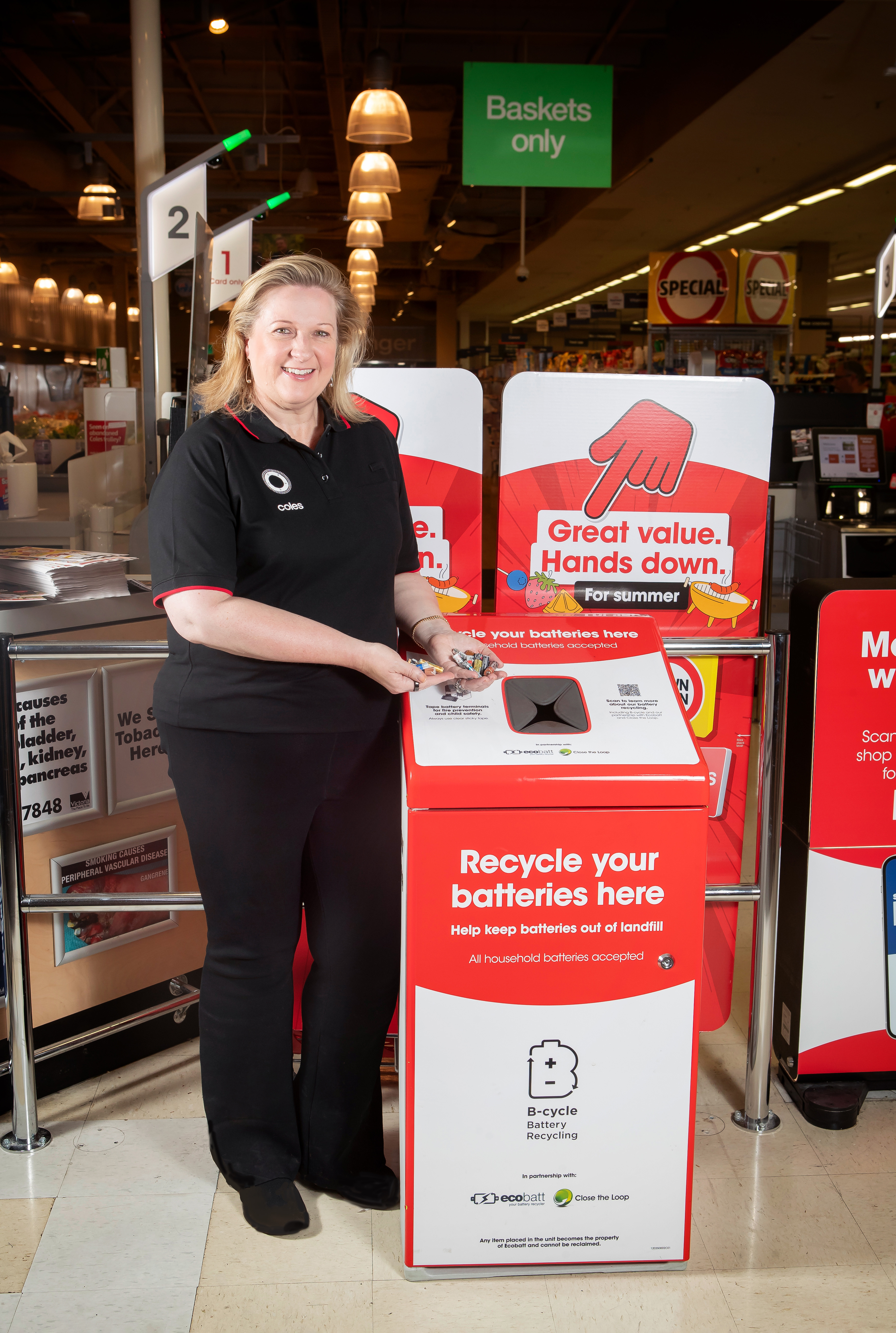
Coles General Manager of Sustainability Brooke Donnelly with a new battery recycling bin
ends-
For media enquiries, please contact
Coles Media Line (03) 9829 5250 or [email protected]