The Multilateralism Index 2024 reveals a contradiction: while participation in the multilateral system has largely held steady or even increased, its effectiveness in addressing global challenges has declined.
WASHINGTON, DC / ACCESSWIRE / October 17, 2024 / Today marks the launch of the second edition of the Multilateralism Index from the International Peace Institute (IPI) and the Institute for Economics & Peace (IEP). The Index reveals that states remain engaged in the global multilateral system even as it increasingly struggles to address the crises it faces.
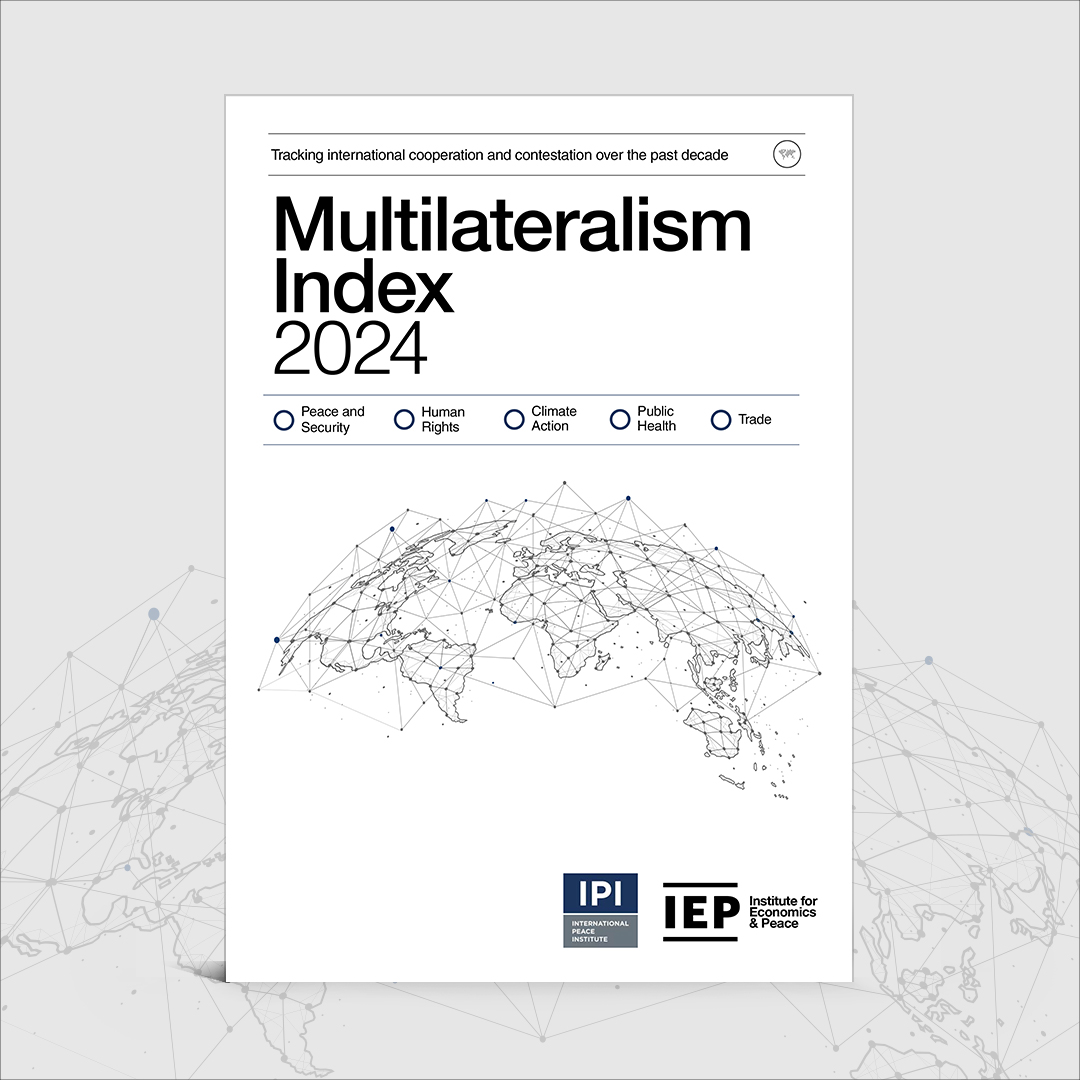
An image of the front cover of the Multilateralism Index 2024 Report
Key results
The performance of the multilateral system declined across all five domains examined.
Peace and security showed the steepest deterioration in performance, with the number of armed conflicts rising from 39 in 2013 to 55 in 2022.
Climate action and human rights also saw significant declines in performance, despite increased engagement from member states.
Participation in multilateral institutions has increased in most domains, even as performance has declined, indicating a shift from cooperation to contestation.
Inclusivity improved across all domains, with steady growth in NGO engagement and women's representation in UN bodies.
The Multilateralism Index 2024 presents a complex picture of global cooperation over the past decade, examining five crucial domains: Peace and Security, Human Rights, Climate Action, Public Health, and Trade. It reveals a contradiction: while participation in the multilateral system has largely held steady or even increased, its effectiveness in addressing global challenges has declined.
Dr. Adam Lupel, IPI Vice President & COO said: "Over the past decade, we've witnessed a paradox in multilateralism. While participation in international institutions has largely held steady or even increased, the performance of the multilateral system in addressing global challenges has declined. This suggests a shift from cooperation to contestation at a time of transformation and rising global crises."
The peace and security domain experienced the most significant deterioration in performance. Active armed conflicts increased from 39 in 2013 to 55 in 2022, with a notable rise in internationalized conflicts. The UN Security Council has seen more frequent use of the veto power, constraining its ability to respond to crises. However, states have not broadly pulled back from the UN peace and security architecture, and commitments in some areas, such as multilateral peacebuilding, have increased.
Climate action presents another contradiction. Despite near-universal participation in the Paris Agreement and growing climate commitments, these commitments continue to fall short of necessary targets. Projections show an 8.8% increase in emissions by 2030, in stark contrast to the 43% decrease required to meet the critical 1.5°C target.
The human rights domain exhibits a counterintuitive pattern. While engagement with UN human rights mechanisms has increased, global human rights protections have steadily declined. Most strikingly, members of the UN Human Rights Council consistently scored lower on human rights measures than the global average, indicating that many states are engaging less to advance human rights than to shape the direction of the system.
Multilateral action on public health was significantly shaped by the COVID-19 pandemic, which reversed years of progress, particularly in areas such as childhood immunization. It also put the shortcomings of the global public health system in stark relief, spurring negotiations on an international pandemic agreement aimed at strengthening preparedness and response capabilities for future health crises.
Trade is the one area where both performance and participation decreased. The paralysis of global trade negotiations and breakdown in adherence to global trade rules signal a shift away from multilateral approaches. This trend, combined with growing geopolitical tensions, creates challenges for global economic cooperation.
Steve Killelea, Founder & Executive Chairman of IEP, commented: "The Multilateralism Index 2024 reveals a challenging trend: while engagement in global institutions has increased, their effectiveness has declined across key areas. There is a need to revitalize our multilateral system to address today's complex challenges."
Despite these challenges, the Index highlights positive developments, particularly in the area of inclusivity. NGO engagement with the UN system has grown, and women's representation has increased across many UN bodies. However, the Global South remains underrepresented in many areas, suggesting that geographic inclusivity remains a work in progress.
As the world contends with interconnected crises, from conflict to climate change, the Multilateralism Index 2024 provides valuable insights into the current state of global cooperation. It underscores the need for thoughtful reform to ensure that multilateral institutions can effectively address the complex challenges of the 21st century.
Contact Information
Mike Koslowski
IEP Senior Communications Advisor
[email protected]
+61418410531
Related Files
Multilateralism Index 2024 - Full Press Release (1)
Multilateralism Index 2024 - Full Press Release (1)
SOURCE: International Peace Institute
View the original press release on newswire.com.