
Global Anti-Scam Alliance and Feedzai Unveil 2024 Global State of Scams Report
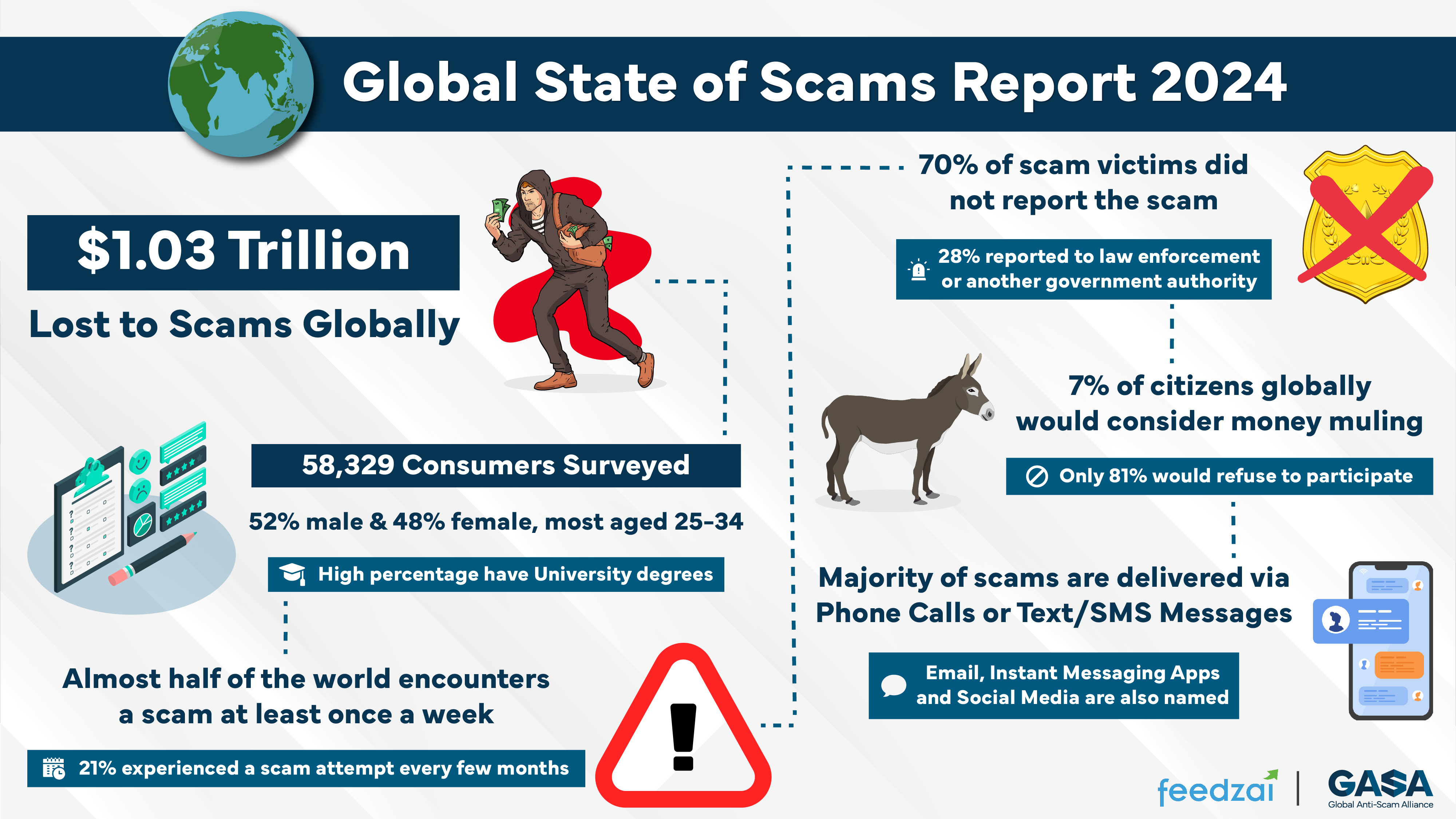
THE HAGUE, NETHERLANDS / ACCESSWIRE / November 7, 2024 / The Global Anti-Scam Alliance (GASA), in partnership with Feedzai, has released its 2024 Global State of Scams report, revealing that scams have stolen another staggering US $1.03 trillion globally over the past year. The report, based on insights from 58,329 respondents across the world, highlights the vast losses to scam activity but also a growing disparity between scam survivors in different regions.
Educational Campaigns See Varied Results Across the Globe
Despite ongoing awareness campaigns, scams remain a constant threat. Nearly half of global consumers are targeted by scammers at least once a week. The report sheds light on the stark disparities in scam trends across different regions. While countries like Brazil, Hong Kong, and South Korea see scams as an almost daily occurrence, other nations, such as Vietnam, Saudi Arabia, and China, report a marked decrease in scam activity.
"Very little has changed in the last 12 months, as the world's consumers bear the weight of another US $1.03 trillion stolen by scammers," says Jorij Abraham, Managing Director of GASA. "We must do more to combat these crimes, as they continue to erode trust in our systems and cause immense harm to individuals and economies."
Developed Nations Lose Most per Capita, but Developing Nations Sustain Bigger Hit to GDP
The financial losses from scams remain staggering, with the hardest-hit regions being the U.S., Denmark, and Switzerland. Victims in these countries reported some of the highest per capita losses, with the average U.S. victim losing $3,520. Yet, in developing nations like Pakistan, the losses represent a far graver concern, with scams accounting for a jaw-dropping 4.2% of the country's GDP. Countries such as Kenya and South Africa follow closely behind, with losses equivalent to 3.6% and 3.4% of GDP, respectively.
While developed nations may lose more in absolute dollar amounts, the report emphasizes that developing economies often suffer more profoundly in proportion to their overall economic output, highlighting a disparity that calls for targeted interventions.
Trust in the Internet Largely Unaffected Despite Scams Causing Emotional Turmoil
The emotional impact of scams cannot be understated. In nations like Kenya, South Africa, and the Philippines, victims report feeling deeply vulnerable, fearful, and disillusioned. Yet, in regions like Japan and South Korea, while the financial damage is substantial, the emotional toll seems comparatively lighter. The report also finds that the internet itself is not losing trust worldwide, though developing nations saw a decline in trust in online services.
The report highlights the urgent need for global cooperation, enhanced public awareness, and stronger financial recovery processes to combat the growing threat of scams. With only 4% of global scam victims able to recover their losses, the time for decisive action is now.
For more information and to access the full Global State of Scams 2024 report, please visit https://www.gasa.org/research.
Contact Information
Sam Rogers
Marketing Director, Global Anti-Scam Alliance
[email protected]
Austin Hyslip
Media Relations Manager - US, Feedzai
[email protected]
SOURCE: Global Anti-Scam Alliance (GASA)
View the original press release on newswire.com.