A new measure of what’s needed to maintain health has identified Australia’s healthiest areas to live based on a range of environmental and socioeconomic factors.
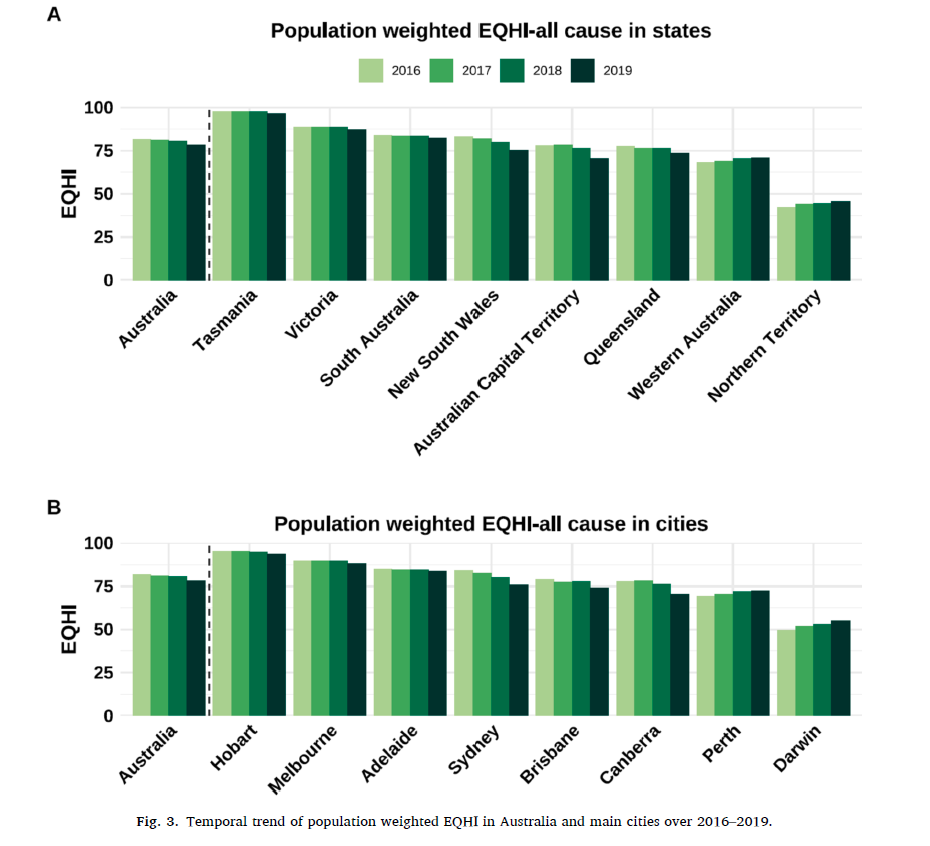
The Monash University-led research found Tasmania and Hobart were the healthiest state/territory and capital city to live in, while the Northern Territory and Darwin were rated the unhealthiest.
Published in Environment International, the new Environmental Quality Health Index (EQHI) provides a robust framework to assess environmental health risks and guide targeted interventions globally. It combines 12 factors, such as air quality, green spaces, climate and socioeconomic conditions, then evaluates how these factors relate to mortality risks.
Researchers in the School of Public Health and Preventive Medicine’s (SPHPM) Climate, Air Quality Research Unit analysed 2,180 Statistical Areas Level 2 across all regions in Australia.
The south, east and southwest coastal regions generally scored higher than inland and northwest regions on a scale of zero to 100, with higher numbers indicating better environmental and health conditions.
Senior author and Monash University Distinguished Professor of Global Environmental Health in the SPHPM, Yuming Guo, said areas with lower environmental risks and better conditions that reduced mortality risk, like Tasmania and Hobart, received higher scores.
“Hobart, the capital of Tasmania, had the highest overall EQHI,” Professor Guo said. “The differences were significant, with Hobart showing exceptionally good results (highest scores), while Darwin had the lowest scores, reflecting poorer environmental and socioeconomic conditions.
“Similarly, Melbourne’s higher score compared to Sydney reflects a combination of better air quality, favourable climate and other environmental conditions, and higher socioeconomic advantages, which are linked to lower health risks.”
Professor Guo said the study provided a valuable tool for measuring the environmental conditions and highlighted the need for targeted efforts to improve environmental conditions in regions with lower EQHIs, to reduce health risks and promote wellbeing.
He said that from 2016 to 2019, the proportion of areas with highest EQHIs decreased by six per cent; however, more than 70 per cent of Australians still lived in high-scoring areas.
“When accounting for population distribution, this study found that scores improved in Perth and Darwin, decreased in Sydney, Canberra and Brisbane, and remained stable in Melbourne and Adelaide over 2016-2019,” Professor Guo said.
The study’s authors aimed to develop an index that integrated multiple environmental exposures and socio-economic status to assess mortality risks across Australia.
They believed existing environmental quality indices often failed to account for the varying health impacts of different exposures and excluded socio-economic status indicators.
The researchers combined all-cause, cardiovascular and respiratory mortality data (2016–2019) from Australian regions encompassing 12 environmental exposures, including PM2.5 (very small particles usually found in smoke), ozone, temperature, humidity, normalised difference vegetation index, night light, road and building density, and socioeconomic status.
Using various models, they used the data to calculate which locations were the healthiest for people to live in.
“We established the first, to our knowledge, practical and effective tool for communicating environmental health risks based on quantitative relationships using three types of mortality data and 12 environmental factors,” the study found.
“This EQHI provides a comprehensive framework for developing targeted environmental improvement measures tailored to local conditions in Australia. Our methodology can also be adapted by other countries to develop their own EQHIs, enabling consistent and comparable evaluations of environmental health risks globally.”
Professor Guo said the EQHI could be integrated into policy and public health frameworks by:
- Disseminating results to policymakers to inform environmental improvement and health interventions.
- Educating the public and stakeholders on how to interpret and use the EQHI.
- Collaborating with local governments and organisations to implement targeted measures in low-scoring areas.
The 12 environmental and socio-economic factors:
|
1 |
Fine particulate matter (PM2.5) |
|
2 |
Ozone (O3 ) |
|
3 |
Green space: Normalised Difference Vegetation Index |
|
4 |
Night time light |
|
5 |
Mean temperature in summer |
|
6 |
Mean temperature in winter |
|
7 |
Temperature variability in summer |
|
8 |
Temperature variability in winter |
|
9 |
Relative humidity |
|
10 |
Building density |
|
11 |
Road density |
|
12 |
Socioeconomic status: the Index of Relative Socio-Economic Advantage and Disadvantage |
*Please note: Professor Guo is travelling and can only speak to the media from 6-8.30am AEDT and 4-5.30pm AEDT.
For media enquiries please contact:
Monash University
Cheryl Critchley – Media and Communications Manager (medical)
E: [email protected]
T: +61 (0) 477 571 442
For more Monash media stories, visit our news and events site
For general media enquiries please contact:
Monash Media
E: [email protected]
T: +61 (0) 3 9903 4840
***ENDS***