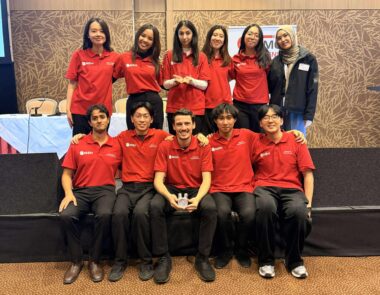
A pioneering rehabilitation program led by RMIT University has fitted more than 200 prosthetics legs and delivered more than 4,600 biomechanical therapy treatments and counselling sessions in partnership with local programs across Indonesia, Timor-Leste and Cambodia.
The three-year initiative, coordinated by RMIT’s Digital Health Hub Rehabilitation Project (DHHRP), has recently wrapped up, but partners continue to support people in these countries with the skills and knowledge they have gained.
RMIT researchers continue to conduct research using the data provided by Indonesian project partner Pusat Rehabilitasi YAKKUM, which has become a training hub for the region.
A breakthrough in prosthetics
At the heart of the program is an innovative pressure-casting (PCAST) system for prosthetic limbs developed by Professor Peter Lee from the University of Melbourne who then successfully trialled it with RMIT’s Associate Professor Noel Lythgo in Vietnam from 2011 to 2015.
“This system allows us to create an artificial leg in about six hours,” said Lythgo, co-director of DHHRP.
“It’s comfortable and patients are satisfied.”
About 96% of patients chose to leave rehabilitation centres after their fitting with the PCAST leg as opposed to their original prosthetics.
“Importantly, we can use the PCAST system in rural and remote communities as it is portable and only requires mains water pressure – no electricity is needed.”
Co-director Dr Dein Vindigni OAM said the initiative’s holistic approach was key to its success.
“It’s not just about body parts,” he said.
“Once people with lower limb amputation are fitted with the pressure-cast system, biomechanical therapy, similar to remedial massage, and counselling are important ways we add value to the outcomes for our patients.”
Vindigni said the impact of the program was clear in its outcomes and approach.
“We focus on the whole person and being responsive to their needs,” Vindigni said.
“When patients leave, they’ve been given the very best evidence-based approaches to make a difference in their lives.”
The initiative has empowered healthcare professionals in Indonesia, Timor-Leste and Cambodia, training 160 people in PCAST, biomechanical therapy and counselling, building local capacity to deliver life-changing care.
In total, the RMIT program has involved collaboration with 16 community organisations and universities across the region.
Another program using the PCAST system, supported by RMIT, has recently started in Tanzania, with the aim of fitting 100 people with prosthetic limbs.
Helping patients adapt to change
Beyond physical rehabilitation, the RMIT program addressed the emotional and psychological challenges of limb loss, and the musculoskeletal and mental health concerns of other people.
“As part of the project, we developed a counselling program under the guidance of Dr Prasad Podugu from Charles Sturt University,” said Dr Dawn Wong Lit Wan, a counselling advisor for the DHHRP.
“It includes a two-month course covering basic counselling skills and coping strategies, followed by two months of clinical placement to build confidence and ensure practitioners can work effectively with their patients.”
For people like Javanese farmer Painu, one of the 204 recipients of prosthetic legs fitted through the RMIT program, the integrated support provided with his prosthetic has been transformative.
Painu’s story
Painu was involved in a single-vehicle accident several years ago while returning home along the highway from an Eid Al-Fitr holiday.
Faced with the devastating choice between amputation or a risky surgery with a 50% chance of success, Painu decided on amputation, allowing him to return to work within months.
Farming and life generally with his own makeshift prosthetic leg presented significant challenges, in terms of comfort and productivity.
Southeast Asia has a relatively high incidence of traumatic amputations compared to other regions, driven by a combination of factors such as road traffic accidents, occupational injuries, landmines, natural disasters and limited access to emergency medical care.
In late 2023, Painu’s life took a remarkable turn. He learned of a prosthetic leg donation program run by Pusat Rehabilitasi YAKKUM and supported by RMIT University.
“Thankfully, a week later, their staff came and measured my leg for a new prosthetic,” Painu said.
“I was so happy. I feel comfortable wearing it in the fields or anywhere else, without worrying about it coming loose.
“I believe God never gives us trials beyond our capacity. My experience has taught me that difficulties are not an excuse to stop growing,” he said.
With his well-fitted prosthetic leg and the other support through the RMIT initiative, Painu can tend to his fields and travel to local markets with confidence, ensuring that he can provide for his family and help drive the local economy.
Contact details:
To arrange interviews with the researchers, contact Will Wright at [email protected] or on +61 417 510 735.