Technology transfer from India to Japan, accomplished by GN Corporation
TOKYO--BUSINESS WIRE--
Urethral stricture affecting men of all ages, with increasing incidence after 55, is a recurring problem despite several treatment options. By transplanting autologous lab-engineered buccal tissue cells (BEES-HAUS), Dr Akio Horiguchi successfully accomplished the first clinical transplantation in Edogawa Hospital, Japan as per Japanese Regenerative Medicine law, and presented in International Meeting Of Reconstructive Urology (IMORU) in Hamburg, Germany. Safety and efficacy clinically, reported earlier by Dr Suryaprakash from India, triggered this tech-transfer feat, spearheaded by GN Corporation.
This press release features multimedia. View the full release here: https://www.businesswire.com/news/home/20250330565540/en/
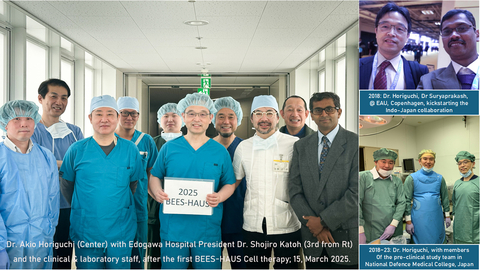
In 2008, GN Corp initiated research with NCRM, Chennai, Tamil Nadu, India on restoring corneal blindness using buccal tissue epithelial cells. An out of the box idea of Dr. Suryaprakash, Urologist from Hyderabad, India in 2012 to apply buccal (oral) mucosal cells to repair stricture-inflicted male urethra, led to a clinical study, which he presented in NCRM NICHE 2017 in Tokyo, kickstarting a collaboration with Dr. Akio Horiguchi, National Defence Medical College, Japan, as they met in EAU in 2018 (Top right picture). Upon confirming successful cell engraftment in urethral stricture pre-clinical models taking help from the Dept. of Medical Engineering of NDMC between 2018~2023, (Bottom, right picture), now in 2025, clinical application has been initiated in Edogawa Hospital, Tokyo. Main picture: BEES-HAUS team after the first clinical transplant in Edogawa Hospital, Tokyo; Dr.Horiguchi (Centre) with Dr.Shojiro Katoh (President, Edogawa Hospital) standing left to him.
Urethral lumen is a delicate tissue, when damaged, inflammation and fibrosis lead to stricture. While idiopathic causes comprise the majority, radiation therapy for prostate cancer, trauma and infection are other causes. At early stages, endoscopic dilatation or urethrotomy are undertaken, but disease recurrence is common, causing difficulty in voiding urine, sexual dysfunction and infertility. Repeated interventions make the diseased segment longer and at some point, require a buccal tissue urethroplasty, where a large tissue from the mouth is harvested and used as a graft, causing oral morbidity. In BEES-HAUS procedure, cells from a small buccal tissue, cultured in the lab are transplanted, that cover and replace the damaged urethral epithelium, proven clinically and pre-clinically, healing the urethra and preventing recurrence. BEES-HAUS technology uses a hybrid combination of 2D cultured fibroblast like cells secreting IGF-1, yielding paracrine healing effect and 3D thermo-reversible gelation polymer cultured cells that engraft and restore the epithelial integrity, considered as the first of its kind feat in regenerative medicine. BEES-HAUS therapy could be recommended at earlier stages of the disease as well, after validations, opined Dr. Horiguchi.
The Indo-Japan team has standardized the tissue engineering procedure, engraftment of cells on epithelial surface, transport of buccal tissue from hospital to lab and harvested cells back to hospital using a nano-polymer cell and tissue transportation cocktail, making the entire procedure highly efficient, end to end.
Based on inter-disciplinary research by GN Corporation since 2008 with NCRM, Chennai, Tamilnadu, India, after having yielded a clinical solution and successful tech-transfer to Edogawa Hospital, Japan, GN Corporation has now signed a MoU with Soulsynergy, Mauritius. This partnership will propagate cell-based therapies for urethral stricture, corneal regeneration and AIET for cancer, making Mauritius, a healthcare technology cum medical tourism hub for African continent and Indian ocean rim countries.
View source version on businesswire.com: https://www.businesswire.com/news/home/20250330565540/en/
Contact details:
Samuel JK Abraham
[email protected]