
Skip to content
Energy

New Report: Nuclear could suck Brisbane dry and still meltdown

Queensland Conservation Council 2 mins read

Wednesday 19 March 2025


The Coalition’s proposed nuclear sites in Queensland would not have access to enough water to manage a nuclear incident, according to an explosive new report by the Queensland Conservation Council.


We’ve just hit 14 years since the Fukushima nuclear accident. The new report shows that during the Fukushima emergency, the nuclear facility was flooded with 1.3 million cubic metres of sea water to prevent the plant from blowing up – more than a 1,000 times the water available in the dams connected to the existing coal generators the Coalition wants to turn nuclear.


According to the Queensland Conservation Council, the proposed nuclear reactor in Callide would use more than double the water currently used by the existing Callide power station, while the proposed Tarong nuclear reactor would use 50 per cent more water than the existing coal station.


Queensland Conservation Council Director Dave Copeman says:


“The findings of this report are damning for the Coalition’s nuclear fantasy. There simply is not enough water available in the proposed locations to run nuclear facilities, let alone manage them in the case of an emergency.


“Even though Brisbane just experienced a major rainfall event, there’s nowhere near enough water capacity in our dams to stop a nuclear meltdown if things go wrong.


“The Coalition’s proposed Tarong nuclear reactor would be connected to Wivenhoe dam, which is Brisbane’s main water supply. If there was an emergency, you could run the whole dam dry and still not have enough water to stop a meltdown.


“The Coalition is not being honest with farmers and the community about the realities of their nuclear scheme. At best it’s impractical, at worst it’s grossly irresponsible and could result in a major incident.
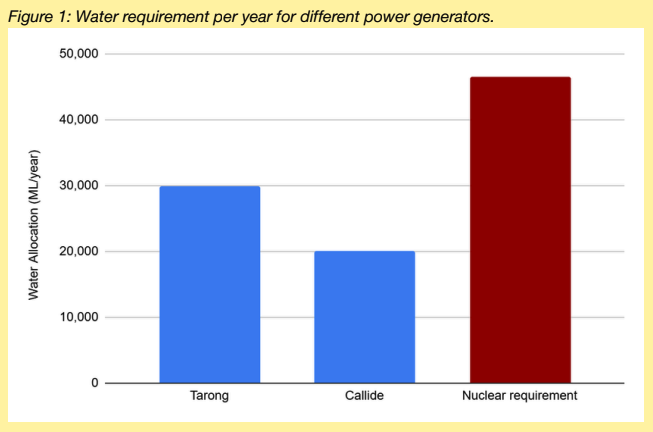
 

Water Requirements


“We’ve seen during droughts that there’s not enough water for existing coal power stations, especially in Central Queensland, so coal units have to wind down their operation.


“So the Coalition’s ‘plan’ is to build the most expensive form of electricity generation that won’t be ready in time to replace our retiring coal power stations, and then won’t be available at times because of water constraints.


“You know what doesn’t use a lot of water? Renewable energy and it’s already powering 40 per cent of Australia.”


Media contact: Ellie McLachlan, 0407 753 830

Available for interview: Dave Copeman


ENDS

Media

More from this category

  • Energy
  • 15/07/2026
  • 14:15
Greenpeace Australia Pacific

Albanese rolls out the red carpet to data centre ‘energy vampires’, delays meaningful legislation

SYDNEY, Wednesday 15 July 2026 — Greenpeace Australia Pacific has called for an urgent pause on data centre approvals, after Anthony Albanese revealed the government’s AI legislation won't be introduced until 2027. The PM outlined plans for "greater clarity and speed for approvals" for data centre proponents, but, despite acknowledging the severe strain these facilities place on Australia's land, water, and clean energy resources, will not bring legislation to Parliament until early next year. Last month, Greenpeace called on the Federal Government to urgently implement a moratorium on the construction and approval of new data centres until appropriate regulations and…

  • Contains:
  • Energy, Government Federal
  • 15/07/2026
  • 12:57
Climate Council

New AI office must make good on PM’s pledge for additional renewable energy to power new data centres

The new Office of AI – announced today in a speech by Prime Minister Anthony Albanese – must enforce his directive that new Australian data centres bring additional renewable energy to the table from the get-go. With the Queensland Government threatening to allow data centres to expand without any renewable energy requirements, posing significant risks to power bills and our climate, the new Office of Artificial Intelligence must ensure Australians do not pay the price for a state-by-state race to the bottom for data centre expansion. Prime Minister Albanese’s announcement is a welcome step in ensuring the AI and data…

  • Energy, Environment
  • 15/07/2026
  • 07:27
Climate Media Centre

Talent Alert: Experts available for interview on CSIRO GenCost Final 2025-26 Report

Wednesday 15 July For immediate release. CSIRO’s Final 2025-26 GenCost report, released today, has once again confirmed that renewables are the fastest and lowest-cost way to replace Australia’s ageing and unreliable coal power stations and cut climate pollution. Right now, data centre development is moving at break-neck speed, with 162 data centres operating and more than 90 new projects in the pipeline. Without better regulatory guardrails, data centres risk delaying our shift to what CSIRO has found is the lowest cost generation mix- wind and solar. We can't risk that happening. The data centre industry’s electricity demand over the next…

Media Outreach made fast, easy, simple.

Feature your press release on Medianet's News Hub every time you distribute with Medianet. Pay per release or save with a subscription.