Stills here: https://dams.wwf.org.au/resourcespace/?c=6133&k=22c6c4b794
When Barbara Linley discovered there were koalas on her recently purchased Tullymorgan farm she was delighted. It was a big surprise.
But she was far from thrilled by a serious lantana infestation. It covered about 80% of her property in the NSW Northern Rivers Region.
Considered one of the world's top 10 invasive species, lantana prevents koalas from moving freely and accessing food trees. It also increases the severity of bushfires, and acts as a fuel ladder carrying flames into tree canopies.
“Finding out I had koalas was a real highlight but lantana was strangling the place. It was so thick I couldn’t even see the creek. I spent a considerable amount getting rid of some of it,” Barbara said.
Her concern for the future of her beloved old growth trees and the expense of removing the remaining lantana led to Barbara signing a private conservation agreement covering nearly 51 hectares of her farm.
In return she knows her trees are safe and Barbara can receive up to $45,000 to fund action – like clearing weeds – to improve the quality of the koala habitat.
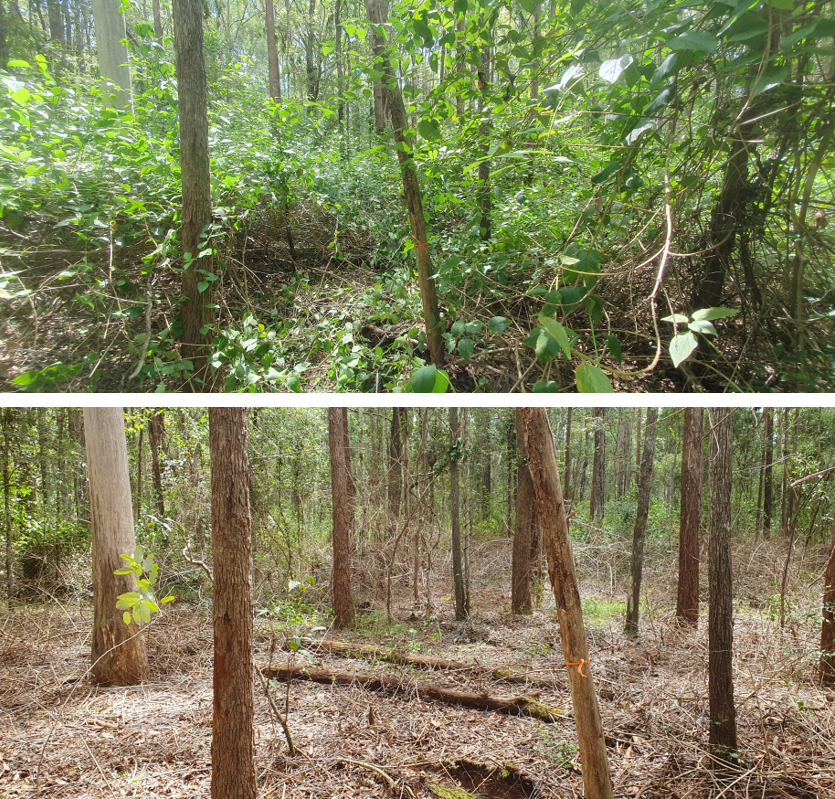
Before and after lantana removal at Tullymorgan
The funding came through a project that encourages private conservation agreements in the Northern Rivers region to protect koala habitat.
It’s a collaboration between the World Wide Fund for Nature - Australia, the NSW Department of Climate Change, Energy, the Environment and Water, the NSW Biodiversity Conservation Trust and Envite Environment.
The project has smashed its target of protecting 500 hectares. Twenty conservation agreements have been signed, or are being finalised, that protect more than 900 hectares.
“Thanks to money from my conservation agreement we’re discovering what’s actually here because we’re getting though the lantana,” Barbara said.
“Recently, clearing away the noxious weed revealed a huge eucalypt tree I didn’t even know was there. Ecologists say it’s over 500 years old and has an 11-metre circumference,” she said.
Barbara removed the cattle being agisted on her farm and Envite Environment planted 1,000 koala trees to reconnect habitat. Traditional Owner visitors say it is very spiritual place.
A trail camera revealed some of the property’s rich biodiversity. There, just a metre apart, were a goanna and a land mullet, Australia’s largest skink species.
There is also at least one powerful owl, a pair of goshawks, glossy black cockatoos, yellow-tailed black cockatoos, little bent-wing bats, rare frogs and the Nature Conservation Council has put up 25 nest boxes for the squirrel gliders and feathertail gliders and are monitoring a resident pair of barking owls.
“I’m hoping to improve and increase the biodiversity, especially for endangered animals, and to prevent fires getting up into our magnificent mature trees and destroying them,” said Barbara.
Lola Topsom has a conservation business aimed at saving endangered animal and plants species and has been doing a lot of the lantana removal, assisted by Barbara – a very hands on property owner.
“I really love being out in nature, so working in conservation is the perfect job for me,” said Lola.
“When I see a serious lantana infestation my first thought is usually ‘wow, that's hectic’, followed by, ‘I can't wait to get stuck in’ and later I see that all my hard work has paid off.
“Discovering beautiful trees and freeing them of noxious weeds is so satisfying,” Lola said.
Barbara has also signed a permanent conservation agreement on a second property she owns further south in Taloumbi.
“I saw emus and thought that is a sign so I decided to buy it. I didn’t know they were rare emus,” Barbara said.
What Barbara saw was the endangered coastal emu, genetically different from all other emu populations. It’s estimated there are fewer than 50 left.
“Yaegl elder Aunty Elizabeth Smith said to me ‘the emus brought you here,’” said Barbara, who is now involved in their protection.
Using funding from her permanent conservation agreement, Barbara has employed Lola to work on Taloumbi.
The focus will be on lantana removal, keeping tracks free of vegetation, and clearing around old trees. These actions all boost fire prevention.
A number of old gums were still smouldering immediately after the 2019 fires and Barbara was able to rescue some of them.
“I walk past those trees now and say ‘I saved you,’” said Barbara.
Barbara works with First Nations experts who have used cool burning on both properties for five years to begin healing the land.
Tanya Pritchard, Senior Manager Koala Recovery for WWF-Australia, said private landholders are playing a crucial role to help the recovery of koalas.
“More than 50% of remaining habitat for koalas is on private land, so landholders such as Barbara are a critical for koalas long-term survival,” Tanya said.
“Supporting landholders to enter a private conservation agreement and assisting with restoration costs will ensure these areas are protected as high quality habitat for future generations of koalas and other wildlife species,” she said.
Contact details:
Mark Symons
Senior Media Officer, WWF-Australia
m 0400 985 571