Australia’s dairy sector may be the beneficiary of a new school milk program being implemented in Indonesia.
Food and agribusiness banking specialist Rabobank says the program, which is currently being rolled out across 400,000 schools in Indonesia, is part of the recently-elected Indonesian government’s Nutritious Meals Program, aimed to combat malnutrition and promote healthy eating among the country’s 60 million school children, as well as in pregnant women.
The school milk program is expected to significantly increase Indonesia’s total dairy consumption, creating opportunities for Australia and other global dairy players, according to a new report by Rabobank’s RaboResearch division.
In the report, Indonesia’s new school milk program could nourish minds and global dairy markets, Rabobank says the new Indonesian government has introduced a range of policy measures with the potential to transform the country’s dairy supply chain.
“The centrepiece is the Nutritious Meals Program, which aims to provide food, including milk, to 60 million students on every school day by 2029, report author RaboResearch senior analyst Michael Harvey said.
RaboResearch estimates the total milk required at full implementation could surpass two billion litres.
“This estimate is based on an anticipated 83 million recipients accounting for school absenteeism, lactose intolerance, and an average serving size between 125ml and 200ml,” Mr Harvey said.
The report says the school milk program has the potential to significantly increase Indonesian demand for liquid milk, both domestically produced and imported.
“The majority of milk consumed in Indonesia in 2024 was imported, with domestic production estimated at 900 million litres, and an additional 2.5 billion litres (liquid milk equivalent) imported,” Mr Harvey said.
Indonesia was Australia’s fourth largest dairy export market in 2023/24, after China and Japan, taking over 60,000 tonnes of Australian product. Australia has also been a long-standing exporter of dairy cattle to Indonesia.
Ramping up local production
To meet the growth in demand that will result from the program, the Indonesian government and dairy industry plan to significantly increase the national dairy herd, the report says.
As the rollout of the program gathers pace, investment across Indonesia’s dairy sector is expected to accelerate, Mr Harvey said, and this will also have pronounced impacts on the global sector.
“For Indonesia to achieve its ambitious milk supply growth targets and accommodate the considerable number of dairy cattle needed, it will need to scale up both live cattle supply and the local dairy supply chain,” he said.
“This will include need for feed genetics, farm infrastructure and farm management skills to support the expanding local industry. And overall, we expect global input players and dairy companies to benefit.”
Import opportunities
While the school milk program is likely to result in an increase in domestic milk supply and provide a tailwind for local Indonesian dairy players, Mr Harvey says, Indonesia’s dairy import demand is also expected to rise.
“Fundamentally, RaboResearch expects Indonesia to remain a net importer of dairy and anticipates that annual import volumes are likely to grow over the medium term.” he said.
The report says Indonesia is recognised as a high-growth dairy market compared with advanced economies, driven by its large population and rising disposable incomes.
“Even before the announcement of the school milk program, Indonesia was viewed as a dairy market with long-term high growth potential,” Mr Harvey said. “In a country with nearly 280 million people, the average per capita dairy consumption is around 15 kilograms annually. Indonesia boasts a vibrant liquid milk market, which in 2024 was estimated at 1.1 billion litres, including both flavoured and white milk. And Indonesia faces a significant dairy import deficit as it strives to keep up demand.
Mr Harvey said Australia plays an important role in Indonesia and the new program could create opportunities to further lift dairy exports to Indonesia.
Indonesia’s milk powder imports, market share by exporter, 2019-2024
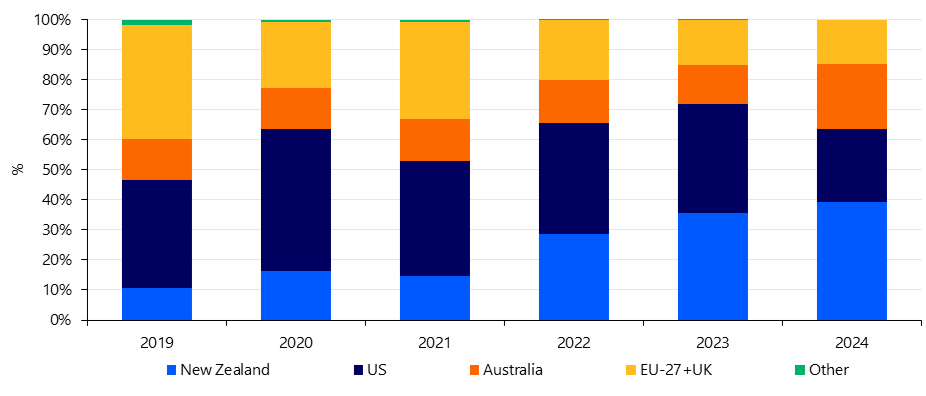
Source: Trade Data Monitor, RaboResearch 2025
Mr Harvey said the new school milk program could also create additional live cattle export opportunities for Australia given Indonesia’s desire to expand its domestic dairy cattle herd.
“To meet the increased milk demand, the local milk supply would require a four-fold increase in the domestic Indonesian dairy herd, underpinned by the importation of more than one million dairy cattle from various countries over the next five years,” he said.
Mr Harvey said Australia has been a long-standing exporter of dairy cattle to Indonesia.
“According to Dairy Australia, between 2019 and 2023, Australia exported an average of 80,000 dairy cows each year, although with the vast majority going to China and only 7,500 destined for Indonesia,” he said.
However, he said, the timing of Indonesia’s current herd expansion is somewhat favourable, given “the softer Chinese demand for imported dairy heifers resulting in a surplus of heifers in Australia”.
Overall, Mr Harvey said, “clearly Indonesia is an important trading partner for Australian dairy and will continue to present growth opportunities moving forward”.
<ends>
RaboResearch Disclaimer: Please refer to Australian RaboResearch disclaimer here
Media contacts:
Denise Shaw Will Banks
Media Relations Media Relations
Rabobank Australia & New Zealand Rabobank Australia
Phone: 02 8115 2744 or 0439 603 525 Phone: 0418 216 103
Email: [email protected] Email: [email protected]
About us:
Rabobank Australia & New Zealand Group is a part of the international Rabobank Group, the world’s leading specialist in food and agribusiness banking. Rabobank has more than 125 years’ experience providing customised banking and finance solutions to businesses involved in all aspects of food and agribusiness. Rabobank is structured as a cooperative and operates in 38 countries, servicing the needs of more than nine million clients worldwide through a network of more than 1000 offices and branches. Rabobank Australia & New Zealand Group is one of Australasia’s leading agricultural lenders and a significant provider of business and corporate banking and financial services to the region’s food and agribusiness sector. The bank has 87 branches throughout Australia and New Zealand.