
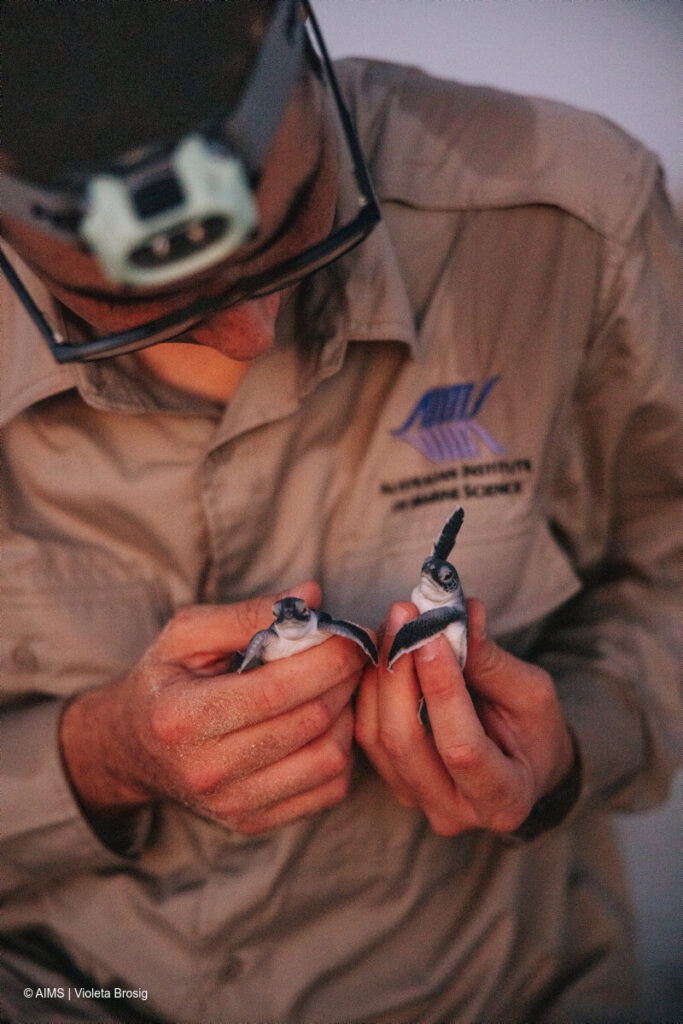
A new study on turtle hatchlings will help researchers understand more about the potential impact that artificial light at night (ALAN) has on their behaviour after they emerge from beach nests.
Turtle hatchlings should instinctively head for the ocean after clambering out from sandy nests, using natural cues such as dark dunes and the starlit ocean surface. But introduced artificial lights from coastal developments can interfere with their ability to head in the right direction, making them susceptible to higher levels of predation, as well as exhaustion and dehydration.
“Our goal is to better understand how green turtle hatchlings – a threatened species - respond to lights of different intensities and types,” said Australian Institute of Marine Science (AIMS) senior lead researcher Dr Michele Thums.
The project is a collaboration between AIMS, Pendoley Environmental and the WA Department of Biodiversity, Conservation and Attractions.
“Our collaborators and others, have been researching the impact of artificial lights on turtles for the last few decades, finding that different light wavelengths have different impacts on how hatchlings behave after emerging from nests,” added Dr Thums. “We are expanding on this to focus on a range of light types as well as glow that results from a blend of different types of lights in the environment, such as the light produced by coastal human activity from towns, cities and industrial infrastructure.
“We hope the findings will guide future lighting decisions that meet the needs of coastal residents, councils and industry, and at the same time, aid in the conservation management of marine turtles.”
A team led by AIMS recently collected more than 200 green turtle hatchlings from Jurabi Coastal Park, near Exmouth over seven days, to conduct an experiment on the types and intensities (brightness) of light the hatchlings were most attracted to.
Using an apparatus known as a Y maze under controlled laboratory conditions, the researchers tested how each hatchling responded to different light levels compared to darkness to understand the thresholds at which the hatchlings’ ability to find the ocean may be hampered. After the nighttime experiments, the hatchlings were returned to the beaches they were found.
AIMS post-doctoral researcher Dr Daniel Gomez Isaza, co-leader of the research, said all the hatchlings went through the Y maze up to three times.
“The experiment went well. We tested three different types of light on the turtles: two were types of light emitting diodes, or LEDs, that are commonly used, with the aim of establishing intensity, or brightness levels that are minimally attractive to hatchlings for these lights. We also tested a blended spectrum, mimicking the light spectrum typically found in coastal areas occupied by humans. Our control was no light in the other arm of the Y-maze.
“The aim is to pinpoint the intensity that has minimal attraction of hatchlings for each of the different types of light we tested.
“From our early observations, the hatchlings quickly crawled towards the illuminated arm of the Y maze at high light intensities, but the attraction for the lights was reduced as we lowered light intensities.
“The next step is for us to analyse the data to pinpoint the intensity when attraction for the lights is not observed. The key new aspect of this research is that we tested how the hatchlings respond to broad-spectrum LED lighting, which are being installed widely across the world. We are hoping to provide guidance on light intensity levels that have minimal impact to the hatchlings.”
Collaborator and turtle expert Dr Kellie Pendoley from Pendoley Environmental added the findings will inform risk assessment and guidance for industry, coastal developers, and management authorities to mitigate the threat posed by ALAN to the hatchlings.
“Natural mortality of hatchlings is already high and there is some evidence to suggest that only 1 in 1000 turtle hatchlings make it to adulthood,” she said.
“If artificial lights increase mortality, then turtle populations may be at further risk. As all turtle species are threatened globally, it is important that we understand these processes in order to provide guidance to assist with mitigation of this threat.”
The project is supported by AIMS and Woodside.
ENDS
About us:
The Australian Institute of Marine Science (AIMS) is Australia’s tropical marine research agency. In existence for half a century, it plays a pivotal role in providing large-scale, long-term and world-class research that helps governments, industry and the wider community to make informed decisions about the management of Australia’s marine estate. AIMS science leads to healthier marine ecosystems; economic, social and environmental benefits for all Australians; and protection of coral reefs from climate change. More here: https://www.aims.gov.au/
Contact details:
Jo Manning
AIMS Media officer
[email protected] / +61 456 196845
