

Species uses tail to carry leaves into hollow to feed young
Broll, interviews, and stills here: https://dams.wwf.org.au/resourcespace/?c=6191&k=664afbb215
A world first livestream from the hollow of endangered greater gliders has filmed stunning parental behaviour never before witnessed.
Native forest logging is one of the reasons greater glider numbers have declined by up to 80%. There is growing pressure on the New South Wales government to end native forest logging to save threatened species.
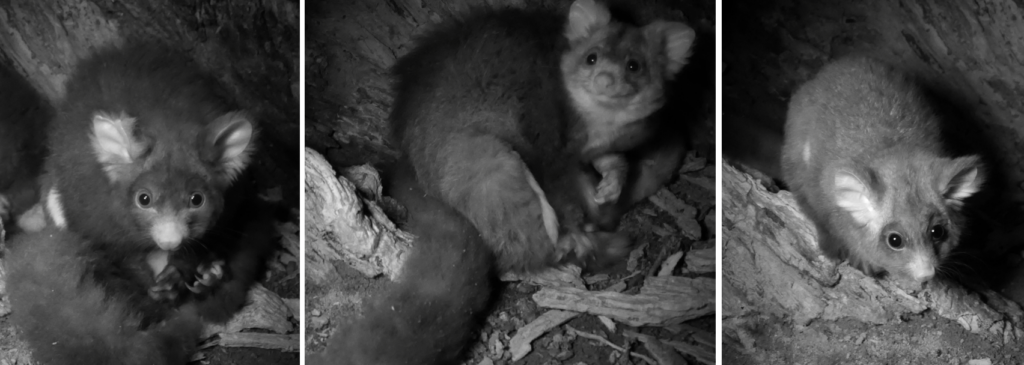
The stars of the 24/7 broadcast are Pip, a white-faced female, her partner Milo, a male with black fur and a white belly, and their joey Brimi (sex unknown) who has a similar colour pattern to Milo. A viewer nominated the name Brimi, which means night in the language of the Biripi people, and it received the most votes.
Broadcast from a secret location on private land in Tallaganda, NSW the livestream is the work of Dr Ana Gracanin from the Australian National University.
Greater gliders are often described as not having a prehensile tail – meaning their tail does not grip. But the livestream challenges that thinking.
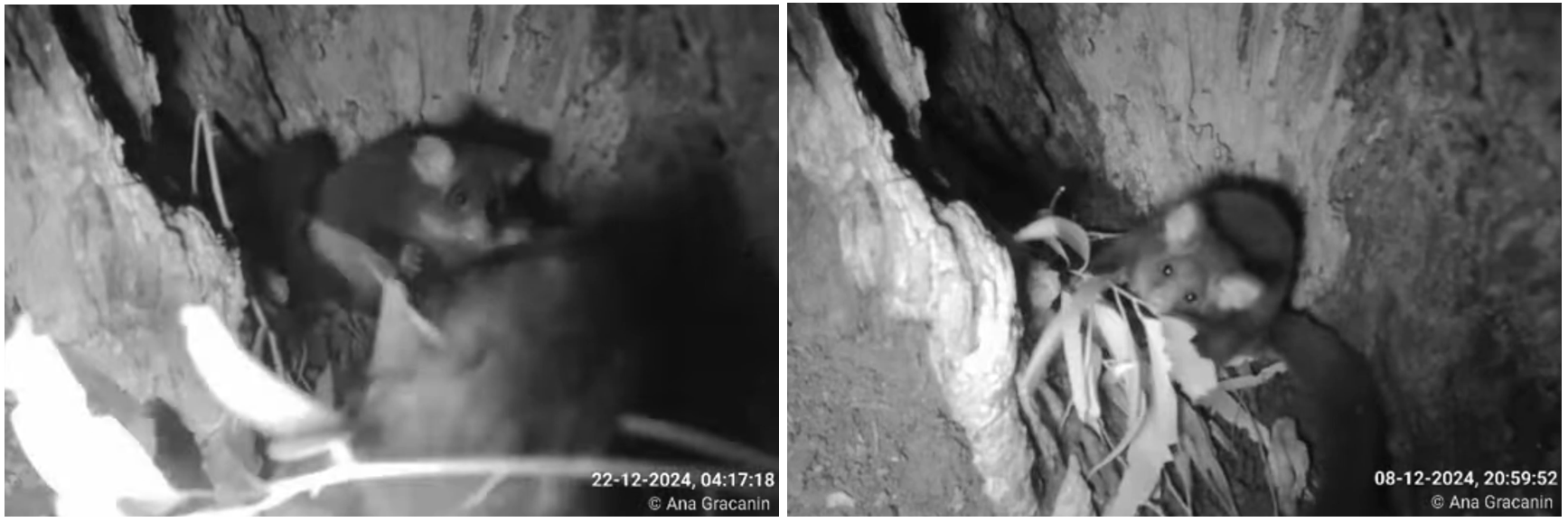
“The camera captured Milo using his tail to grasp eucalyptus stems and carry them into the hollow for Brimi and then Brimi eating the leaves,” said Dr Gracanin.
“This unique behaviour had never been observed before, it’s also some of the first evidence for paternal care in the species. Watching the joey take its first few nibbles was adorable, with little bite marks left as it tasted leaves, one by one,” she said.
The World Wide Fund for Nature-Australia, National Parks Association NSW, Wilderness Australia, and Social Justice Advocates of the Sapphire Coast have supported the project.
People from Australia, United Kingdom, United States, Germany, Canada, New Zealand, Netherlands, Denmark, Ireland and Italy have spent more than 10,000 hours watching the livestream, describing it as "magical" and their "favourite reality tv show". A lot of comments also expressed concern after learning the species is endangered.
On 2 October 2024, viewers saw Brimi emerge from Pip’s pouch and climb onto her back. Since then they’ve witnessed the baby grow to full size.
Dr Gracanin said one of the biggest surprises has been just how much social interaction occurs inside the hollow.
“Greater gliders are often thought of as solitary, but we've seen Pip, Milo, and Brimi grooming, snuggling, and even engaging in what looks like play.
“But the livestream is about more than watching cute animals—it’s a window into the importance of tree hollows and old-growth forests. Every night we get to witness something that would otherwise go unseen. That’s an incredible privilege. If people enjoy watching Pip, Milo, and Brimi, I’d encourage them to take action—support conservation efforts, speak up for native forests, and help protect the habitats that species like greater gliders rely on. Every bit of awareness and advocacy helps,” said Dr Gracanin.
WWF-Australia conservation scientist Dr Kita Ashman has studied greater gliders in Tallaganda and seen firsthand logging destruction in Tallaganda State Forest.
“As the livestream has shown, greater gliders need a large hollow to shelter and raise their young. Destroy hollow bearing trees and you destroy greater gliders. It’s that simple,” Dr Ashman said.
“Greater glider trees are being logged by a government owned hardwood business that has lost nearly $90 million in the last four and a half years. Losing that much money to degrade habitat and hurt our unique wildlife is shocking.
“The NSW government needs to transition out of native forest logging to save greater gliders and other threatened species,” she said.
Contact details:
Mark Symons
Senior Media Officer, WWF-Australia
m 0400 985 571