Whale videos and images here: https://hive.panda.org/Share/y44c3027utrdwnmkojy3b473tamac508
Animated maps and more images here: https://dams.wwf.org.au/resourcespace/?c=6182&k=44cf4e4e63
4 JUNE 2025: The world’s first interactive map of whale migration routes has revealed the growing dangers whales face in the oceans surrounding Australia.
Launched ahead of World Oceans Day on 8 June, BlueCorridors.org is a collaboration between WWF and more than 50 global research groups.
The platform combines over 3.2 million kilometres of satellite tracking data from more than 1400 migratory whales with information on overlapping threats and conservation solutions.
It’s the first time the “blue corridors” used by great whales have been digitally mapped, animated and made publicly accessible to inform science, policy and ocean protection efforts.
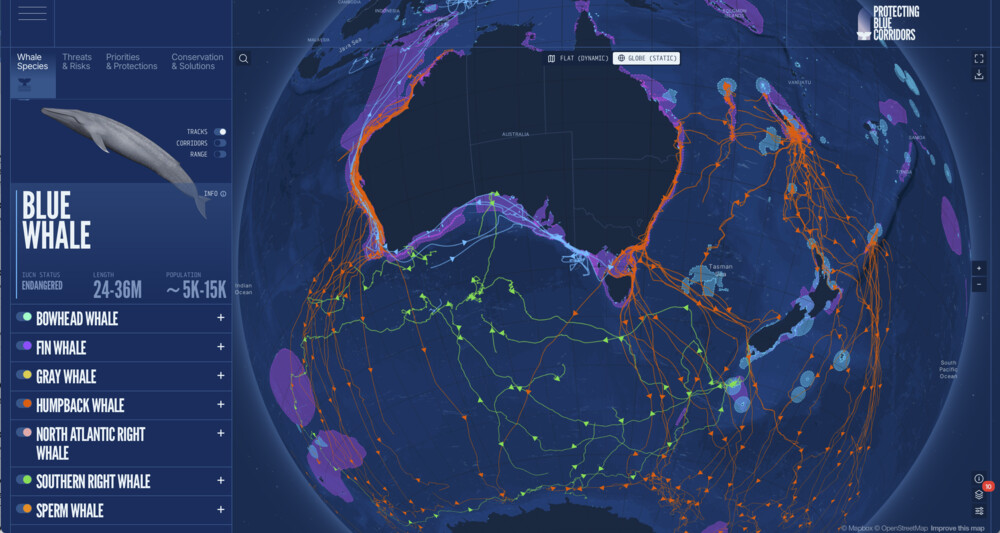
BlueCorridors.org visualises the satellite tracking data of whales in the oceans surrounding Australia.
These maps trace the migratory superhighways that connect critical breeding, feeding and social habitats across ocean basins—routes essential not only for whale survival but for the health of marine ecosystems.
Platform users can see the epic satellite tracks of the humpback whales that travel along Australia’s east and west coasts each year on their way to feeding grounds in Antarctica – and explore other regions around the world.
“Blue corridors are more than migration routes—they’re lifelines for the ocean’s giants and the ecosystems they support,” said Chris Johnson, Global Lead for WWF’s Protecting Whales and Dolphins Initiative.
But these lifelines are under considerable and increasing threat.
Seven of the 14 great whale species remain endangered or vulnerable, facing growing risks from ship strikes, entanglement in fishing gear, underwater noise, plastic pollution and climate change.
BlueCorridors.org shows how these threats intersect with whale migration routes in the oceans surrounding Australia, from oil and gas exploration off the northwest shelf of Western Australia to shipping traffic on Australia’s east coast.
“Ship strikes, entanglement in fishing gear and shark nets are a growing concern on Australia’s east coast, especially during humpback whale migration season,” said Mr Johnson.
“The cumulative impact of these activities are creating a dangerous and sometimes fatal obstacle course for our great whales.
“Whales face serious injury or death when they are hit by ships or accidentally caught in fishing gear and ghost nets.
“On top of this, climate change is impacting their migration cues and shifting their prey populations, especially in the polar regions.
“The Australian Government needs to lift its game to better protect whales in our waters and collaborate with other governments on bold solutions to safeguard their migratory journeys.”
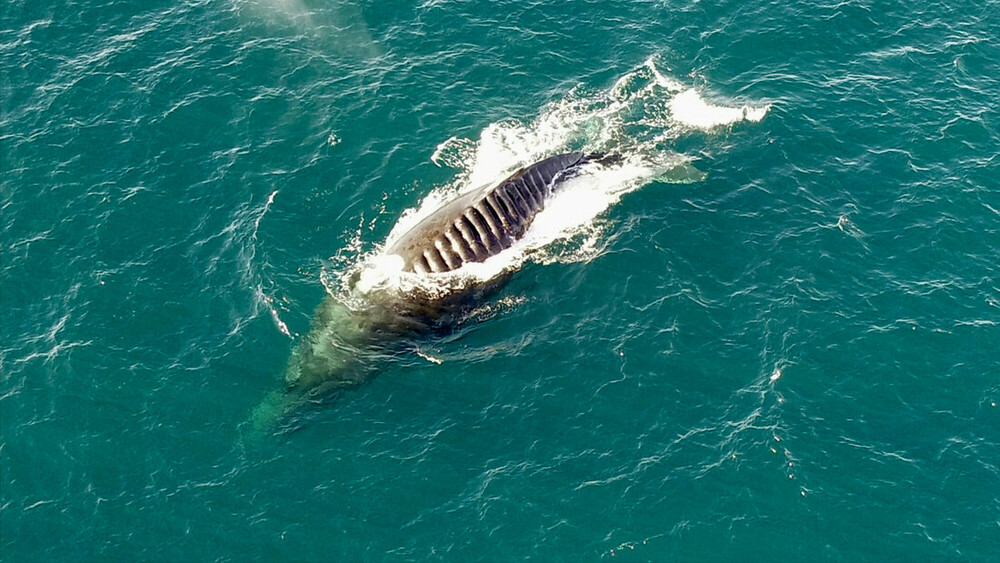
Female humpback whale ‘Bladerunner’, who sustained serious injuries from a ship's propeller, passing Tathra, NSW © oceanspray_photography
WWF and its collaborators hope that BlueCorridors.org will be a powerful tool to help guide conservation efforts to meet global goals to protect 30% of the ocean by 2030.
The platform has been launched ahead of the UN Ocean Conference in Nice, where countries will be urged to ratify the High Seas Treaty to protect marine life and restrain harmful activities in the international waters that cover nearly half the planet.
“This platform transforms decades of science into a tool for action—showing when, where and how to protect whales in a rapidly changing ocean,” said Mr Johnson.
WWF-Australia has called on the Australian Government to establish a Western Pacific Blue Corridor Initiative for whales, working collaboratively with Pacific countries, scientists and other stakeholders.
Safeguarding this corridor would create a network of protection mechanisms for whales and other key ocean species from the Pacific through Australian waters and down to Antarctica.
Mr Johnson said this would benefit not just whales, but the entire planet.
“Healthy whales lead to healthy oceans,” he said.
“Growing evidence shows whales fertilise our oceans over great distances. This helps boost phytoplankton production, which captures about 40% of all carbon dioxide produced and generates over half the atmosphere’s oxygen. Thriving and healthy whale populations benefit nature and people.”
BlueCorridors.org builds on the collaborative “Protecting Blue Corridors” report (2022), which mapped global whale migration for the first time.
NOTES TO EDITORS:
About the Blue Corridors Initiative:
Protecting Blue Corridors is a collaborative initiative across the marine mammal science and conservation communities to visualise growing risks to whales and marine connectivity conservation solutions to inform policy. A core governance team of world-leading science and conservation organisations oversees the Initiative, data sharing, transparency, and the BlueCorridors.org platform growth. They include: Dr Rochelle Constantine (University of Auckland, New Zealand), Dr Violaine Dulau (Globice, Reunion Island), Dr Ari Friedlaender (University of California, Santa Cruz, USA), Chris Johnson (WWF), Dr Daniel Palacios (Oregon State University / Center for Coastal Studies, USA), Dr Simone Panigada (Tethys Research Institute, Italy), Dr Rui Prieto (University of Azores), Dr Ryan Reisinger (University of Southampton, UK), Dr Els Vermeulen (University of Pretoria, South Africa), Dr Alex Zerbini (University of Washington, USA), https://bluecorridors.org
Contact details:
Paul Fahy, 0455 528 161, [email protected]