

Skip to content
Environment

“Disturbing” 50% jump in NSW land clearing

WWF-Australia 1 min read

Pictures: https://dams.wwf.org.au/resourcespace/?c=6245&k=7967f891a8

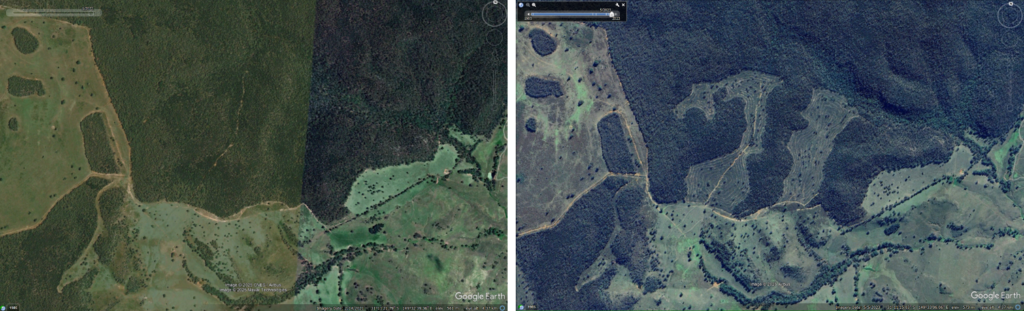
New figures reveal 66,498 hectares were cleared in New South Wales in 2023, a disturbing increase of nearly 50% on the previous year.

The NSW Government’s just-released Statewide Landcover and Trees Study (SLATS) shows 478,750 hectares were cleared from 2018 to 2023.

That’s an area more than twice the size of the ACT. It equates to 132 SCG playing fields cleared every day over the past six years.

Of the 66,498 hectares cleared in 2023, 32,847 hectares was woody vegetation (trees and shrubs) and 33,651 hectares was non-woody vegetation (grasslands, ferns, and ground cover).

“The NSW government committed to ending excessive land clearing at the last state election and needs to turn that promise into action,” said Dr Stuart Blanch, WWF-Australia’s forest policy manager.

“Koalas, greater gliders and many other species face the threat of extinction largely because land clearing destroys their homes and food. Such a huge jump in clearing is the worst news possible for our precious native wildlife.

“Our nature crisis calls for state and federal collaboration. It’s time for the Federal Government to finally deliver EPBC reform.

“The NSW Government needs to strengthen native vegetation laws to reduce clearing rates. Separately they must create more national parks, starting with the Great Koala National Park.

“Improved state laws would also support producers in accessing the growing market for deforestation-free commodities.   

“Most clearing of woody vegetation was ‘un-allocated’, meaning it was likely exempt from any requirement for an assessment by an ecologist to see if the clearing would kill threatened species.

“Current rules allow landholders to clear vegetation they self-assess to be Invasive Native Species. A more scientific approach is required to ensure areas of ecological value are retained,” he said.


Contact details:

Mark Symons

Senior Media Officer, WWF-Australia

[email protected]

m 0400 985 571

Media

More from this category

  • Environment, Transport Automotive
  • 12/12/2025
  • 14:27
NALSPA

Electric Car Discount review must drive clean energy transition and cost-of-living relief

The National Automotive Leasing and Salary Packaging Association (NALSPA) has today welcomed the federal government’s announcement of the statutory review of the Electric Car Discount, noting that the policy continues to be highly effective in encouraging Australians to make the switch to cleaner cars.The federal government announced today that next year it will review the Electric Car Discount, otherwise known as the EV FBT exemption which came into effect in July 2022.The review will consider the operation of the Electric Car Discount over the first three years it has been in place, as required by the legislation.“We will actively participate…

  • Banking, Environment
  • 12/12/2025
  • 10:38
Australian Conservation Foundation

NAB shareholders owning $9.74bn in shares call on the bank to do better on deforestation

Investors owning $9.74 billion of shares in Australia’s largest agribusiness bank have backed a resolution calling on NAB to disclose deforestation linked to its lending.* The resolution on disclosure of financed deforestation, facilitated by the Australian Conservation Foundation and co-filed by SIX, Australian Ethical, Melior Investment Management, was supported by 13.98% of shares voted at NAB’s AGM today. A second resolution, calling on the bank to set out a strategy to eliminate financed deforestation, was supported by 10.39% of NAB shares voted. Jolene George, head of corporate advocacy at the Australian Conservation Foundation, said: “The support for the resolution on…

  • Environment
  • 12/12/2025
  • 10:34
UNSW Sydney

Droughts lasting longer across Australia, study shows

A studytracking not only the forces that drive drought but the damage it leaves behind has revealed that droughts have lasted longer in Australia in recent decades, especially in areas with the most people and farms. UNSW researchers analysed drought trends across Australia between 1911 and 2020 based on rainfall shortages and falling river and dam levels. Their analysis showed that, since 1971, the time spent under drought conditions has increased across most of Australia, especially in the southeast and southwest, which are densely populated and key breadbaskets. The increasing dryness was especially felt during winter and spring, which are…

Media Outreach made fast, easy, simple.

Feature your press release on Medianet's News Hub every time you distribute with Medianet. Pay per release or save with a subscription.
