
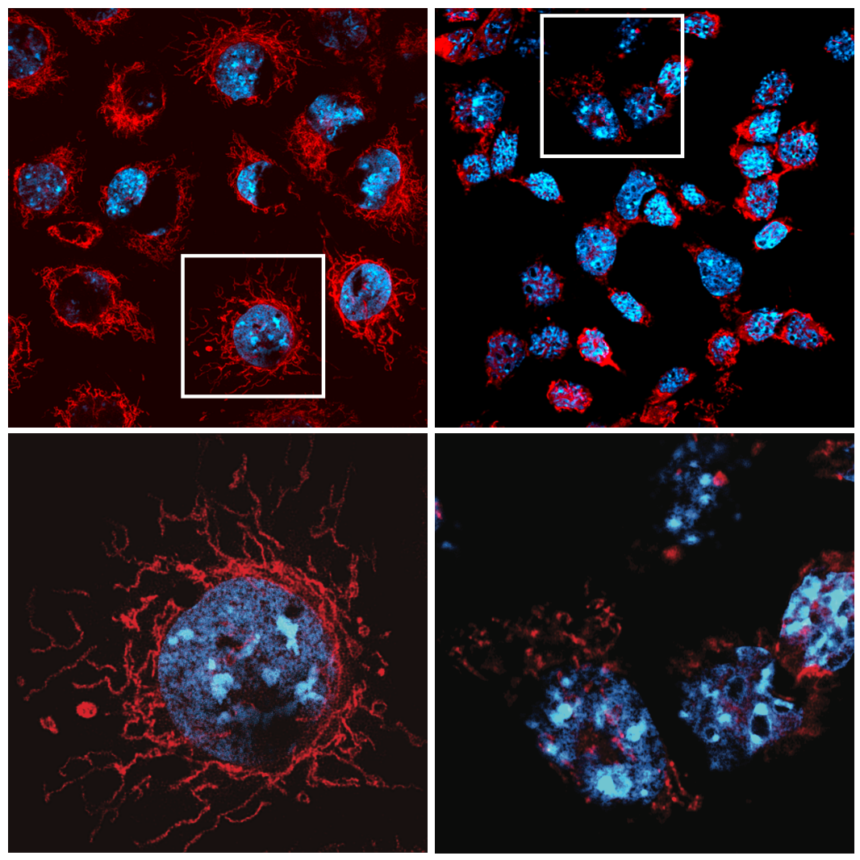
Landmark research on MCL-1, a critical protein that is an attractive target for cancer drug development, helps explain why some promising cancer treatments are causing serious side effects, and offers a roadmap for designing safer, more targeted therapies.
The WEHI-led discovery, published in Science, has uncovered a critical new role for MCL-1, revealing it not only prevents cell death but also provides cells with the energy they need to function.
The findings reshape our understanding of how cells survive and thrive, with implications for both cancer treatment and developmental biology.
At a glance
- Landmark research shows the protein MCL-1, in addition to its well-understood role in preventing cell death, plays a second essential role in helping cells function by supporting energy production.
- Drugs targeting MCL-1 have shown great promise as a future cancer treatment, but have been shown to harm healthy tissues, especially in organs with high energy demand like the heart and liver.
- The findings published in Science pave the way for safer, more targeted cancer therapies targeting MCL-1.
First author Dr Kerstin Brinkmann said that while previous research in cell cultures had hinted at the metabolic role of MCL-1 in providing energy to cells, it was unclear whether this mattered in living organisms.
“This is the first time MCL-1’s metabolic function has been shown to be critical in a living organism,” said WEHI researcher Dr Brinkmann.
“It’s a fundamental shift in how we understand what this protein does.
“The findings open up a completely new way of thinking about the intersection between programmed cell death and metabolism – something that’s been speculated on for years but never been shown in a living organism until now.”
Cancer drug target
The research strengthens the potential of MCL-1 as a cancer drug target, which is currently the subject of clinical trials all over the world.
While drug compounds targeting MCL-1 that have been developed to date are considered extremely effective at combating cancer, they have unfortunately also caused significant side effects in early clinical trials, particularly in the heart.
Co-senior researcher Professor Andreas Strasser said the findings could help resolve the safety issues of drugs targeting MCL-1 that have hindered these promising treatments.
“If we can direct MCL-1 inhibitors preferentially to tumour cells and away from the cells of the heart and other healthy tissues, we may be able to selectively kill cancer cells while sparing healthy tissues,” Prof Strasser, a WEHI laboratory head, said.
The study also lays the groundwork for better combination therapies. By understanding the distinct pathways the protein influences, researchers can design smarter dosing strategies and pair MCL-1 inhibitors with other treatments to reduce toxicity.
“This work exemplifies the power of discovery science,” said co-senior researcher Professor Marco Herold, CEO of the Olivia Newton-John Cancer Research Institute (ONJCRI).
“The sophisticated preclinical models we developed allow us to interrogate the precise function of MCL-1, and to address fundamental biological questions that have direct relevance to human disease.”
Protein link to rare, fatal diseases
MCL-1’s role in energy production could help explain fatal metabolic diseases in infants, such as mitochondrial disorders. These rare conditions, often caused by mutations in genes that stop cells from generating enough energy, can be lethal in early life.
The study suggests MCL-1 may play a previously unrecognised role in these diseases, offering a potential new target for future therapies.
Another key outcome of the study is the creation of a system that allows researchers to compare the functions of pro-survival proteins like MCL-1, BCL-XL and BCL-2.
These new tools will help identify which roles are shared and which are unique – knowledge that could inform future drug development across multiple targets.
A collaborative discovery
The project was made possible by WEHI’s collaborative research environment, bringing together experts in cancer biology, metabolism, developmental biology and gene editing.
Co-senior authors Prof Herold (from the ONJCRI), Associate Professor Tim Thomas and Professor Anne Voss played key roles in the study.
“This kind of discovery only happens when you have the right mix of people and expertise,” said Prof Strasser.
“It’s a powerful example of how fundamental science drives future medical breakthroughs.
“This came from a simple biological question – not a drug development project. It shows why we need to support curiosity-driven science. That’s where the big insights come from.”
The study, "Relative importance of the Anti-Apoptotic versus Apoptosis-Unrelated Functions of MCL-1 in vivo”, is published in Science (DOI: 10.1126/science.adw1836).
About us:
About WEHI (Walter and Eliza Hall Institute of Medical Research)
WEHI is where brilliant minds collaborate and innovate to make life-changing scientific discoveries that help people live healthier for longer. Our medical researchers have been serving the community for more than 100 years, making transformative discoveries in cancer, infection and immunity, and lifelong health. WEHI brings together diverse and creative people with different experience and expertise to solve some of the world’s most complex health problems. With partners across science, health, government, industry, and philanthropy, we are committed to long-term discovery, collaboration, and translation. At WEHI, we are brighter together.
Find out more at www.wehi.edu.au
Contact details:
M: +61 475 751 811
E: [email protected]