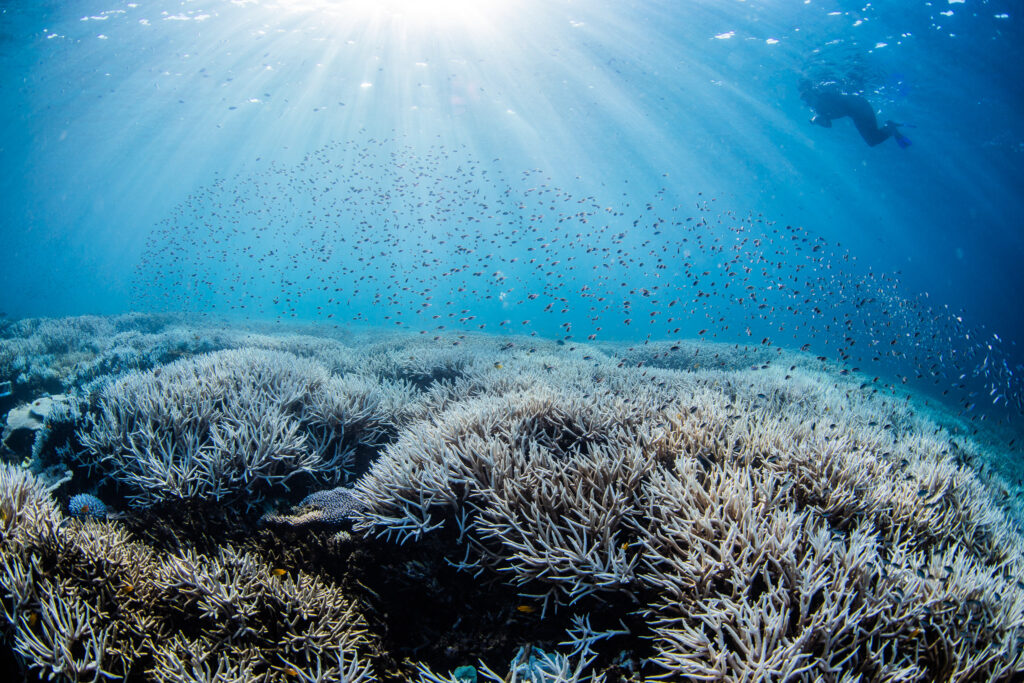

The Great Barrier Reef could be declared World Heritage in Danger next year – with Australia’s climate policy looming as a critical factor.
A decision overnight by the World Heritage Committee, meeting in Paris, called for Australia to set an ambitious climate target consistent with limiting global temperature increases to 1.5°C.
Failure to do so will be considered at the Committee’s next annual meeting in mid-2026 where it could decide to place the Reef on the “in Danger” List.
Climate science shows Australia must reduce emissions by at least 90% by 2035 and net zero before 2040 to do our part to stabilise global warming to 1.5°C.
Australia is due to announce its 2035 target in September.
The Great Barrier Reef suffered mass coral bleaching in 1998, 2002, 2016, 2017, 2020, 2022, 2024 and 2025, with the World Heritage Committee noting with utmost concern the outlook for the Reef “remains one of continued deterioration due largely to climate change”.
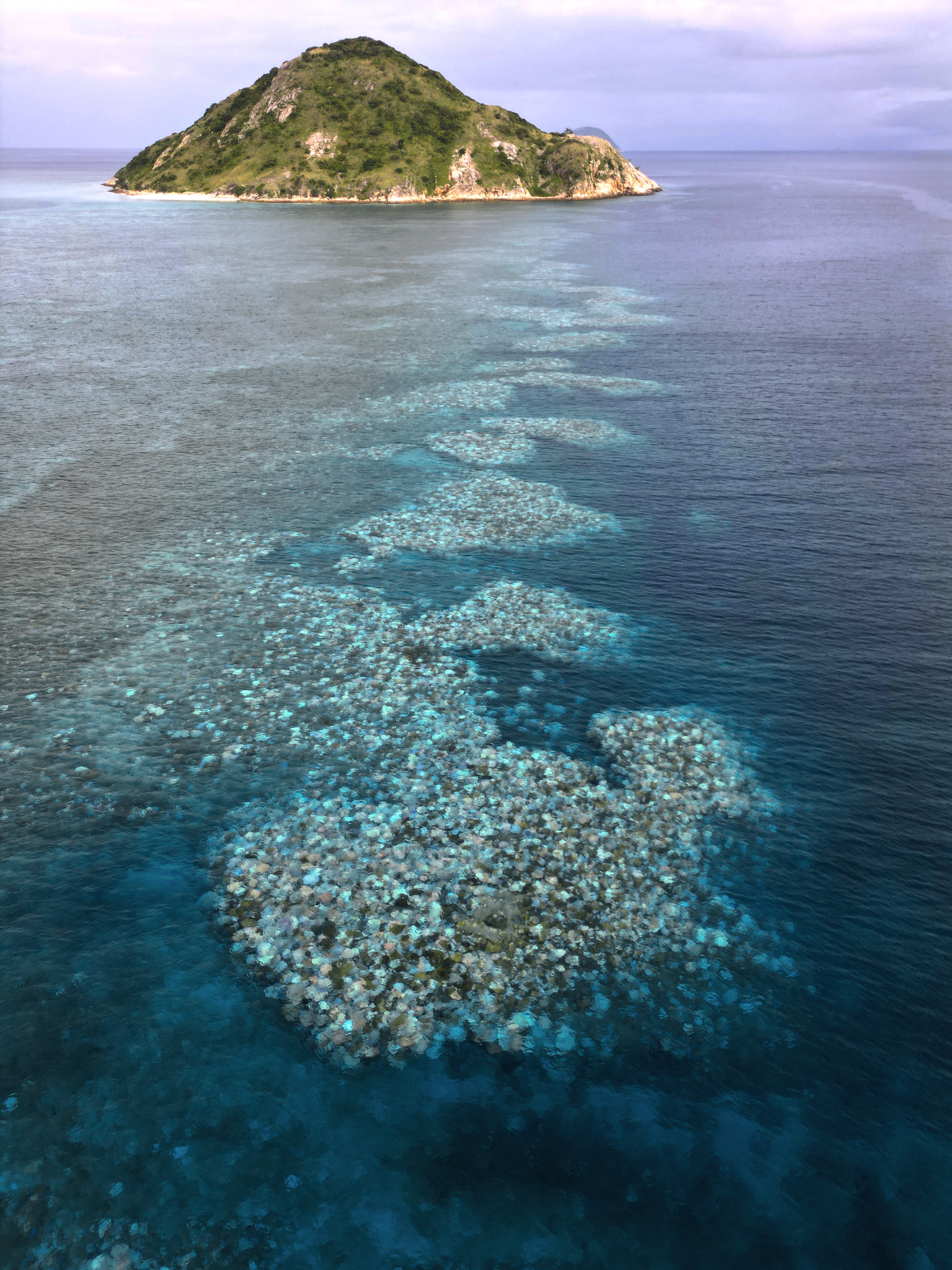
Above: Coral bleaching off Lizard Island in the far north 23 March 2024, courtesy of George Roff, CSIRO
“Mr Albanese has an opportunity to be the first Australian Prime Minister to set a climate target to give our Reef a fighting chance,” said Dermot O’Gorman, CEO of the World Wide Fund for Nature Australia.
“A strong 2035 target would help protect the Reef, the industries that depend on it, and thousands of years of priceless Traditional Owner cultural heritage.
“It would defend Australians and all our cherished natural places from the worst impacts of climate change,” Mr O’Gorman said.
Bleaching is worse than UNESCO itself predicted
WWF-Australia Head of Oceans Richard Leck said UNESCO may well consider the coral bleaching projections made in its own scientific report.
“In 2017, UNESCO – in collaboration with leading reef experts – predicted that under a worst case scenario the Great Barrier Reef would experience two severe bleaching events per decade by 2035. Under a milder scenario this would not happen until 2041.
“We’ve had six mass bleaching events on the Great Barrier Reef in the past decade. The impacts of heat stress on the Reef are far more severe than UNESCO itself predicted,” he said.
The World Heritage Committee’s call for a strong climate target is among more than a dozen actions the UNESCO body has requested to preserve the Reef’s Outstanding Universal Value.
Others include strengthening laws to protect vegetation from clearing, ensuring the Reef is fully gillnet-free by mid-2027 at the latest, and supporting the Great Barrier Reef Traditional Owner Taskforce (ReefTO).
Australia must submit a progress report on implementing these measures and give an update on the Reef’s health – including the full impacts of the 2024 bleaching event – by 1 February 2026.
The World Heritage Committee will consider these updates at its 48th session in mid-2026 where it could possibly decide to include the Reef on the List of World Heritage in Danger.
Contact details:
Paul Fahy, 0455 528 161, [email protected]