Media b roll and stills here
New South Wales’ love affair with Return and Earn recycling has reached a new high, with the 14th billion container officially returned.
In just seven years since launching in December 2017 as a litter reduction initiative, Return and Earn has grown to deliver strong environmental, social, and economic benefits for communities across NSW.
The positive environmental impact of returning 14 billion bottles and cans for recycling instead of making new containers with virgin materials includes:
- Water savings equivalent to 32,840 Olympic swimming pools
- Energy savings equivalent to powering 191,100 homes for an entire year
- Carbon emission savings equivalent to taking 1,017,400 cars off the road annually.
“This impressive milestone means over $1.4 billion in container refunds has gone back into people’s pockets, helping with the cost of living, saving for a special goal or supporting some amazing organisations,” said James Dorney, CEO of network operator TOMRA Cleanaway.
Danielle Smalley, CEO of scheme coordinator, Exchange for Change, said over $82 million has been raised for charities and community groups through donations and return point hosting fees, supporting their important work from providing food and shelter to environmental conservation.
“Return and Earn is one of the best product stewardship schemes in the country and shows what incredible environmental, economic and social outcomes can be achieved when government, industry and the community work together,” she said.
The 14 billion milestone coincides with Return and Earn releasing the latest Local Government Volume Report, which shows the enthusiastic community participation in container returning by council area in the last six months.
Return and Earn is delivered in partnership between the NSW Government, scheme coordinator Exchange for Change and network operator TOMRA Cleanaway.
For more information visit returnandearn.org.au.
FAST FACTS
- An additional 3.8 billion drink containers have been returned via yellow bin kerbside collections.
- Two out of every three eligible drink containers supplied into NSW are recycled through the scheme.
- Return and Earn has achieved a 73 per cent reduction in drink container litter since the scheme began.
- Aluminium containers (513,877,536) and PET containers (358,569,925) were the most common drink containers recycled through the return point network in the last six months.
- Glass bottles are recycled into new bottles and jars in as little as 30 days.
- Plastic soft drink and water bottles are back on shelves in six to eight weeks.
- Plastic bottle lids are recycled into items including flowerpots and bin lids
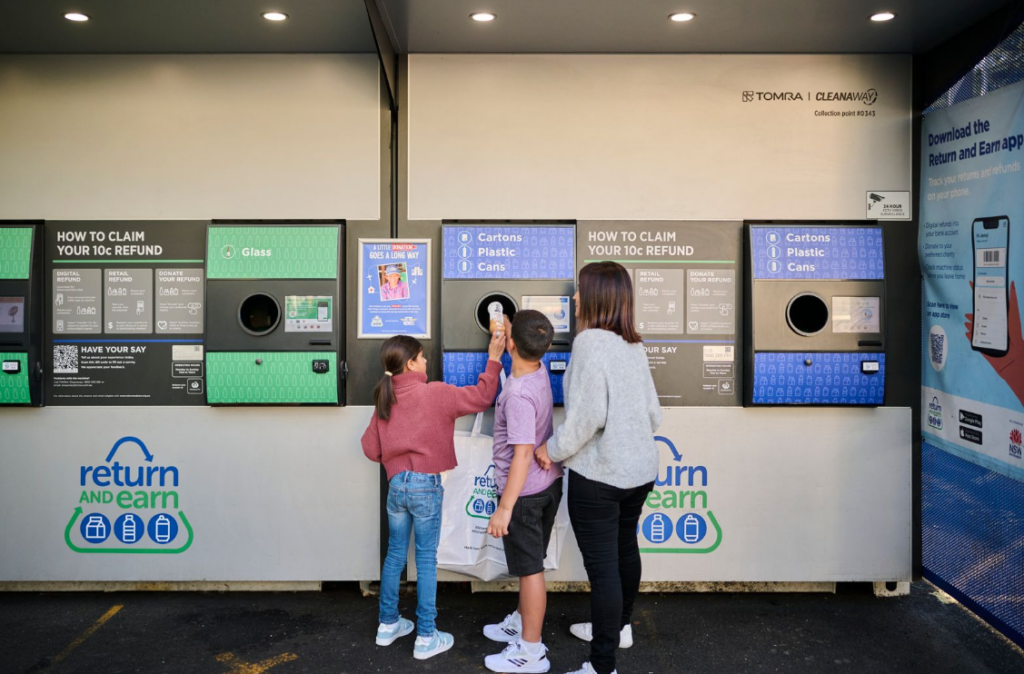
- There are more than 660 return points across NSW and 83 per cent of adults have participated in Return and Earn, the majority doing so monthly.
- Recyclers can choose to donate their return to one of over 400 donation partners on the Return and Earn app.
MEDIA NOTE: A Return and Earn Local Government Network Volume Report has been released. It lists the total volume of containers redeemed by the community through local return points by local government area over the last six months
Contact details:
Denne Dempsey M: 0474313310
E: [email protected]