
There is also a YouTube video outlining the project. https://www.youtube.com/watch?v=kYNu1MzH0Ao
A UNSW Sydney project customising artificial seawalls aims to restore oyster populations in Blackwattle Bay.
A team of computational designers from the School of Built Environment at UNSW Arts, Design & Architecture has developed innovative 3D-printed reef structures – called BioShelters – to help reestablish oyster populations around Sydney Harbour. The project, supported by Landcom and NSW Government funding, applies advanced computational methods architects use to design and fabricate green coastal infrastructure.
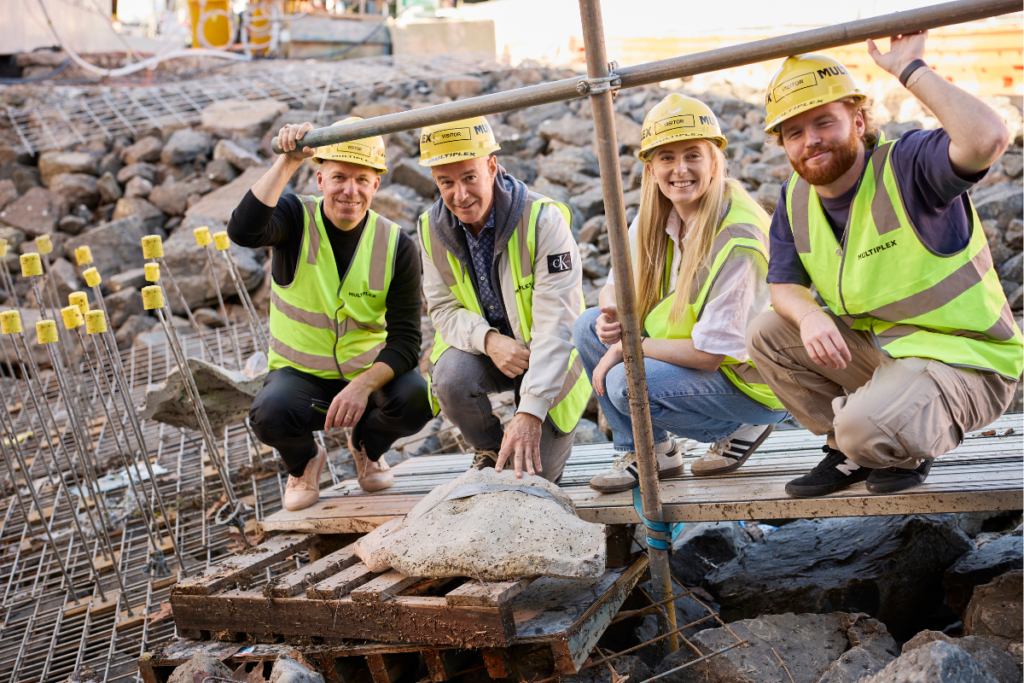
Each BioShelter is made from a 3D-printed recycled plastic mould and filled with a concrete mix that includes crushed oyster shells. They are approximately six metres by two metres and 90 centimetres in height and segmented into 25 individual panels. The BioShelters have recently been installed at the new Sydney Fish Market site in Glebe, an area where natural habitats have been lost due to urban development.
In places like Sydney, more than 50 per cent of the harbour shoreline has been modified with built structures, such as seawalls, to protect coastal infrastructure. However, these structures are typically flat and lack the features and crevices of a natural rocky shoreline needed to support native biodiversity.
“Just as there is a housing crisis in Sydney for humans, there is one for sea creatures like oysters,” says Professor M. Hank Haeusler, Director of the ARC Centre for Next-Gen Architectural Manufacturing at UNSW, who leads the BioShelters project. “What this project aims to do is create new artificial habitats that are as close to nature as possible.”
Why oysters matter
Oysters are critical to marine ecosystems, helping to maintain clean water by filtering, opens in a new window up to 100 litres of water a day. They also play an important role as a food source for fish and provide complex habitats for other invertebrate species.
Oysters colonise by building on other oyster shells, so the BioShelters incorporate reclaimed oyster shells into the build material, supporting colonisation and the work to rebuild and rehabilitate an important marine ecosystem, explains Prof. Haeusler.
“We are using crushed oyster shells from the Fish Market as an aggregate in the concrete instead of pebbles or rocks,” Prof. Haeusler.
The project is similar to another project involving UNSW marine scientists, Living Seawalls, which fits similar textured concrete panels to seawalls around the harbour to create more rocky habitat space for small sea creatures along the harbour shoreline.
What sets BioShelters apart is the use of computation design and robotic fabrication to create site-specific habitat solutions.
”We use algorithms and robotic fabrication that translates marine biology data to create 3D forms that support a range of species,” says Prof. Haeusler. “It not only restores oysters, but also supports fish, seaweed, kelp and other native marine species.”
From concept to delivery
The project was born in 2016 in a collaborative effort between architecture, computational design, marine biology, and engineering specialists. Previous research by marine biologists identified the environmental conditions required by three habitat-forming species – the Sydney rock oyster, native hairy mussels and a species of native kelp.
“Filter-feeders rely on good water flow, algae need light and moisture, so they don’t dry out, and mobile species like snails and crabs need places to hide,” explains marine biologist Nina Schaefer.
“So the design had to accommodate water flowing through the structure, and include features that also trap water, and offer small, shaded areas for shelter.”
Using this data, the design team developed digital models and created miniature prototypes using 3D printing. In 2020, they installed a full-scale prototype under the Anzac Bridge. After six months, marine biologists confirmed that the structure was colonised by oysters, seaweed, kelp and small fish – proving the concept’s success.
“The success of the proof-of-concept trial led to the commission from the new Sydney Fish Market to install and design the permanent feature,” says Prof. Haeusler.
Future directions
The next phases of the BioShelters project will focus on refining the fabrication process. Currently the team prints moulds and fills them with concrete, but they aim to print directly in concrete to streamline production.
“We want to develop a system where marine biologists can input site-specific information into a program, approve or modify the design, and then submit it for fabrication.”
The ultimate aim is to see BioShelters used in harbours around the world, Prof. Haeusler says. The modular design of the structures means they could be adapted to fit any seawall structure.
“We have already started a conversation for a larger installation, revitalising seawalls across Sydney Harbour,” Prof. Haeusler says. “And there’s potential to take the principles to design and generate similar artificial habitats for other species on land such as mammals, birds, bats and rodents that also need homes.”
Contact details:
Samantha Dunn
UNSW News & Content
0414 924 364
[email protected]