Teasing apart the sources of organic carbon stored in coastal wetland soils around the world was the ‘grand challenge’ Australian Institute of Marine Science (AIMS) scientists successfully tackled in a seminal blue carbon research paper recently published in Global Change Biology. Their work provides vital insights into how marine ecosystems can naturally contribute to climate abatement on a global scale.
During photosynthesis, coastal plants absorb some of the carbon dioxide they take from the air and water around them into their biomass. When this plant carbon becomes buried in soils it is locked away from the atmosphere for hundreds to thousands of years, a process known as carbon sequestration.
An important step in protecting and enhancing this natural pathway for carbon sequestration is determining the contributions of different coastal plants to this ‘blue carbon’ pool. Lead author AIMS research scientist Dr Chris Fulton said it was like trying to unravel the ingredients in a baked cake when you don’t know the recipe.
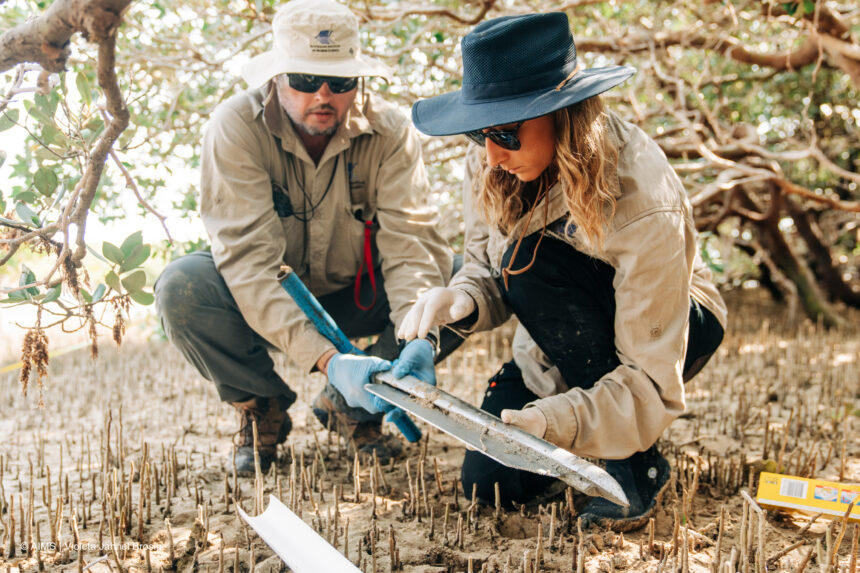
The team created a mathematical model that standardised and analysed data from hundreds of measurements taken in the soils beneath saltmarsh, mangrove, and seagrass wetlands.
“While the source of the organic carbon varied a lot depending on the location and conditions, we found that generally more than half the organic carbon stored in these soils came from plants outside of the wetland – things like seaweeds and land plants growing offshore and upstream,” he said.
“This means we need to start thinking about these blue carbon wetlands as part of a connected matrix. We can't just protect mangrove forests; we need holistic coastal management to protect a diversity of organic carbon sources.
“This work also shows we can enhance this blue carbon sequestration by understanding how a spread of plants in the seascape will contribute more carbon to a restored coastal wetland.”
Dr Fulton said enhancing blue carbon sequestration had the potential to unlock vast sums of finance at a time when Australia and the world was seeking carbon capture and storage solutions to remove carbon from our atmosphere and lock it away as part of reaching our net zero emissions targets.
“One of the oldest carbon capture and storage technologies is the mangrove forest, which we've just discovered not only stores organic carbon from itself but also grabs carbon from all around it and buries it in the soil for centuries,” he said.
“Excess carbon in our atmosphere is the root cause of climate events: from the marine heatwaves that have so clearly affected Australia’s marine ecosystems recently to the floods and fires that occur across our continent.
“So, what can we do? Help our coastal plants to continue burying carbon in the soil while we also do our best to reduce greenhouse gas emissions.
“Our findings also highlight the need to update blue carbon crediting systems—both in Australia and internationally—which are focused on the plants that create the wetlands and ignore other important sources of carbon sequestration.”
Dr Fulton is leading a team of AIMS scientists working on a new seascape blue carbon model that includes all potential carbon sources, the Blue Carbon Seascapes Project, jointly funded by BHP.
Blue carbon refers to the ‘capture’ and ‘storage’ of carbon dioxide from the atmosphere by natural plant growth and decay processes that remove greenhouse gases from the atmosphere to mitigate the effects of climate change.
The Global Change Biology paper, Tracing blue carbon flows across diverse seascapes, can be accessed: https://doi.org/10.1111/gcb.70420
Media contact: Danielle Koopman, Senior Communications Officer: [email protected]; +61 499 744 677
Images and vision: https://aimsimages.fotoware.com.au/fotoweb/albums/aIsPzCTIX-xvGYnh/
More about the Australian Institute of Marine Science:
The Australian Institute of Marine Science (AIMS) is Australia’s tropical marine research agency. In existence for half a century, it plays a pivotal role in providing large-scale, long-term and world-class research that helps governments, industry and the wider community to make informed decisions about the management of Australia’s marine estate. AIMS science leads to healthier marine ecosystems; economic, social and environmental benefits for all Australians; and protection of coral reefs from climate change. More here: https://www.aims.gov.au/