
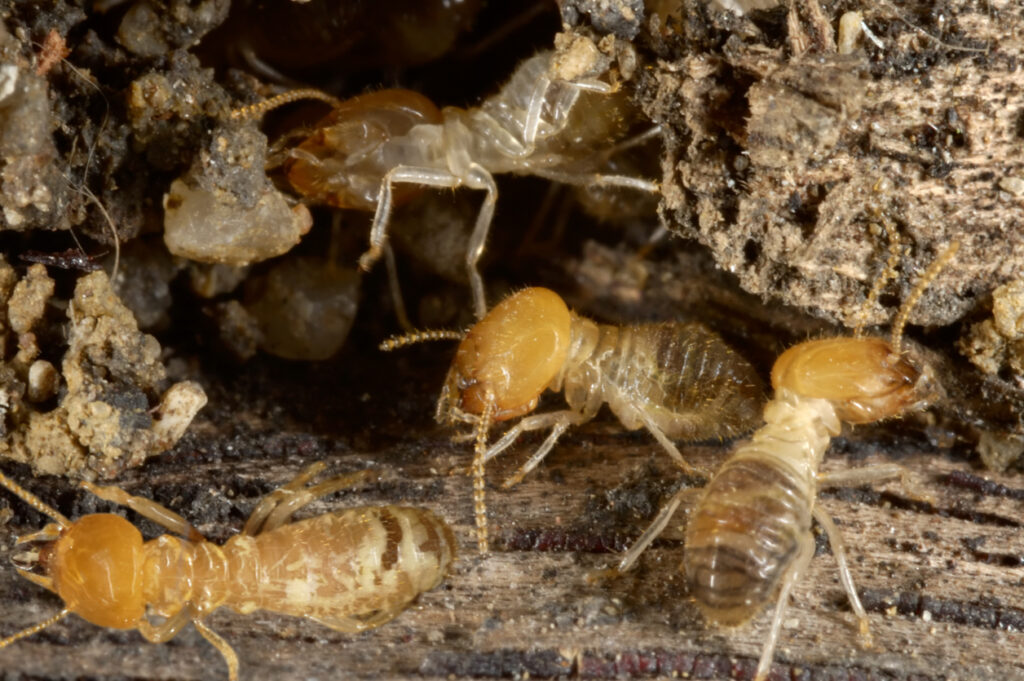

Non-monogamy and colony inheritance are the leading causes of conflict among termites, but these social cockroaches prove you don’t always need a big brain to get to the bottom of even the curliest of problems peacefully, new research from Charles Darwin University (CDU) has found.
Study author Judith Korb, a CDU and University of Freiburg researcher, investigated a termite species found in Darwin and its mangroves to analyse which mechanisms these invertebrates have evolved to resolve conflict.
Dr Korb said termites rarely address conflict with aggression – more often, problems are resolved indirectly.
For example, she said in cases of non-monogamous colonies with limited resources, termites turn to nepotism to keep their closest kin fed and healthy.
“Non-monogamy among termites usually occurs when a colony is founded by more than one breeding pair or if ‘new blood’ is brought in due to fusion with neighbouring colonies,” she said.
“In a situation where there’s multiple kings and queens – non-monogamy – and limited food, that’s where nepotism comes in as a source of conflict.
“But when there’s an abundance of food, they more or less don’t care if there’s multiple kings and queens and they feed all nestmates regardless of how close they are related.”
Alternatively, termites turn to direct conflict – butting and biting – when colony inheritance causes tension in a community.
Dr Korb said worker termites could become the new king or queen when the previous one died, with those who show the most dominant behaviour inheriting the breeding position.
However, they will only successfully establish themselves as royals if they feed their nestmate workers a lot – if not, they are killed.
“This ensures only very fit individuals that are in good physiological conditions will become the new king or queen,” she said.
Dr Korb said it was important to understand the conflicts and resolutions of creatures such as termites because the evolutionary principles that underlie their conflict hold lessons for us as humans.
“For example, there is conflict among human siblings just as there is among termite siblings – though such tension in the former is nowadays more related to resources rather than reproduction,” she said.
“By analysing the plights of termites, we learn which mechanisms can evolve to solve conflicts among small-brained species so they can live together socially.
“I find it exciting how evolution always finds a way, and you don’t need a large brain to solve conflicts. I even think, we as humans don’t use our brains very often to solve problems but react emotionally instead.”
Cooperation and conflict in termite societies was published in Current Opinion in Insect Science.
Contact details:
Sierra Haigh she/her
Communications Officer
Marketing, Media & Communications
Larrakia Country
E: [email protected]
W: cdu.edu.au

Charles Darwin University acknowledges all First Nations people across the lands on which we live and work, and we pay our respects to Elders both past and present.
CRICOS Provider No. 00300K | RTO Provider No. 0373 | TEQSA Provider ID PRV12069