

Skip to content
Environment

Mass coral mortality on the Great Barrier Reef

WWF-Australia 2 mins read

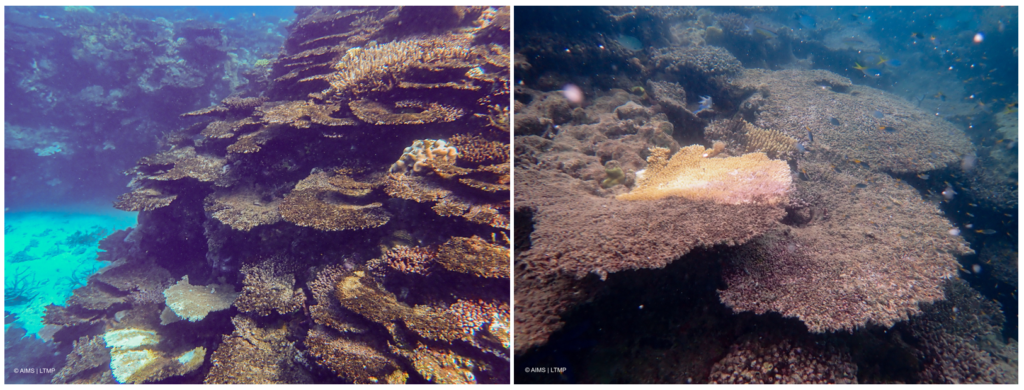
Following mass bleaching in 2024 and 2025, the Great Barrier Reef has suffered the biggest declines in coral cover in recorded history according to the Australian Institute of Marine Science’s (AIMS) annual survey report.

Decreases in coral cover are caused by the death of corals.  

AIMS said heat stress driven by climate change was the primary cause, mass bleaching events are becoming more frequent and intense, and “the future of the world’s coral reefs relies on strong greenhouse gas emissions reduction”.

Compared to the 2024 levels, coral cover in the northern region dropped by a quarter (from 39.8% to 30%), the central region by 13.9% (from 33.2% to 28.6%), and the southern region by almost one third (from 38.9% to 26.9%.)

For the northern and southern regions, those losses were the largest annual declines since monitoring began nearly 40 years ago.

The Great Barrier Reef has now suffered mass coral bleaching in 1998, 2002, 2016, 2017, 2020, 2022, 2024 and 2025.

Richard Leck, Head of Oceans for the World Wide Fund for Nature Australia said the devastating coral mortality intensifies the focus on Australia’s 2035 emissions reduction target, due to be announced soon.

“The evidence from AIMS’ report shouts from the rooftops ‘we need a strong 2035 target’.

“In one fell swoop, climate change wiped out the encouraging coral recovery of recent years.

“The Australian Government can show it’s determined to give the Reef a fighting chance by announcing a strong 2035 target backed by policies to deliver big emissions reductions.

“A strong 2035 climate target will fast track Australia’s transition to become a renewable energy superpower, supporting an abundance of new economic opportunities in the regions, including regional Queensland,” Mr Leck said.

Just last week, the Climate Change Authority (CCA) advised:

“Limiting climate warming… to 1.5 °C now hinges on rapid, large-scale reductions in global emissions. As the home and custodian of the Great Barrier Reef, Australia can spearhead shared efforts to accelerate these necessary reductions – both through its own actions and in coordination with global partners.” 

“Under the Paris Agreement, Australia has committed to pursue efforts to limit warming to 1.5 °C.

“To back up that promise with action and unlock fantastic economic benefits for future generations, Australia must commit to a 2035 emissions reduction target of at least 90% by 2035 and net zero before 2040,” Mr Leck said.

For more information please see WWF-Australia’s Briefing Note - Australia’s 2035 Climate Target Brief


Contact details:

Mark Symons

Senior Media Officer, WWF-Australia

[email protected]

m 0400 985 571

Media

More from this category

  • Environment, Transport Automotive
  • 12/12/2025
  • 14:27
NALSPA

Electric Car Discount review must drive clean energy transition and cost-of-living relief

The National Automotive Leasing and Salary Packaging Association (NALSPA) has today welcomed the federal government’s announcement of the statutory review of the Electric Car Discount, noting that the policy continues to be highly effective in encouraging Australians to make the switch to cleaner cars.The federal government announced today that next year it will review the Electric Car Discount, otherwise known as the EV FBT exemption which came into effect in July 2022.The review will consider the operation of the Electric Car Discount over the first three years it has been in place, as required by the legislation.“We will actively participate…

  • Banking, Environment
  • 12/12/2025
  • 10:38
Australian Conservation Foundation

NAB shareholders owning $9.74bn in shares call on the bank to do better on deforestation

Investors owning $9.74 billion of shares in Australia’s largest agribusiness bank have backed a resolution calling on NAB to disclose deforestation linked to its lending.* The resolution on disclosure of financed deforestation, facilitated by the Australian Conservation Foundation and co-filed by SIX, Australian Ethical, Melior Investment Management, was supported by 13.98% of shares voted at NAB’s AGM today. A second resolution, calling on the bank to set out a strategy to eliminate financed deforestation, was supported by 10.39% of NAB shares voted. Jolene George, head of corporate advocacy at the Australian Conservation Foundation, said: “The support for the resolution on…

  • Environment
  • 12/12/2025
  • 10:34
UNSW Sydney

Droughts lasting longer across Australia, study shows

A studytracking not only the forces that drive drought but the damage it leaves behind has revealed that droughts have lasted longer in Australia in recent decades, especially in areas with the most people and farms. UNSW researchers analysed drought trends across Australia between 1911 and 2020 based on rainfall shortages and falling river and dam levels. Their analysis showed that, since 1971, the time spent under drought conditions has increased across most of Australia, especially in the southeast and southwest, which are densely populated and key breadbaskets. The increasing dryness was especially felt during winter and spring, which are…

Media Outreach made fast, easy, simple.

Feature your press release on Medianet's News Hub every time you distribute with Medianet. Pay per release or save with a subscription.