In December 2022, the Joint Council on Closing the Gap formally endorsed the establishment of the Housing Policy Partnership (HPP) under Priority Reform One of the National Agreement.
The HPP is a national mechanism that brings together Aboriginal and Torres Strait Islander representatives and all levels of government to develop a joined-up approach to Aboriginal and Torres Strait Islander housing policy, with a focus on Outcome 9 of the National Agreement — ensuring Aboriginal and Torres Strait Islander people secure appropriate, affordable housing that is aligned with their priorities and needs. A key output of the HPP is to make recommendations to the Joint Council about improving housing outcomes and homelessness prevention for Aboriginal and Torres Strait Islander people.
The Housing Policy Partnership (HPP) is proud to release the Housing Policy Partnership Workplan, a clear and collective roadmap for change that’s grounded in Country, culture, and community.
Co-chaired by the National Aboriginal and Torres Strait Islander Housing Association (NATSIHA), and The Treasury, the HPP is a national mechanism that brings together Aboriginal and Torres Strait Islander representatives and all levels of government to develop a joined-up partnership approach and shared-decision forum on Aboriginal and Torres Strait Islander housing policy, with a focus on Outcome 9 — ensuring Aboriginal and Torres Strait Islander people secure appropriate, affordable housing that is aligned with their priorities and needs.
The HPP Workplan marks a turning point in how governments and Aboriginal and Torres Strait Islander communities work together on housing. For Aboriginal and Torres Strait Islander peoples, home has always meant more than shelter. It’s where families are raised, where knowledge is shared, and where connections to kin, culture and Country are nurtured. That’s why this Workplan doesn’t just centre on housing as a policy area, it treats it as the foundation for thriving futures. It directly advances Outcome 9 and provides a shared roadmap for action and accountability, making sure governments and communities alike can track progress and deliver change.
NATSIHA Co-Chair Zachariah Matysek said:
"As Co-Chair of the Housing Policy Partnership, I see this Workplan as a marker of real change. Housing has always been about more than bricks and mortar, it is the anchor for culture, community, and identity. This Workplan sets out a decisive path forward: reform that is led by Aboriginal and Torres Strait Islander peoples, shaped by cultural authority, and backed by genuine partnership. It represents a shift away from top-down decision-making towards a shared approach where governments and community sit at the same table, accountable to each other and to our people."
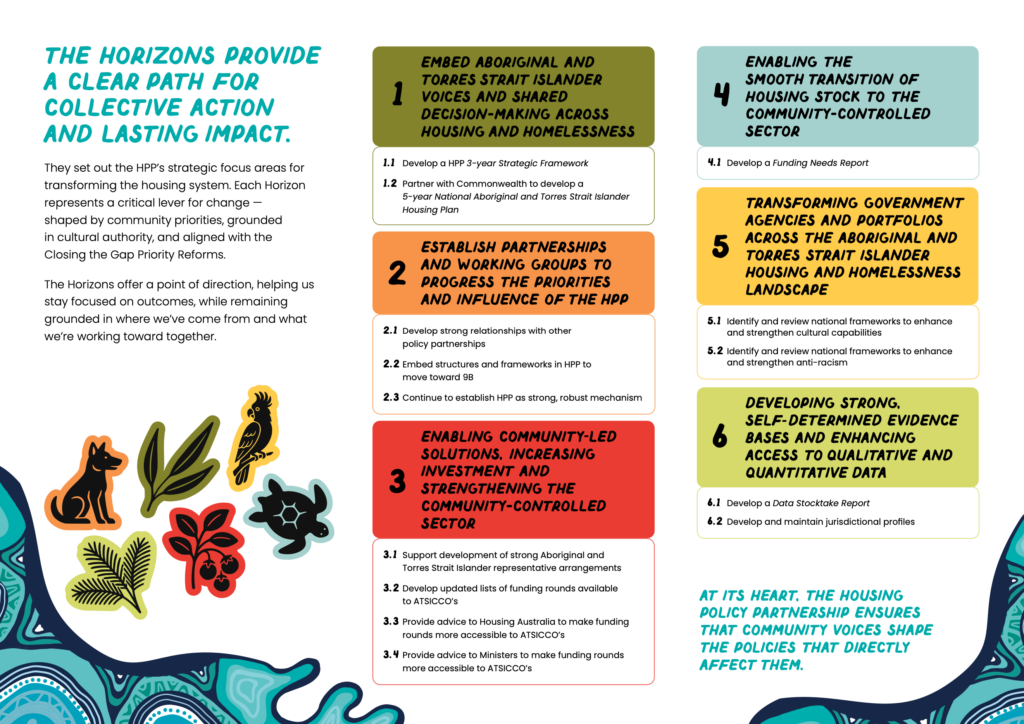
The Workplan is structured around six Horizons — strategic focus areas that provide the levers for lasting reform:
- Embedding Aboriginal and Torres Strait Islander voices and shared decision-making across housing and homelessness policy.
- Establish partnerships and working groups to progress priorities and influence of the HPP.
- Enabling community-led solutions Increasing investment and strengthening the Community-Controlled Sector.
- Enabling the smooth transition of housing stock to the community-controlled sector.
- Transforming government agencies and portfolios across the Aboriginal and Torres Strait Islander housing and homelessness landscape.
- Developing strong, self-determined evidence bases and enhancing access to qualitive and quantitative data.
These Horizons set out a pathway for governments and communities to act in genuine partnership, strengthening the housing system and delivering change that endures.
Read the full Housing Policy Partnership Workplan Here
About us:
The National Aboriginal and Torres Strait Islander Housing Association (NATSIHA) is the national peak body for Aboriginal and Torres Strait Islander housing. It represents, supports, and advocates for Aboriginal and Torres Strait Islander Community Controlled Housing Organisations across Australia. NATSIHA works to strengthen the sector by providing a unified voice on housing issues, influencing policy reform, and building strong partnerships with government, industry, and community.
Guided by the principles of self-determination and Closing the Gap, NATSIHA ensures housing solutions are culturally grounded, community-led, and designed to improve long-term outcomes for Aboriginal and Torres Strait Islander peoples. Through initiatives in policy, data, governance, and workforce development, NATSIHA is committed to creating a sustainable housing system that supports safe, secure, and connected housing for current and future generations.
Contact details: