
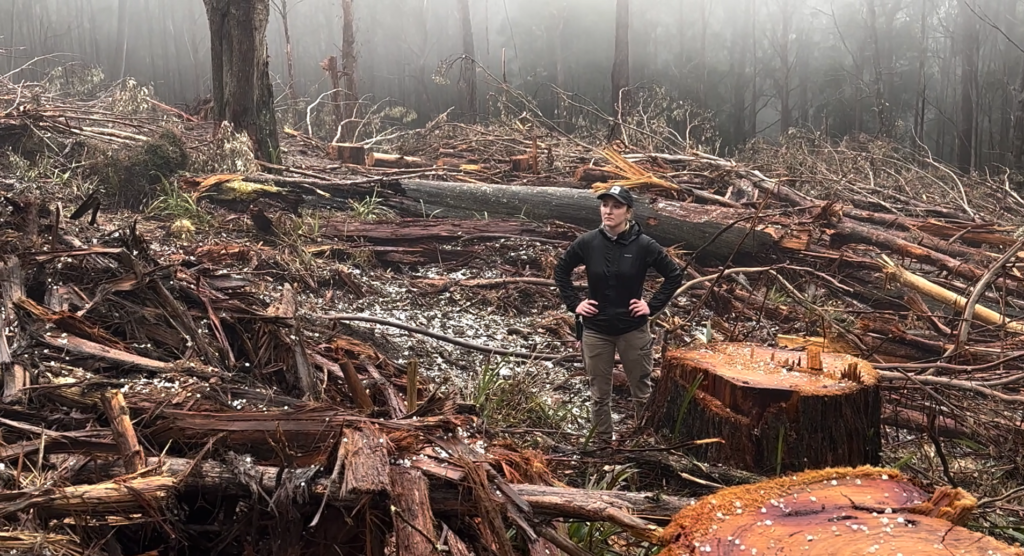

Stills here: https://dams.wwf.org.au/resourcespace/?c=6285&k=0d65a7775f
Conservation groups say today’s charges against Forestry Corp over its conduct in Tallaganda State Forest are the final straw and they urged the New South Wales Government to end native forest logging.
Pictures of the logging devastation in Tallaganda– one of the few remaining strongholds for endangered greater gliders – caused community outrage.
After a two-year investigation, the EPA today filed 29 charges against Forestry Corp in the Land and Environment Court for alleged breaches of forest and biodiversity laws in Tallaganda State Forest.
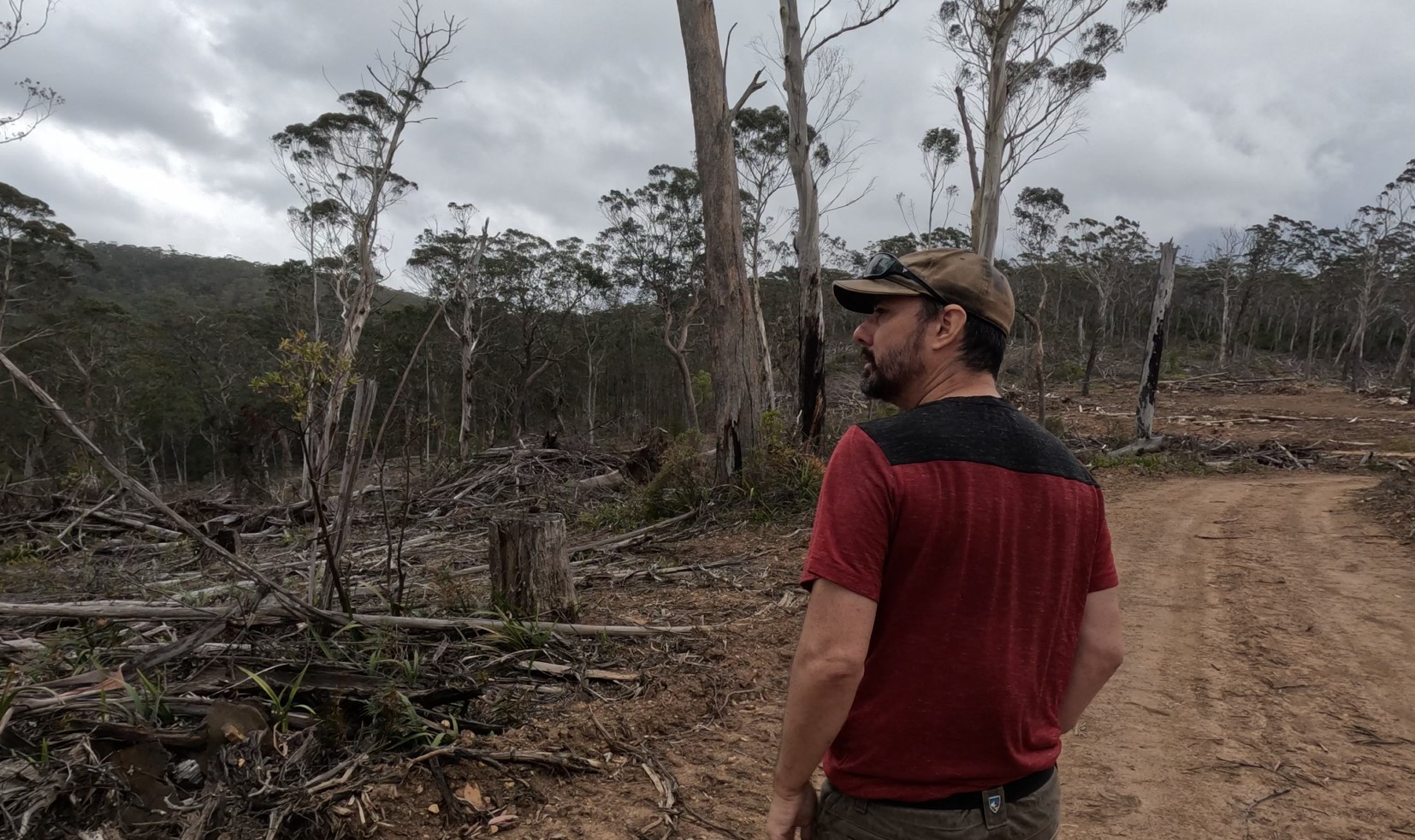
Andrew Wong from Wilderness Australia amid logging destruction in Tallaganda State Forest
The World Wide Fund for Nature Australia, Wilderness Australia, and South East Forest Rescue teamed up to expose the destruction in Tallaganda. Today they called for the NSW Government to commit to a transition out of native forest logging in this term.
Dr Kita Ashman, WWF-Australia conservation scientist said:
Healthy forests cool our towns, clean the air, and protect drinking water for millions. They are life support for threatened species. Forests are far more valuable standing — for wildlife, carbon storage, and future generations. Native forest logging must stop.
Andrew Wong, Operations Manager, for Wilderness Australia said:
Forestry Corp operates as a rogue agency with scant regard for the rules, while killing native species and costing taxpayers millions. This is just the tip of the iceberg. For every case of wrongdoing that comes to light, there are countless others that are never discovered. This agency is built on a business model of pushing boundaries to survive, and yet it still racks up millions in losses. Shutting down native forest logging and transitioning to plantations will be hugely beneficial.
Scott Daines, spokesperson for South East Forest Rescue, said:
It’s pleasing to see the EPA finally act on Tallaganda. People get investigated and convicted of murder faster than the EPA takes Forestry Corp to court. Australia is the only wealthy nation still cutting forests down at scale. Eastern Australia remains a global deforestation front and much of that is driven by logging in NSW. Western Australia and Victoria shut down their native forest logging. A 2024 poll found 7 in 10 NSW residents support an end to native forest logging. How much longer can the NSW government persist with destroying our irreplaceable forests.
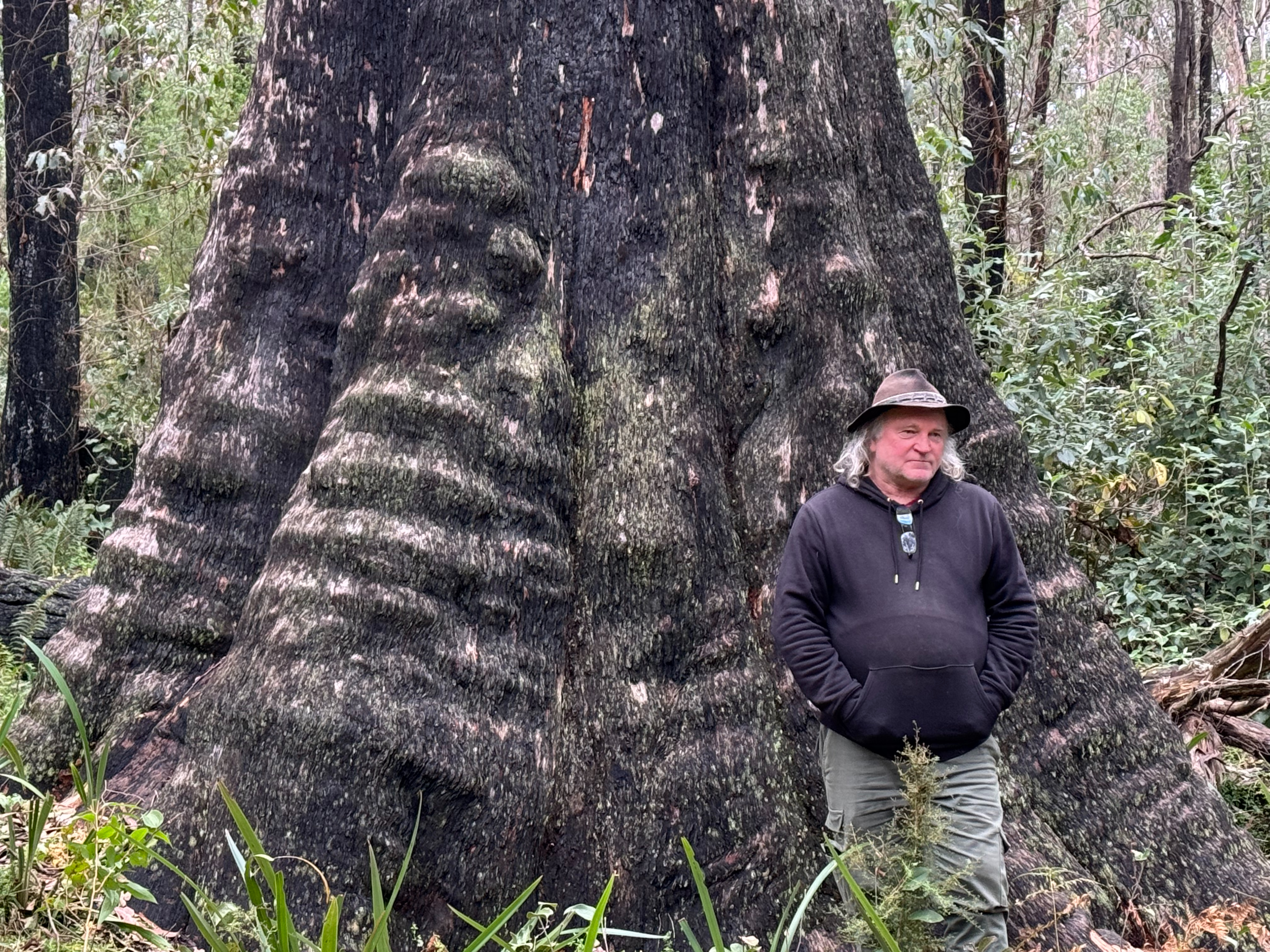
Scott Daines from South East Forest Rescue beside a large tree in Tallaganda State Forest saved from logging
Tallaganda Background
On 30 August 2023, the NSW Environment Protection Authority issued a stop work order and launched an investigation after finding a dead greater glider, about 50 metres from logging operations in Tallaganda State Forest.
Forestry Corp is required to search for greater glider den trees and protect each one from logging with a 50 metre exclusion zone but had only found one den tree. The EPA investigation found 20, and conservation groups found many others.
It was later revealed Forestry Corp had been looking for greater gliders, a nocturnal species, during the day when there was virtually no chance of seeing one.
Forestry Corp’s astonishing rap sheet and history of losses.
Since the 2019-2020 bushfires, more than 50 investigations have been launched into Forestry Corp and it
has racked up fines, court costs, and enforceable undertakings worth more than $2.7 million with some matters still outstanding.
In a case last year, a judge agreed with the EPA’s submissions that Forestry Corp “has a pattern of environmental offending, has not provided any compelling evidence of measures taken by it to prevent its reoffending, and does not accept the true extent of harm that it has caused”.
On top of that, Forestry Corp’s hardwood division, the part which logs native forests, has lost nearly $90 million in the last 4.5 years.
Contact details:
Mark Symons
Senior Media Officer, WWF-Australia
m 0400 985 571