

The long-running debate over the ideal city size has an answer, with a new study pinpointing the ‘magic number’ of residents where sustainability and liveability peak.
A major study of 655 Australian cities by the Monash Institute of Transport Studies found that sustainability peaks when a city’s population sits within four per cent of its ideal capacity – the level at which housing, jobs, transport and services operate in balance.
The results show that cities operating within the four per cent rule saved renters an average of $1,560 a year, or $5.3 billion nationally, while 44,000 more people could walk to work daily, and 275,000 households could cut back on cars.
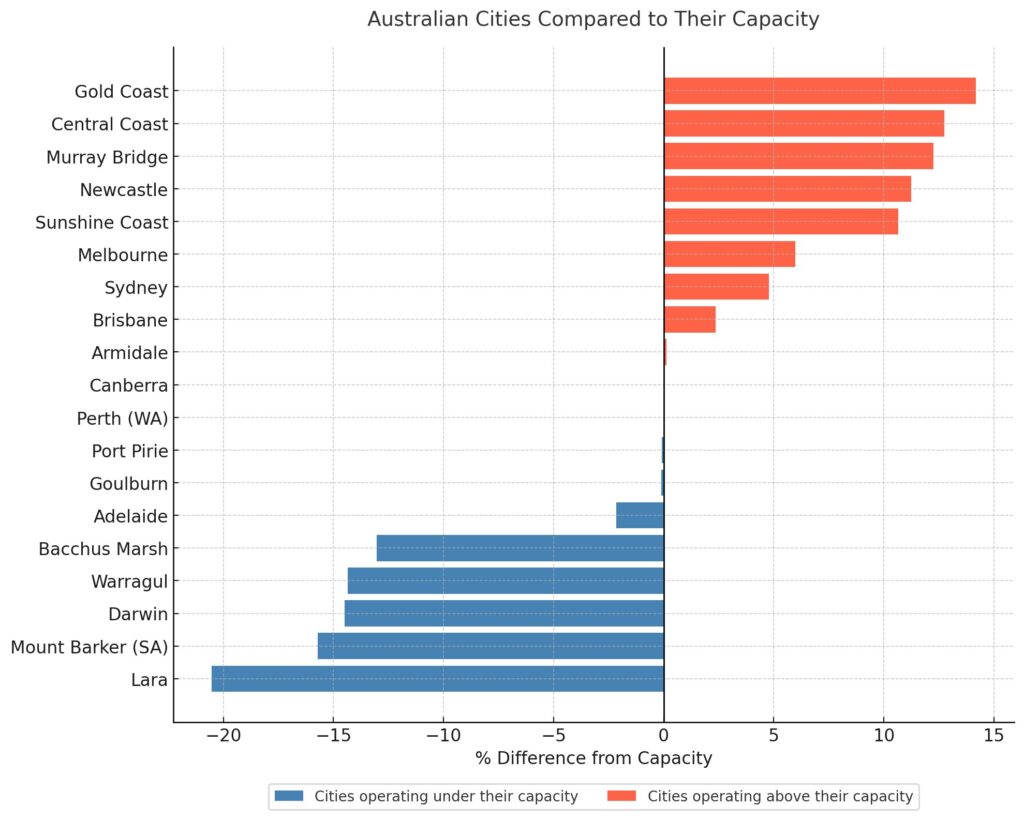
It also revealed which cities were overstretched, which had untapped potential, and highlighted why planning shouldn’t rely on blunt growth targets.
According to the study, Perth and small regional centres like Port Pirie are operating near their ideal population size, while Melbourne and the Gold Coast are over capacity, risking higher costs and infrastructure strain.
Smaller towns enjoyed lower rents and more walking to work, but relied more on cars. Mid-sized cities often had good train access yet remained relatively isolated.
The study points to solutions like better transport links, more balanced job locations, and fairer land-use rules to help cities get to their ‘just right’ size.
To determine a city’s ideal size, the researchers used four well-known measures about city growth and function: capital city status, access to jobs, the mix of services on offer, and how well it’s connected.
Lead author, Associate Professor Liton Kamruzzaman from Monash University’s Institute of Transport Studies, said the study combined the measures into a single model to guide city planning and urban growth.
“When a city grows too big, the signs are clear; longer commutes, traffic jams, soaring rents, and overcrowded services,” Associate Professor Kamruzzaman said.
“But when it’s too small, valuable infrastructure and opportunities go to waste.”
“Using this research as a benchmark new cities could be designed with a population range that avoids the pitfalls of over- or under-capacity, while existing ones can be recalibrated through policy levers like transport links or decentralised jobs.”
Associate Professor Kamruzzman cautioned against comparing the sizes of different cities.
“This study shows it’s not about being large or small,” Associate Professor Kamruzzaman said.
“It’s about whether a city’s population matches what its systems can handle.
“That’s the key to sustainability.”
Read the research paper: https://doi.org/10.1038/s42949-025-00254-4
MEDIA ENQUIRIES
Courtney Karayannis, Media and Communications Manager
Monash University
P: +61 408 508 454
[email protected]
GENERAL MEDIA ENQUIRIES
Monash Media
P: +61 3 9903 4840
[email protected]
For more experts, news, opinion and analysis, visit Monash News