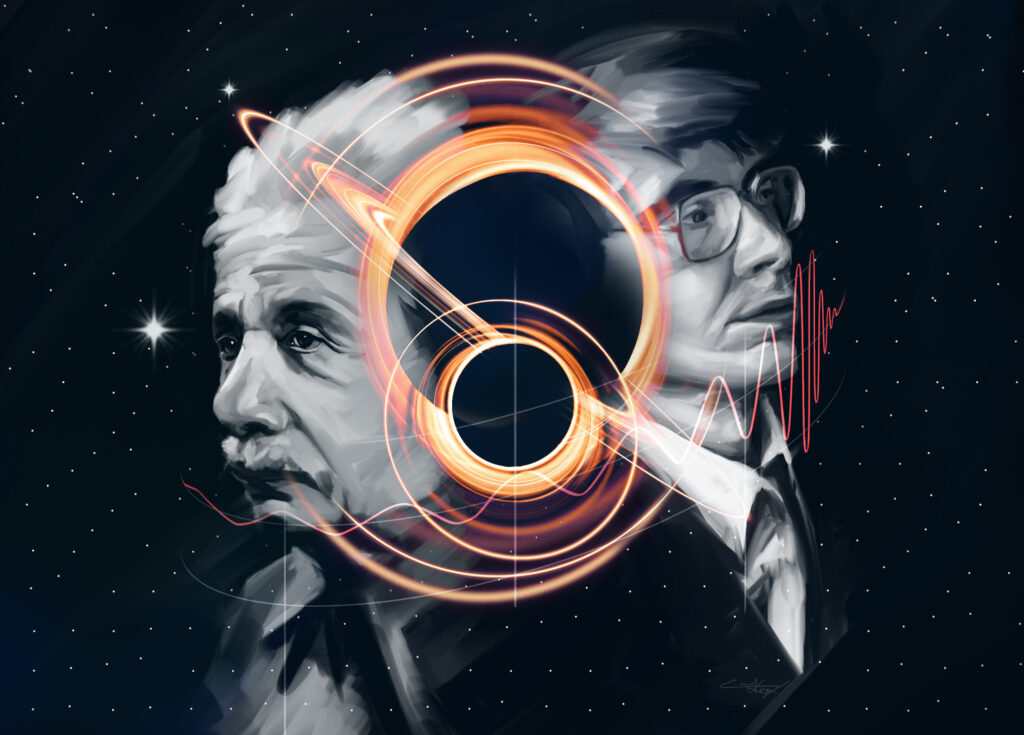

A global team of astrophysicists, including Australians, has witnessed a collision between two black holes that was so loud, they were able to use it to test and prove Stephen Hawking’s Theory of Black Hole Thermodynamics.
The event, observed by the LIGO, Virgo, and KAGRA collaborations, involved two black holes merging to form a single, larger one, strikingly reminiscent of the historic first detection in 2015.
But this time, thanks to a decade of instrumental upgrades and data analysis advances, the signal was captured with three times more clarity, enabling scientists to test two fundamental predictions of black hole physics.
The first is that black holes obey the laws of thermodynamics, meaning their surface areas always increase and never decrease.
The second is that disturbed black holes behave exactly as predicted by Einstein’s theory of general relativity.
It also tests a profound idea from Stephen Hawking and Jacob Bekenstein that a black hole’s surface area encodes entropy, a measure of disorder that can only grow.
Using this new observation, scientists measured the surface areas of the two original black holes and compared them to that of the final remnant.
The result was unambiguous: the total area increased, confirming that entropy had indeed risen.
Lead researcher Teagan Clarke, PhD candidate from Monash University’s School of Physics and Astronomy and the ARC Centre of Excellence for Gravitational Wave Discovery (OzGrav), said it was a groundbreaking finding for the field.
“We’ve just witnessed the laws of thermodynamics play out on the grandest scales imaginable,” Clarke said.
“The final black hole area is bigger than the sum of the originals, just as Hawking predicted.
“This result represents a new step towards understanding the quantum properties of black holes.”
Lead researcher Neil Lu, from the Australian National University and OzGrav, said the result marks the culmination of decades of international effort perfecting ultra-sensitive instruments, pioneering new analysis techniques, and training a generation of scientists to listen for the faintest ripples in spacetime.
“Excited black holes are known to ‘ring’ like cosmic bells at precise frequencies,” he said.
“This is the strongest and cleanest black hole ‘note’ we’ve ever heard.
“For the first time, we can clearly identify more than one of the predicted tones from the final black hole, and they match exactly what Einstein’s theory says they should.”
The latest discovery is both a celebration of human ingenuity and a glimpse of the transformative science that lies ahead.
The research has been published in Physical Review Letters: doi.org/10.1103/kw5g-d732
MEDIA ENQUIRIES
Toni Brient
Media and Communications Manager
P: +61 456 428 906
E: [email protected]
GENERAL MEDIA ENQUIRIES
Monash Media
P: +61 3 9903 4840
E: [email protected]
For more Monash media stories, visit our news and events site