BioEYES program using Zebrafish to teach genetics expands to regional Victoria
A pioneering school science program using zebrafish to spark curiosity and critical thinking is expanding to regional and remote schools across Victoria, thanks to generous support from Melbourne Rotary Club and the Finkel Foundation.
BioEYES, delivered by the Australian Regenerative Medicine Institute (ARMI) and Monash Biomedicine Discovery Institute (BDI), is a week-long, in-school program that brings authentic science experiences directly into the classroom. Designed to inspire and demystify science, BioEYES allows students to carry out real biological investigations while building confidence in their ability to think and act like scientists.
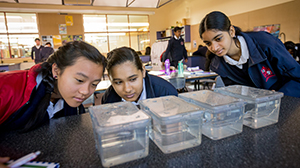
The program will begin its regional expansion at Bairnsdale Secondary College in September, with local students set to observe zebrafish embryos developing under microscopes and participate in collaborative experiments that mirror real-world scientific discovery.
“Our aim is to destigmatise science,” says Program Manager Laura Reid. “We want students to move away from the thinking that science isn’t for them because it is only for ‘smart’ people. BioEYES is about making science exciting and accessible. It’s designed to help students build confidence through curiosity.”
Over five days, students use zebrafish to explore the fundamentals of developmental biology, observing how a single cell becomes a complex, living organism. After setting up zebrafish matings, students examine embryos under microscopes, tracking their growth as eyes, hearts, spinal cords and tails begin to form. By the end of the week, they witness embryos hatching and blood circulating, and draw conclusions based on their original predictions. Throughout the incursion, students work like scientists, keeping logbooks, testing hypotheses and analysing results together in real time.
The entire program is delivered on-site at schools, which makes it accessible to a broad range of students and enables teachers to participate fully in the experience. BioEYES also includes teacher training to help build ongoing capacity for science engagement beyond the program itself.
Although zebrafish may seem like unlikely classroom heroes, they are genetically powerful. Around 70 per cent of human genes, including approximately 84 per cent of disease-related genes, are also found in zebrafish. Their transparent embryos give students a rare window into how living organisms grow and develop, offering an accessible introduction to real-world science.
At ARMI, zebrafish are used to explore how the human body regenerates damaged tissue, a frontier in treating diseases such as muscular dystrophy, anaemia and age-related frailty. Director of ARMI, Professor Peter Currie, explains, “Zebrafish are helping us answer some of the biggest questions in biology. But just as importantly, they’re helping us connect with the next generation of scientists.”
Placeholder for teacher quote [Teachers report the program leaves a lasting impact. “It was incredible to watch students who usually sit back in science come alive with questions and observations,” said one Victorian secondary teacher. “BioEYES gave them confidence, not just in science, but in themselves.”]
Since launching in Australia in 2010 through a collaboration between ARMI, BDI and the University of Pennsylvania, BioEYES has reached more than 23,000 Victorian students. Evaluations show that 83 per cent of participants say they can imagine themselves as scientists after the program, a transformative outcome for many students who may not have previously seen science as a space where they belong.
By making science hands-on, inclusive and curiosity-driven, BioEYES supports the development of essential critical thinking skills. These are the same skills young people will need to navigate an increasingly complex world, ask better
About us:
About BioEYES
BioEYES was introduced to Australia in 2010 through a collaboration between ARMI and the Monash Biomedicine Discovery Institute (BDI), in partnership with the University of Pennsylvania. Since its inception, the program has reached over 23,000 students in and around Melbourne, with 83% of participants stating they can imagine themselves as scientists after completing the program.
About ARMI
The Australian Regenerative Medicine Institute (ARMI), based at Monash University in Melbourne, is a world leader in regenerative biology and stem cell research. ARMI works at the frontier of science, translating discovery into hope for people living with conditions like cancer, arthritis, and neurological injury.
About the Monash Biomedicine Discovery Institute
Monash University’s Biomedicine Discovery Institute (BDI) is a world-renowned research powerhouse committed to transforming human health through groundbreaking biomedical research. Home to more than 700 researchers, 120 research groups, and 200 international collaborators, Monash BDI is one of the largest and most prestigious biomedical research in Australia. Our researchers are supported by world-class technology and infrastructure, and partner with industry, clinicians and researchers internationally to enhance lives through discovery. BDI focuses on discovery-led science to improve human health and is committed to inspiring the next generation through education and outreach programs like BioEYES.