
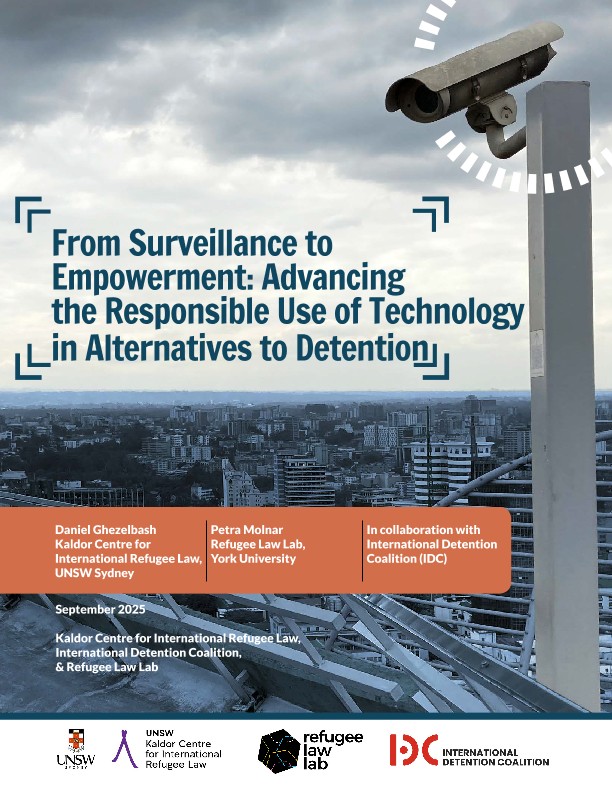
Legal experts are calling for urgent safeguards to prevent surveillance technologies from undermining the human rights of migrants, refugees and people seeking asylum. Governments worldwide are rapidly turning to digital technologies to monitor people on the move – framing tools like GPS ankle monitors and smartphone tracking apps as ‘alternatives to detention’.
But a major new report from UNSW Sydney’s Kaldor Centre for International Refugee Law, the International Detention Coalition (IDC) and the Refugee Law Lab at York University (Toronto) warns that these technologies often replicate detention in another form.
Based on global consultations, the report finds that surveillance-driven tools marketed as humane and cost-effective alternatives are often a privatised and profit-driven extended form of detention – restricting liberty, eroding dignity and causing serious health and psychological harms, especially when imposed by default and without safeguards.
Director of the Kaldor Centre Professor Daniel Ghezelbash co-authored the report with Petra Molnar of the Refugee Law Lab, in collaboration with Carolina Gottardo and Antonella Napolitano (IDC).
“Electronic ankle monitors and tracking apps are not alternatives to detention,” Prof. Ghezelbash said. “This kind of technology replicates the same coercion and control, just in digital form, rather than using technology to support and empower individuals, such as with digital case management platforms. True alternatives are about freedom, dignity and community support – not surveillance.”
The report identifies troubling global trends:
- Expansion of detention ‘by digital means’, rather than reduction
- Outsourcing of coercive technologies to profit-driven companies with little accountability
- Excessive data collection and discriminatory algorithms, lacking transparency and oversight.
At the same time, the report outlines a positive path forward. When grounded in human rights law and co-designed with affected communities, technology can support freedom and integration in the community. Used well, technology can help people report more easily to migration officials, navigate complex systems and connect with essential services.
To guide governments, civil society and technologists, the report sets out 10 guiding principles to ensure technology reduces, rather than expands, detention.
“The choice is stark. Digital tools can either entrench surveillance and control, or they can promote dignity and freedom,” Prof. Ghezelbash said. “Our principles provide a roadmap for governments to choose the latter.”
About the report
From Surveillance to Empowerment: Advancing the Responsible Use of Technology in Alternatives to Detention, was developed through extensive consultations and provides evidence-based recommendations for governments, international organisations, civil society and technologists.
Contact details:
Interviews available on request. Please contact:
Ashleigh Steele
Communication Officer, UNSW Sydney
0421 208 805