
Skip to content
Environment

Expert Alert: Population Growth Key Driver of Species Decline

Sustainable Population Australia 2 mins read

Media Release:  Saturday 06 September

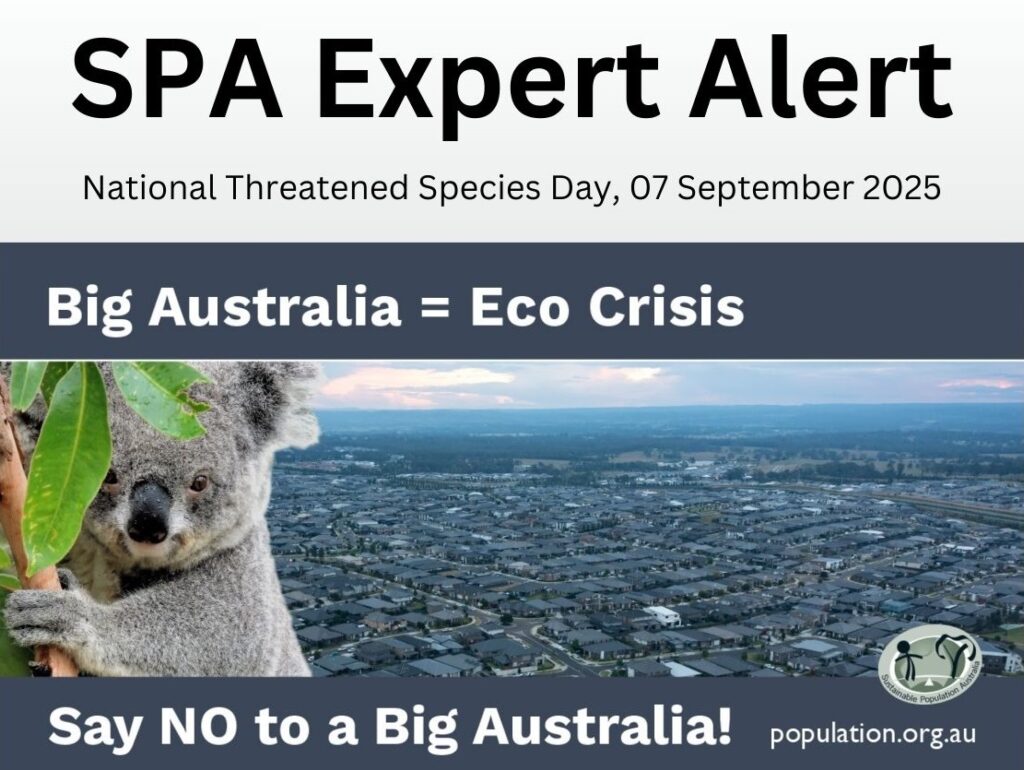
On this National Threatened Species Day, Sustainable Population Australia (SPA) draws focus to the devastating and ongoing decline of Australia’s biodiversity.

The Australia State of the Environment Report 2021 notes that human population growth contributes to pressures on the environment and has ‘very high impact’ on biodiversity.


Available to comment: 

Mr Peter Strachan, National President, Sustainable Population Australia
Contact:  0412 400 952 (from 06:30am AWST);  [email protected]

Comments attributable to Mr Strachan:

“Ongoing loss of plant and animal habitat, driven by the impact of a rising tide of human population in Australia and globally pushes all life on Earth into a sixth great extinction event.”

“Australia’s Wilderness Society lists ten mammal species, including the Koala, that are critically endangered. It is now possible to envisage an Australia that has zero koalas living in the wild within 30 years, because of the loss of their habitat to human population expansion.”


Mr Michael Bayliss, Spokesperson and Communications Manager, Sustainable Population Australia
Contact:  0423 701 611 (from 7:00am AWST);  [email protected]

 

Comments attributable to Michael Bayliss:

"An anthropocentric, growth driven human economy fails to make room for all life forms on our fragile planet. It's time to wind back destructive human population expansion and protect the environment which supports all life on Earth.”

“Western Australia’s Carnaby’s Black Cockatoo is critically endangered due to habitat destruction across Perth’s suburban sprawl.  Perth’s metropolitan areas now extends 150km north to south.  Despite this, the state government has encouraged more population growth, despite recognising that future housing will require even more habitat destroying urban sprawl.”

“SPA’s Position Statement has attracted 20,000 signatures, calling for a return to a net annual migration rate of less than 70,000.  This would support a stabilisation of Australia’s population below 30 million, or 2.3 million more than the current number.”


Media

More from this category

  • Environment, Transport Automotive
  • 12/12/2025
  • 14:27
NALSPA

Electric Car Discount review must drive clean energy transition and cost-of-living relief

The National Automotive Leasing and Salary Packaging Association (NALSPA) has today welcomed the federal government’s announcement of the statutory review of the Electric Car Discount, noting that the policy continues to be highly effective in encouraging Australians to make the switch to cleaner cars.The federal government announced today that next year it will review the Electric Car Discount, otherwise known as the EV FBT exemption which came into effect in July 2022.The review will consider the operation of the Electric Car Discount over the first three years it has been in place, as required by the legislation.“We will actively participate…

  • Banking, Environment
  • 12/12/2025
  • 10:38
Australian Conservation Foundation

NAB shareholders owning $9.74bn in shares call on the bank to do better on deforestation

Investors owning $9.74 billion of shares in Australia’s largest agribusiness bank have backed a resolution calling on NAB to disclose deforestation linked to its lending.* The resolution on disclosure of financed deforestation, facilitated by the Australian Conservation Foundation and co-filed by SIX, Australian Ethical, Melior Investment Management, was supported by 13.98% of shares voted at NAB’s AGM today. A second resolution, calling on the bank to set out a strategy to eliminate financed deforestation, was supported by 10.39% of NAB shares voted. Jolene George, head of corporate advocacy at the Australian Conservation Foundation, said: “The support for the resolution on…

  • Environment
  • 12/12/2025
  • 10:34
UNSW Sydney

Droughts lasting longer across Australia, study shows

A studytracking not only the forces that drive drought but the damage it leaves behind has revealed that droughts have lasted longer in Australia in recent decades, especially in areas with the most people and farms. UNSW researchers analysed drought trends across Australia between 1911 and 2020 based on rainfall shortages and falling river and dam levels. Their analysis showed that, since 1971, the time spent under drought conditions has increased across most of Australia, especially in the southeast and southwest, which are densely populated and key breadbaskets. The increasing dryness was especially felt during winter and spring, which are…

Media Outreach made fast, easy, simple.

Feature your press release on Medianet's News Hub every time you distribute with Medianet. Pay per release or save with a subscription.