
-
Monash engineers are commercialising breakthrough supercapacitors that rival batteries in energy storage while vastly outperforming them in power delivery.
-
This paves the way for faster-charging EVs, more efficient renewable energy storage, and high-performance electronics.
-
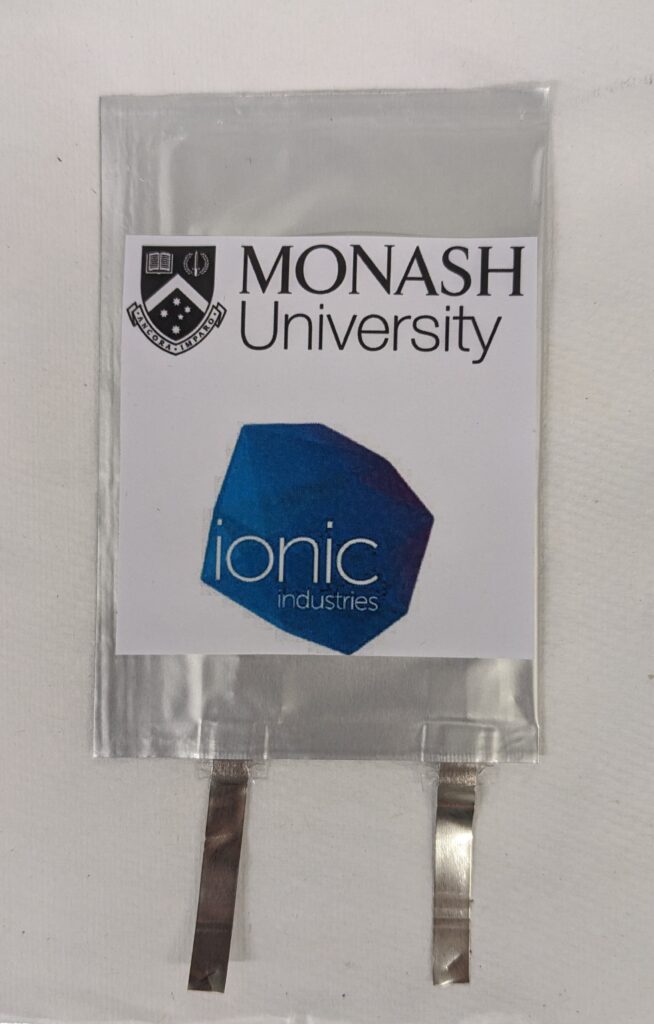
Ionic Industries, a Monash spinout, is working to bring the technology to market.
Monash University researchers have made a major leap forward in the global race to build energy storage devices that are both fast and powerful – paving the way for next-generation applications in electrified transport, grid stabilisation and consumer electronics.
In a study published today in Nature Communications, the team reveals a new kind of carbon-based material that allows supercapacitors to store as much energy as traditional lead-acid batteries, while delivering power far faster than conventional batteries can manage.
Supercapacitors are an emerging class of energy storage devices that store charge electrostatically, rather than through chemical reactions like batteries. Until now, a major barrier has been that only a small fraction of the carbon material’s surface area – essential for storing energy – was accessible for use.
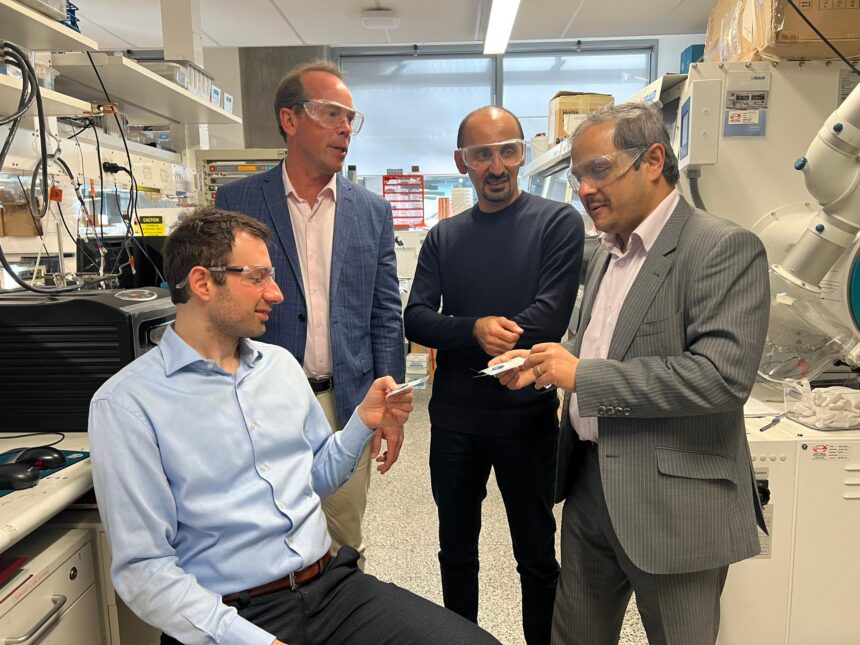
Professor Mainak Majumder, Director of the ARC Research Hub for Advanced Manufacturing with 2D Materials (AM2D), based in Monash’s Department of Mechanical and Aerospace Engineering, was a member of the research team.
“Our team has shown how to unlock much more of that surface area by simply changing the way the material is heat-treated,” said Professor Majumder.
“This discovery could allow us to build fast-charging supercapacitors that store enough energy to replace batteries in many applications, and deliver it far more quickly.”
The secret lies in a new material architecture developed by the team, called multiscale reduced graphene oxide (M-rGO), which is synthesised from natural graphite – an abundant Australian resource.
Using a rapid thermal annealing process, the researchers created a highly curved graphene structure with precise pathways for ions to move quickly and efficiently. The result is a material that offers both high energy density and high power density – a combination rarely achieved in a single device.
Dr Petar Jovanović, a research fellow in the ARC AM2D Hub and co-author of the study, said when assembled into pouch cell devices, the Monash supercapacitors delivered:
-
Volumetric energy densities of up to 99.5 Wh/L (in ionic liquid electrolytes)
-
Power densities as high as 69.2 kW/L
-
Rapid charging capabilities with excellent cycle stability.
“These performance metrics are among the best ever reported for carbon-based supercapacitors, and crucially, the process is scalable and compatible with Australian raw materials,” Dr Jovanović said.
Dr Phillip Aitchison, CTO of Monash University spinout Ionic Industries, and a co-author of the study, said the technology is now being commercialised.
“Ionic Industries was established to commercialise innovations such as these and we are now making commercial quantities of these graphene materials,” said Dr Aitchison.
“We’re working with energy storage partners to bring this breakthrough to market-led applications – where both high energy and fast power delivery are essential.”
The research was supported by the Australian Research Council and the US Air Force Office of Sponsored Research and is part of Monash’s broader commitment to developing advanced materials for a low-carbon energy future.
Read the research paper: doi.org/10.1038/s41467-025-63485-0.
MEDIA ENQUIRIES
Courtney Karayannis, Media and Communications Manager
Monash University
P: +61 408 508 454 or [email protected]
GENERAL MEDIA ENQUIRIES
Monash Media
P: +61 3 9903 4840 or [email protected]
For more experts, news, opinion and analysis, visit Monash News.