
Key points
- Monash scientists have discovered sandy coastlines are a previously overlooked contributor of greenhouse gas methane
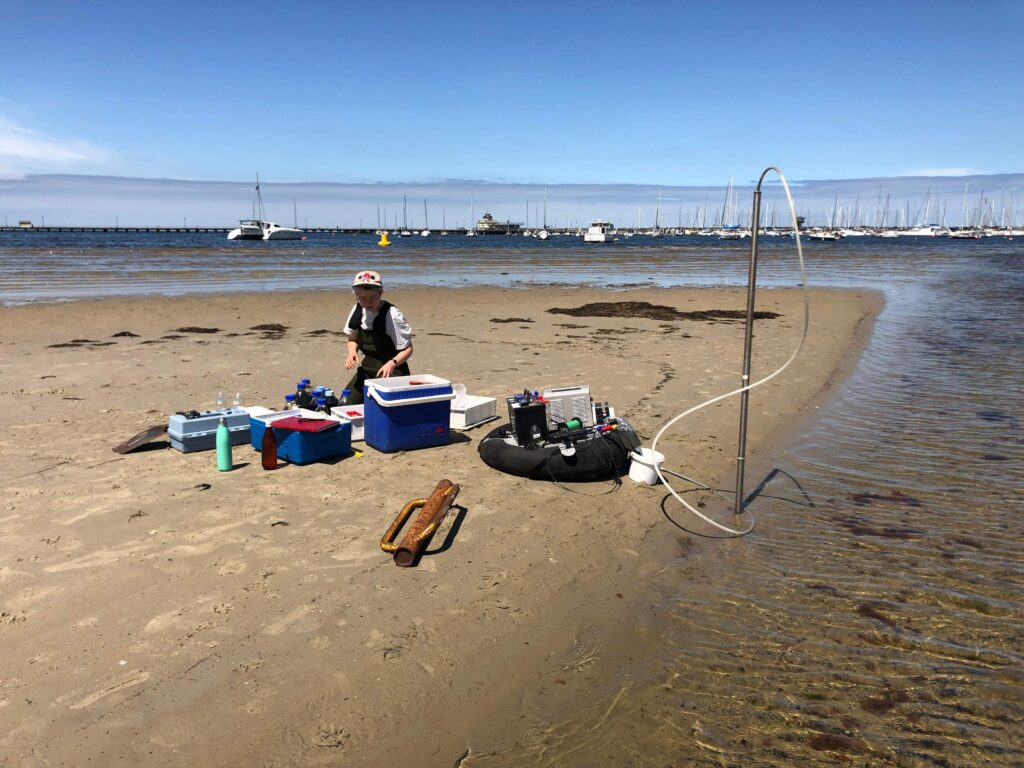
- Two new methane-producing microbes discovered at field sites across Port Phillip Bay and Westernport Bay in Victoria, and in Denmark
- The discovery challenges assumptions about how much carbon coastal vegetation can store
A team of researchers from Monash University has made a paradigm-shifting discovery that could reshape our understanding of greenhouse gas emissions from coastal ecosystems.
Published in Nature Geoscience, the study reveals sandy coastlines, which make up half the world’s continental margins, are a previously overlooked source of methane.
Principal investigator Professor Perran Cook, from the Monash Faculty of Science Climate Hub, said the research challenges the accepted role of coastal vegetation as carbon storage.
“This new finding not only challenges a fundamental assumption in marine science, but calls into question what we thought we knew about the role of sandy coastline ecosystems in greenhouse gas production,” Professor Cook said.
“Our work contributes to the growing body of evidence that shows methane emissions from decaying biomass like seaweed may offset much of the carbon dioxide removal attributed to coastal ecosystems.
“Understanding how much naturally-occurring methane emissions are coming from coastal areas is also important for the climate models we rely on to understand the impacts of climate change and determine climate action.”
The research identified two new strains of methanogens, or methane-producing microbes, at field sites across Port Phillip Bay and Westernport Bay in Victoria, and in Denmark.
These microbes metabolise compounds released from decaying seaweed and seagrass, producing methane as a byproduct.
It was previously understood these microbes couldn’t survive when exposed to oxygen in coastal ecosystems.
The new research proves they are capable of rapid recovery and methane production following oxygen exposure.
Professor Cook said several outbreaks of algal blooms, such as the recent occurrence that has plagued parts of coastal South Australia this year, may also enhance methane emissions where it is washed up on the beach.
“With rising sea temperatures, species invasions and increasing nutrient pollution, we’re seeing more frequent algal blooms and biomass accumulation on beaches,” Professor Cook said.
“This could lead to larger and more frequent pulses of methane to the atmosphere, which in turn contributes to rising sea temperatures.”
First author and Monash PhD candidate Ning Hall said the team will continue its work to understand the implications of methane production in coastal ecosystems, examining how widespread it is and the chemical compounds produced.
“From here, we need to understand this process in more detail,” Hall said.
“Our research will look at how different species of seaweeds and ocean conditions affect these microbes.
“This will then allow us to reassess and better predict how much methane is being produced in the coastal zone.”
The research is supported by the Australian Research Council and conducted in collaboration with partners from the University of Southern Denmark, the Monash-led research centre Securing Antarctica’s Environmental Future (SAEF), and the Monash Biomedicine Discovery Institute.
Read the research paper: doi.org/10.1038/s41561-025-01768-3
ASSETS AVAILABLE
MEDIA ENQUIRIES
Toni Brient
Media and Communications Manager
P: +61 456 428 906
E: [email protected]
GENERAL MEDIA ENQUIRIES
Monash Media
P: +61 3 9903 4840
E: [email protected]
For more Monash media stories, visit our news and events site