Study utilising cutting-edge genetic technology reveals fewer than 1500 grey nurse sharks remain on Australia’s east coast.
Conservation groups call for action from governments as shark nets in NSW and QLD continue to trap up to 20 grey nurse sharks per year.
SYDNEY (September 30, 2025)—Conservation groups are renewing their call for urgent action from state and federal governments following the release of a scientific study revealing confronting new figures on the precipitously low population of Critically Endangered grey nurse sharks on Australia’s east coast.
The report, published in tandem by the Commonwealth Scientific and Industrial Research Organisation (CSIRO) and the NSW Department of Primary Industries and Regional Development (DPIRD), includes new, more precise data obtained by the Close-Kin Mark-Recapture (CKMR) method—a population measurement tool developed by CSIRO to quantify individuals in a population.
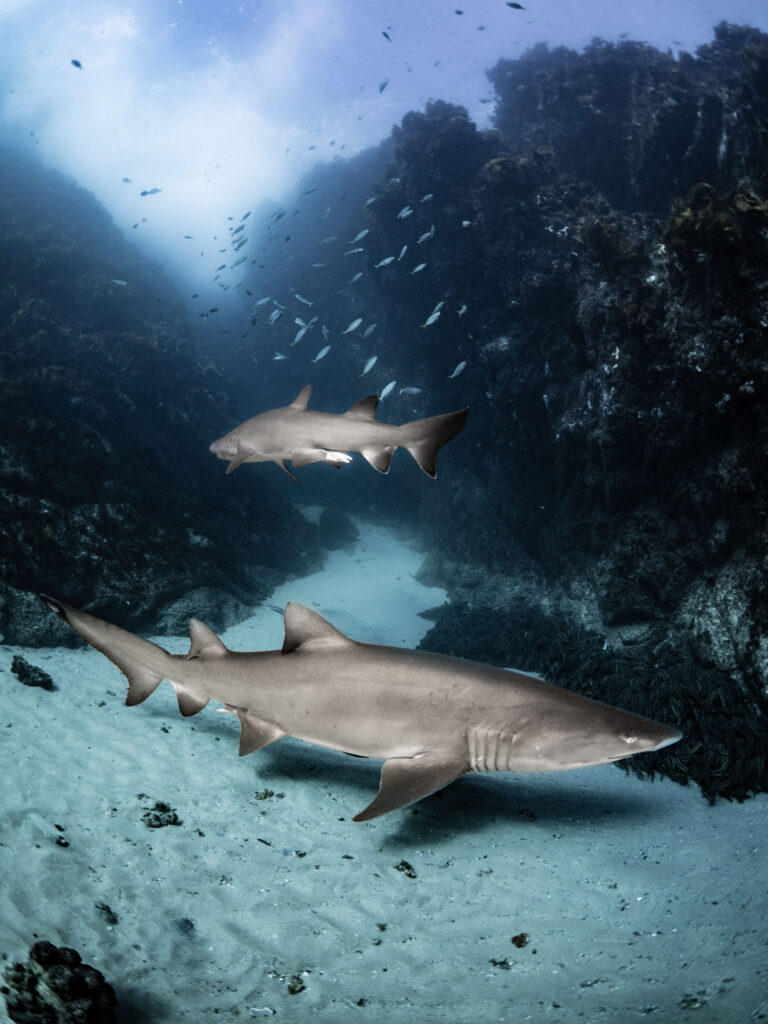
Key to the findings of the report was a revised estimate of the east coast grey nurse shark population, which is now thought to be only 1423 individuals—a terrifying revelation for the Critically Endangered species, which is often referred to as the “labrador of the sea” because of its non-aggressive nature.
Previous studies had put the population at 2000 individuals, but this new, more accurate estimate means the population is even closer to extinction than had been realised.
While the report also outlined a 5% positive increase in the rate of population growth for the east coast grey nurse shark population, this rate is competing with several relentless threats to the species from fishing, climate change and shark nets.
Responding to the report, Humane World for Animals Australia and Australian Marine Conservation Society (AMCS) are renewing calls for urgent action by the NSW, Queensland and Federal governments to remove destructive shark nets from their waters, as they continue to ensnare and kill grey nurse sharks and other marine animals.
“This report couldn’t come with more prescient timing,” said Humane World for Animals Australia marine biologist Lawrence Chlebeck. “In the last few weeks, we’ve seen shark nets along Australia’s east coast garner national media coverage for tormenting helpless whales and killing a dolphin in the waters off Noosa. Grey nurse sharks stand alongside whales, dolphins and turtles as just some of the victims of indiscriminate shark nets. Shark nets catch on average 20 grey nurse sharks per year—nearly half are killed and there’s no guarantee those released alive survive due to their fragility. These numbers are unacceptable from such a small population.”
AMCS biologist Dr Leonardo Guida echoed the call to action, citing the roles that grey nurse sharks play ecologically and economically. “Grey nurse sharks breed incredibly slowly, with up to two pups produced every two years, so every one of them matters—more so when you consider the potential millions of dollars they contribute to diving tourism and regional towns each year across the east coast.”
In September 2025, the NSW Government announced the pausing of a planned trail removal of shark nets from three beaches in Sydney, during the 2025/26 summer months, despite repeated advice from the scientific community, including its own advisors, that shark nets provide no benefit to swimmer safety.
Humane World for Animals Australia and AMCS are calling on the NSW and Queensland governments to take action for grey nurse sharks by defining clear roadmaps toward the full removal of shark nets from the waters of both states and to hold themselves accountable to people and marine animals by investing in shark mitigation technologies with proven efficacy, rather than century-old, dogmatic methodologies. We also call on the federal Environment Minister, Senator Murray Watt, to remove the exemptions in the Environment Protection and Biodiversity Conservation Act, which allow the shark nets to continue despite being a key threat to the Critically Endangered grey nurse shark.
#
Download Photos/Video: https://hsiau.filecamp.com/Shark-Nets
About us:
Together, we tackle the root causes of animal cruelty and suffering to create permanent change. With millions of supporters and work happening in over 50 countries, Humane World for Animals—formerly called Humane Society International—addresses the most deeply entrenched forms of animal cruelty and suffering. As the leading voice in the animal protection space, we work to end the cruelest practices, care for animals in crisis and build a stronger animal protection movement. Driving toward the greatest global impact, we aim to achieve the vision behind our name: a more humane world.
humaneworld.org
Contact details:
Sam Edmonds – Director, Communications, Humane World for Animals Australia
0490 934 290