
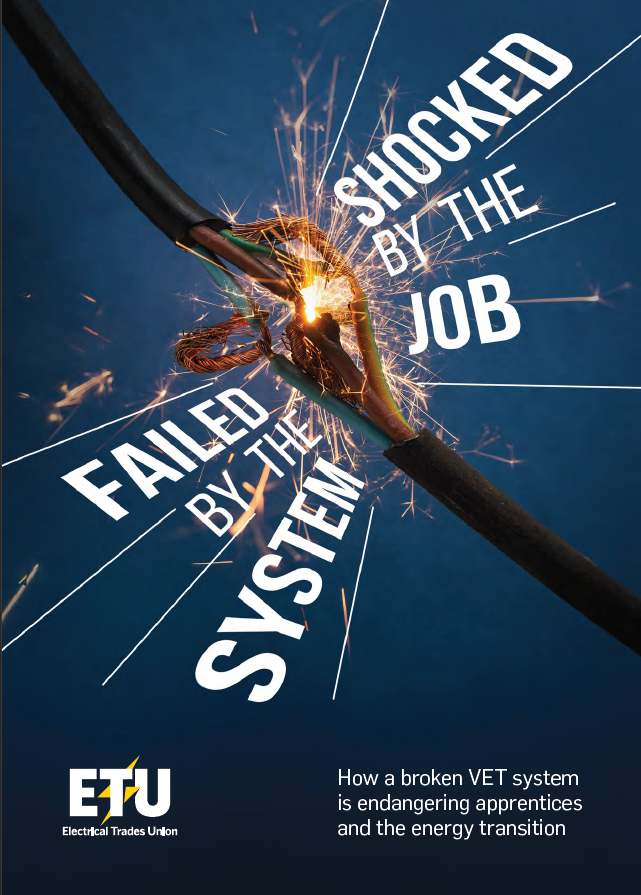
Apprentice electricians taking fight for safety and suppor to parliament
Report recommends more training places in RTOs with best completion rates, review of publicly funded mentors and better repsonse to demand for skills
Follows research showing one in eight apprentices receives a shock at work
MEDIA ALERT
WHO
Electrical Trades Union National Secretary Michael Wright
Apprentice electricians
WHAT
Apprentice electricians take fight for safety, support to Parliament after research revealed one in eight are shocked at work. Chance of shock doubles for the those whose classroom training is delayed. One in five were unable to name their publicly funded mentor from a list.
See release below/attached
Release of report (attached) calling for more training places in RTOs with high completion rates, better monitoring and response to apprenticeship demand and review of publicly-funded apprentice mentoring.
WHERE
Senate Courtyard, Parliament House, Canberra
WHEN
1230PM, Wednesday 29 November (TODAY)
Contact:
Lachlan 0447 682 027 [email protected]
Apprentice sparkies bring fight to Parliament
- Report calls for more training places, demand response and review of mentoring
- One in eight apprentices has been shocked at work and four in ten drop out
- Apprentices to take their case to MPs in Parliament on Wednesday
Wednesday 29 October 2025 – Apprentice electricians will travel to Parliament on Wednesday to make the case for better supervision, mentoring, safety and on-time training to Federal MPs.
The delegation comes as Electrical Trades Union’s Shocked by the Job, Failed by the System report recommends more training places for apprentices in centres with high completion rates, better monitoring of training, and a review of apprentice mentoring programs funded at $200 million per year.
“Jobs and Skills Australia estimated that Australia needs an additional 42,500 electricians by 2030 over and above the status quo, just to deliver on the government’s renewables targets and Future Made in Australia agenda,” the report says.
“On current completion rates, this would mean boosting the number of apprentices in training by 40% or an additional 22,000 more apprentices (over a current total of 55,000) per year. This does not include the additional electricians that will be needed to meet Australia’s new housing targets or data centre build.”
A recent survey of more than 400 apprentices found that one in eight had been shocked at work, with most incidents not captured in government workplace safety figures. For the nearly one in ten apprentices who had their classroom training delayed by more than a year that chance of shock doubled.
It also found that one in five apprentices was unable to name their mentor funded under the Apprentice Connect Australia Program (ACAP), even when presented with a list of ACAP providers.
Electrical Trades Union National Secretary Michael Wright said apprentices were bringing their case to lawmakers because they cared about their trade, and about the future of the country.
“Young people starting out in our trades need an apprenticeship system that teaches them to work safe, on the tools and in the classroom,” Mr Wright said. “They need someone in their corner to stand up for them.”
“Australia desperately needs more apprentice electricians to wire us into the future economy and build our way out of the housing crisis. With one in four apprenticeships ending in withdrawal, we all need the system to work.
“We know that one in eight apprentices receive a potentially deadly electric shock at work. For the nearly ten percent whose classroom training is delayed the chance of shock doubles.
“When we address the capacity of our vocational training system we need to double down on what already works, supporting TAFE and expanding industry-led training with 90 percent completion rates.
“Taxpayers are funding mentors at a cost of more than $200 million a year, yet one in five apprentices cannot name their mentor from a list of providers. They literally cannot pick them out of a lineup.
“If you don’t know who your mentor is, you don’t have a mentor. When apprentices most need support – like when they have had their training withheld, when there is a conflict with their employer, or when they had been exposed to an electric shock – their mentor is nowhere to be seen.
“On the basis of our research none of the current providers deserves to have their contracts renewed, the program should probably be re-designed from scratch and industry placed at its core.”
CONTACT Lachlan Williams 0447 682 027 – [email protected]
Contact details:
Lachlan 0447 682 207