- RMIT University and Bristile Roofing developed sustainable roof tiles using coal ash and recycled glass, reducing CO₂ emissions by 13% compared to traditional concrete tiles
- The tiles replace 10% cement with pond ash and 10% river sand with unwashed glass waste, whilst maintaining quality and improving fire resistance
- Successful full-scale manufacturing trials were conducted at Bristile Roofing's Melbourne facility, demonstrating commercial viability
- The technology has also been adapted to create concrete bricks using 35% waste materials, offering 30% better insulation than conventional bricks
- Australia produces 12 million tonnes of coal ash annually and 1.3 million tonnes of glass waste, making this innovation significant for waste management
A groundbreaking collaboration between RMIT University and Bristile Roofing has led to the development of sustainable roof tiles incorporating coal ash and recycled glass, achieving a 13% reduction in CO₂ emissions compared to traditional concrete tiles.
This Australian innovation addresses the pressing issue of industrial waste management by re-purposing materials that would otherwise contribute to landfill, while offering consumers a durable, fire-resistant roofing option that meets Australian Standards.
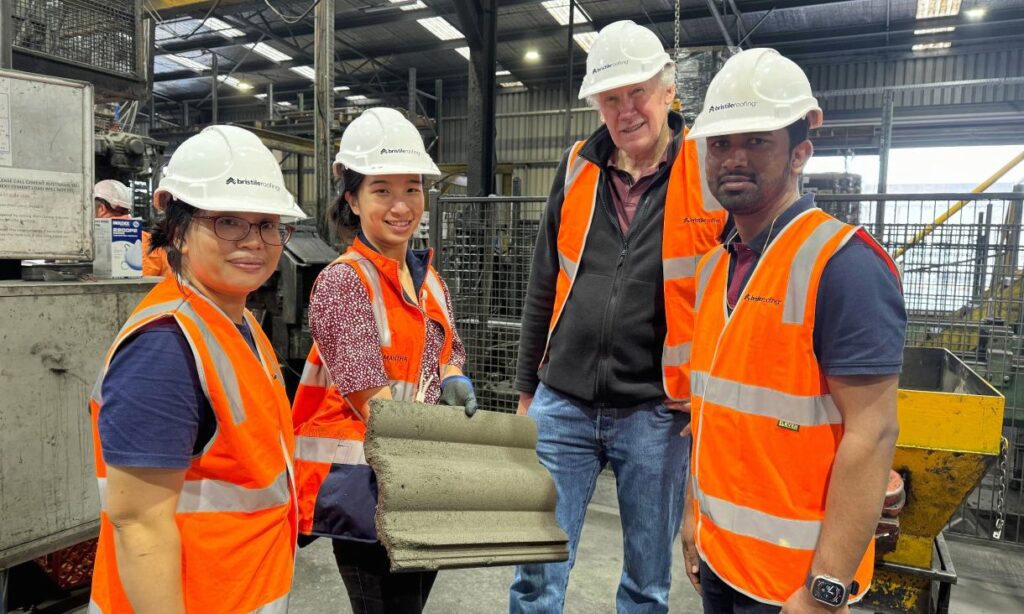
The full-scale manufacturing trials at Bristile Roofing’s Melbourne facility produced hundreds of these eco-friendly tiles, demonstrating both environmental and engineering benefits.
A comprehensive circular life cycle assessment of the new tiles, covering the entire process from raw material production through to end-of-life landfilling, demonstrated a 13% reduction in CO₂ emissions compared to conventional concrete tiles.
RMIT project lead, Dr Chamila Gunasekara, said this substantial environmental benefit largely stems from using harvested pond ash and unwashed recycled glass sand, which avoid energy-intensive processing and effectively replace virgin materials.
“By replacing 10% of cement with harvested pond ash and 10% of river sand with unwashed glass waste – a total of 20% virgin material replacement – we not only reduce waste going to landfill but also produce an improved concrete product with enhanced fire resistance, a valuable feature for roofing in Australia’s climate,” he said.
In Australia alone, approximately 12 million tonnes of coal ash are produced annually from electricity generation, with more than 400 million tonnes of coal ash stored in large settling ponds.
Similarly, over 1.3 million tonnes of glass waste are generated each year, with more than half still ending up in landfills.
RMIT Principal Research Fellow, Dr Yulin Patrisia, said the trial proved we can integrate significant volumes of this industrial waste without compromising quality and safety.
“While harvested waste pond ash is less reactive – primarily due to prolonged storage in settling ponds – it remains an attractive material due to its abundance and contribution to long-term engineering performance,” Patrisia said.
“Despite its lower early reactivity, it helps enhance concrete performance over time. Our tests showed better dimensional stability, reduced shrinkage cracking, and continued strength gain – making it ideal for durable, non-structural applications.”
The product’s engineering performance is described in Sustainable Materials and Technologies, while the environmental assessment has been published in The International Journal of Life Cycle Assessment.
Additional collaborations with local councils and commercial partners are now underway to trial the roof tiles in real-world settings.
“This is more than just a lab success,” said Gunasekara. “We are ready to scale this for industry.”
To achieve this, scaling up will require identifying reliable local waste resources that are consistent in quality, availability, and sufficient volume.
Building out impact from roof tiles to bricks
The concrete mix design also has broader applications beyond just roof tiles.
Another of the team’s prototypes are concrete bricks using 15% harvested pond ash and 20% unwashed glass sand – totalling 35% waste materials – while satisfying Australian standards for load-bearing structural concrete and fire performance for wall elements.
Analysis found using these waste materials also improves insulation, reducing heat loss by 30% compared to conventional cement bricks.
The engineering performance results were published in the October issue of Case Studies in Construction Materials, while the whole life cycle assessment (covering processes from raw material production to end-of-life landfilling) – demonstrating an 18% reduction in CO₂ emissions through material substitution and avoided impacts – was reported in The International Journal of Life Cycle Assessment.
The team is progressing to manufacturing trials for the concrete brick product in collaboration with an industry partner.
The ongoing research is being supported by the ARC Industrial Transformation Research Hub for the Transformation of Reclaimed Waste Resources into Engineered Materials and Solutions for a Circular Economy (TREMS).
Under the leadership of RMIT’s Professor Sujeeva Setunge, TREMS unites leading scientists and industry professionals from nine Australian universities alongside 36 partners from government, industry, and international sectors to minimise waste and transform reclaimed materials into high-value products for construction and advanced manufacturing.
The research is also supported by Sustainability Victoria’s Circular Economy Markets Fund for innovation in sustainable construction and circular resource use.
‘Advanced manufacturing of waste-integrated concrete roof tiles: Scaling up to TRL 6’ is published in Sustainable Materials and Technologies (DOI: 10.1016/j.susmat.2025.e01461)
‘Assessment of waste-integrated concrete products: a cradle-to-cradle perspective’ is published in The International Journal of Life Cycle Assessment (DOI: 10.1007/s11367-025-02443-w)
‘Optimizing engineering potential in sustainable structural concrete brick utilizing pond ash and unwashed recycled glass sand integration’ in published in Case Studies in Construction Materials (DOI: 10.1016/j.cscm.2024.e03816)
Contact details:
Michael Quin
+61499 515 417