
The distinctive coloured fur of two of Australia's rarest marsupials could be caused by 'broken' pigment genes, new research from La Trobe University has found.
The elusive desert-dwelling marsupial mole and the black-coated morph of the endangered eastern quoll are two of a growing number of marsupials showing common colour oddities.
In many species, colour oddities like melanism and xanthism are considered chromatic disorders and are detrimental to an animal’s survival.
But in research published in Biology Letters, scientists discovered that for a growing number of marsupials, colour morphs are common or even universal across all members of their species.
In black morph eastern quolls, a missing stretch of DNA disables the Agouti Signalling Protein (ASIP) gene, which normally leads to the production of light yellow-to-red pigment called pheomelanin.
Remarkably, a nearly identical stretch of DNA was recently found to be missing in the Tasmanian devil, a close sister species to the quolls that also has blackish brown background coat. By comparing sequences around these DNA deletions, the researchers showed that both quolls and devils have lost their ASIP genes independently, a phenomenon called convergent evolution.
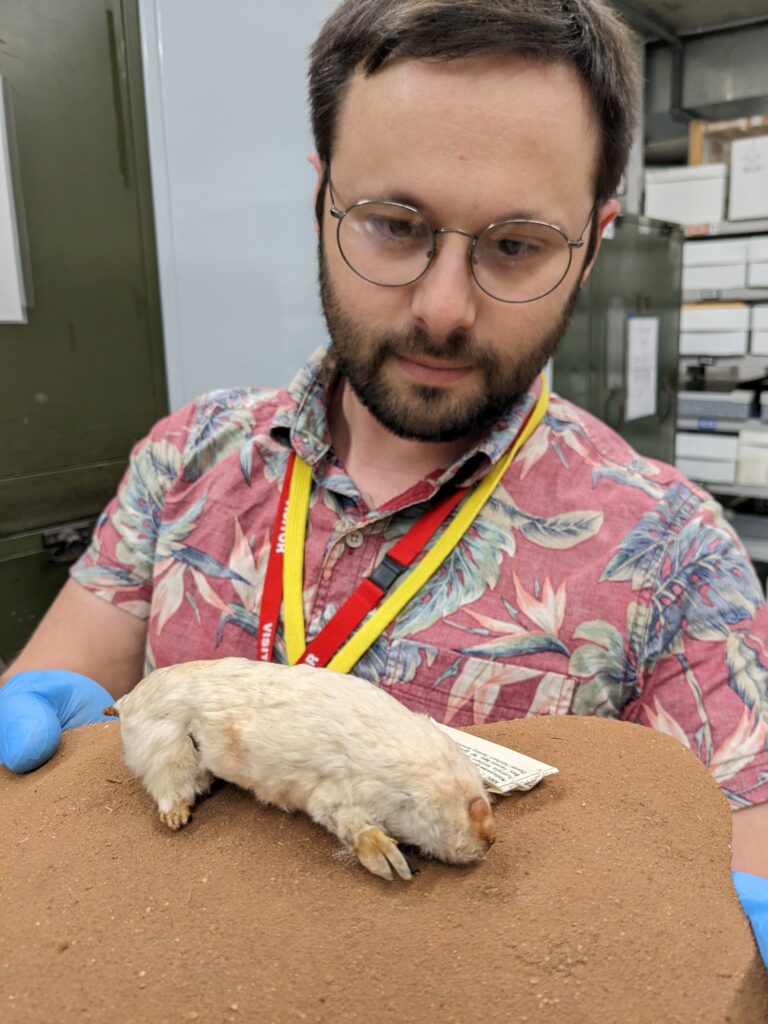
In parallel, the team examined the enigmatic and rarely-seen marsupial mole, a ‘sand swimming’ mammal native to Australia's deep deserts using their recently-released genome assembly.
Marsupial moles are rare among mammals for have a ‘xanthic’ coat - a light-yellow colour caused by the absence of dark eumelanin. In this species, a gene called the Melanocortin 1 Receptor (MC1R), responsible for driving eumelanin deposition, has a mutation that cuts it short and prevents it from functioning.
ASIP and MC1R are known to be critical genes controlling fur colour in mammals, and together function like a molecular ‘switch’ between eumelanin and pheomelanin production.
Study lead Dr Charles Feigin said normally, MC1R is periodically shut off by ASIP, leading to alternating dark and dark bands within individual hair shafts, creating the common grey-to-brown coats seen in most mammals. When either side of the switch breaks, this balance collapses, leading to only one pigment being produced.
“While the exact evolutionary consequences of coat colour variation in marsupials remain to be discovered, ‘broken genes’ seem to be an important player in how they come about,” he said.
The full paper can be read here: Loss-of-function mutations in ASIP and MC1R are associated with coat colour variation in marsupials
DOI: https://doi.org/10.1098/rsbl.2025.0302
Dr Feigin is available for interview.
Media contact
Charisse Ede