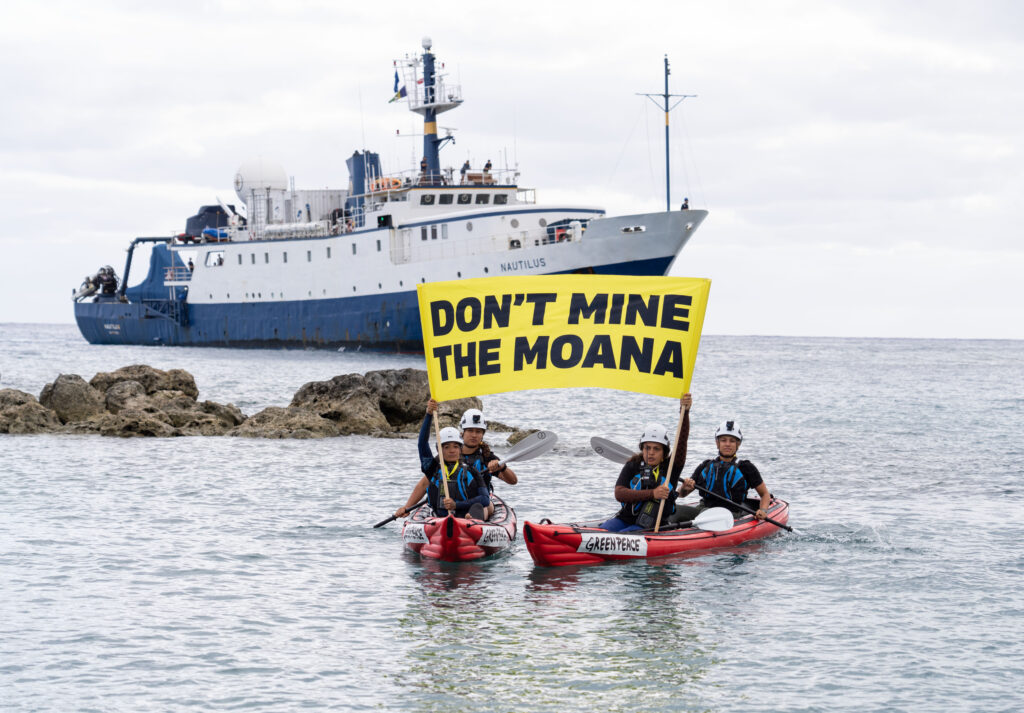

RAROTONGA, Wednesday 22 October 2025 — Cook Islanders holding a banner reading “Don’t Mine the Moana” have confronted an exploration vessel as it returned to Rarotonga port today, protesting the emerging threat of seabed mining.
Four activists in kayaks paddled alongside the Nautilus, which has spent the last three weeks on a U.S. funded research expedition surveying mineral nodule fields around the Cook Islands in partnership with the Cook Islands Government.
The Nautilus expedition comes just six months after President Donald Trump signed an Executive Order to expedite deep sea mining, tasking the National Oceanic and Atmospheric Administration (NOAA) to fast track the licensing process. The research conducted on the Nautilus expedition was funded by NOAA’s Ocean Exploration Cooperation Institute. [1]
Campaigners against seabed mining are calling the expedition one of the first steps in the Cook Island – U.S. partnership on their critical minerals deal which was announced in August, and say it demonstrates the political motive behind the expedition is to advance seabed mining.
Louisa Castledine, Cook Island activist and spokesperson for the Ocean Ancestors collective, says the Pacific movement against seabed mining is strong and mining enablers are not welcome.
“Right now, global superpowers like the U.S. are vying for control of deep sea minerals throughout the Pacific, in an attempt to assert their military might. Seabed mining will lead to the destruction of our home environments and put our Indigenous rights, cultural ways of living, and wellbeing at risk. Any government or corporate looking to exploit us in this way is no true partner of ours,” says Castledine.
“We need to open our eyes to the threats imposed on us by the seabed mining industry and stop the corporate takeover of our ocean. We have long endured environmental and political injustices, brought about by colonialism, that forcefully displace and compromise our way of living and survival. We are taking a stand against the exploitation of our people and resources. As Indigenous Peoples and custodians of the ocean we say NO to seabed mining.”
In August, the U.S. and Cook Islands governments announced their official partnership on developing seabed mineral resources. A senior official at the Cook Islands Seabed Minerals Authority described this research vessel expedition as “a first step in our collaboration”. [2] [3]
Two of the three deep sea mining exploration licences in the Cook Islands’ EEZ waters are held by U.S. companies. [4]
Seabed mining is an emerging destructive industry that has not started anywhere at commercial scale. If it goes ahead, seabed mining within Cook Islands waters could pave the way for mining throughout the Pacific.
Greenpeace Aotearoa Campaigner Juressa Lee says:
“We’re here today, standing alongside our allies in the Cook Islands, who like many across the region want a Pacific blue line drawn against this destructive industry.
“Just like Greenpeace stood with Pacific Peoples in the fight against nuclear testing, we will continue to ally with them against this reckless industry that is gambling with our future.
“The Nautilus, which was confronted today, is doing exploration for the U.S. Pacific People will not be sidelined by corporations and powerful countries that try to impose this new form of extractive colonialism on the region.”
More than 940 leading marine science and policy experts from over 70 countries have voiced their concerns about deep sea mining, and are calling for a precautionary pause on the start of deep sea mining to allow time to gather more scientific information on deep-sea biodiversity and ecosystems [5]
Resistance to deep sea mining across the Pacific is strong and growing. 40 countries have now joined the call for a pause or moratorium on deep-sea mining, including Pacific states such as Palau, Samoa, Vanuatu and Tuvalu. Antigua and Barbuda and Romania added their support today.
—ENDS—
Notes
[1] Donald Trump Executive Order
[2]https://www.state.gov/releases/office-of-the-spokesperson/2025/08/joint-statement-on-u-s-cook-islands-cooperation-on-seabed-mineral-resourceshttps://www.pmoffice.gov.ck/2025/08/05/joint-statement-on-u-s-cook-islands-cooperation-on-seabed-mineral-resources/
[3] Senior official from the Cook Islands Seabed Mineral Authority (source: 1:40) https://www.abc.net.au/pacific/programs/pacificbeat/cook-islands-us-seabed-collaboration/105640744)
[4] The companies that do own licenses in the Cook Islands EEZ are: Moana Minerals (who are a subsidiary of a US company Ocean Minerals LLC (OML).), Cobalt (CIC) Limited and CIIC Seabed resources, which is a joint venture between Belgian GSR and the Cook Islands Investment Corp.
[5]https://deep-sea-conservation.org/solutions/no-deep-sea-mining/momentum-for-a-moratorium/
Contact details:
For more information or to arrange an interview please contact:
Emma Page (in Rarotonga) on +64212075172 or [email protected]
or Kimberley Bernard (in Australia) on +61407 581 404 or [email protected]