
Expert Alert: 28 October 2025
As Perth’s population surges toward 3.5 million people by 2039, experts warn that there is no climate transition plan. As Western Australia’s environment deteriorates, the Albanese government’s ‘priority critical minerals project’ will result in expansion of bauxite extraction in WA’s Jarrah forests.
Sustainable Population Australia (SPA) argues that population growth, globally and domestically, is boosting demand for mineral extraction in WA, a leading cause of environmental decline in the state. Solutions include reducing national Net Overseas Migration (NOM) to 70,000 per year so that Australia’s population can stabilise.
SPA experts are available for further comment
Mr Peter Strachan, National President, Sustainable Population Australia
Contact: 0412 400 952 (from 06:30am AWST); [email protected]
Comments attributable to Mr Strachan:
SPA experts are available for further comment
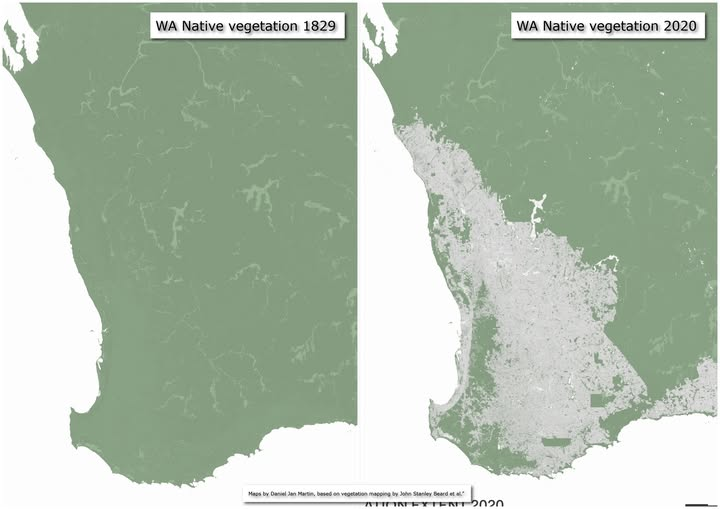
“The below graph shows clearly that in 200 years of European settlement in WA, the natural vegetation cover has reduced to a fraction of the 1829 level. Most West Australians lament the loss of the natural world and wish to see this rate of decimation reduced.”
“How much additional pressure will WA’s natural environment endure if Perth’s population increases by 1.3 million in under 15 years to be 3.5 million people in 2039? The clearance of habitat to date has already impacted on food availability for the iconic Carnaby’s Black Cockatoo."
“Albanese’s ‘priority minerals project’ will also impact WA’s natural environment, as the Alcoa-Sojitz Gallium Recovery Project, to which the Federal government will be investing $200 million, may result in an expansion of bauxite mining, further exploiting WA’s rare Jarrah forests.”
Mr Michael Bayliss, Spokesperson and Communications Manager, Sustainable Population Australia
Contact: 0423 701 611 (from 7:00am AWST); [email protected]

Quotes attributable to Michael Bayliss:
“It has been encouraging to see a groundswell of community action lobbying against Alcoa’s further exploitation of WA’s unique, irreplaceable Jarrah forests and Black Carnaby Cockatoo habitat. However, many people, including some within the environmental movement, fail to appreciate the cause and effect between endless economic and population growth and decline of the natural world.”
“It is often claimed that the housing crisis is not a population crisis because we can build more homes. Or that population isn’t an issue if we switch to renewable energy. However, all new construction, including housing and renewable energy construction, is energy intensive and requires destructive extraction of ‘critical minerals’ including lithium, neodymium and bauxite. The mining of these minerals produces toxic, radioactive waste as a by-product.
“Shamefully, Western Australia, with its increasing salinity in agricultural land, has not produced a State of the Environment report in 18 years. Additionally, as it continues to grow rapidly, Perth lacks a ‘climate transition plan’, despite water insecurities as the climate becomes hotter and drier.”
“Ultimately, no environmental management policy can hope to be effective in a society which presupposes infinite growth in a finite environment. With infinite growth, there will never be enough houses, never enough solar panels or wind turbines. Nowhere will be safe from mineral extraction if there is no end point to growth. In 200 years from now, WA will be almost completely devoid of native vegetation at this rate of growth.”
“Only by ending population growth and transitioning to a planned Degrowth or Steady State society do we have any chance of mitigating our giant, collective footprint on Western Australia’s unique and previous natural environment.”
About us:
SPA is an independent not-for-profit organisation seeking to protect the environment and our quality of life by ending population growth in Australia and globally, while rejecting racism and involuntary population control. SPA is an environmental advocacy organisation, not a political party.