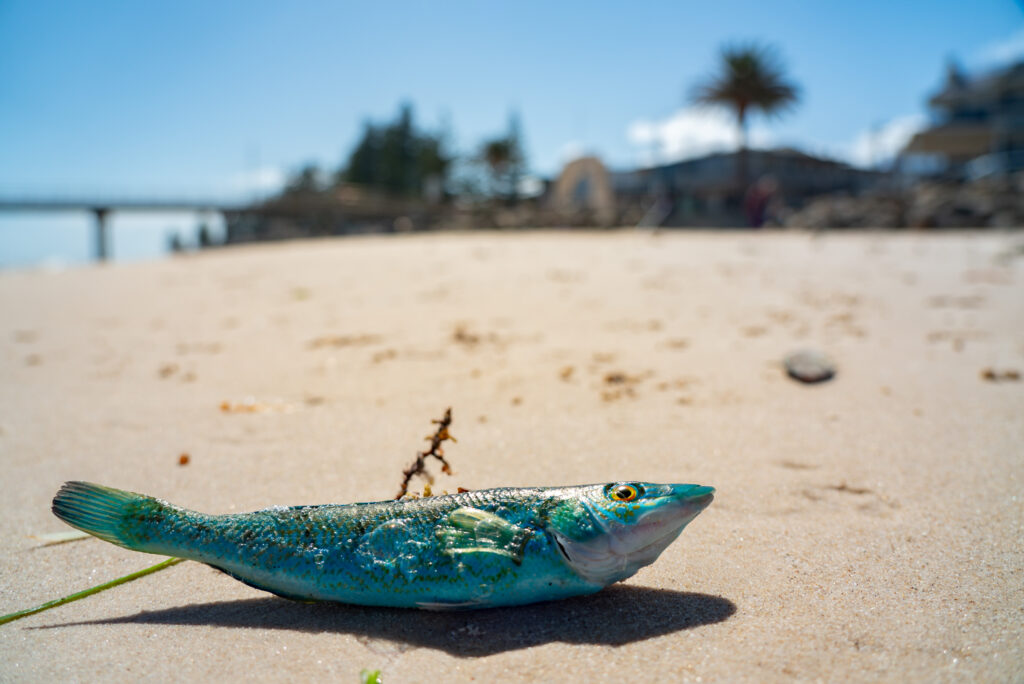
Conservation scientists from The Nature Conservancy (TNC) Australia say large-scale shellfish reef restoration can turn the tide on the toxic algal bloom devastating South Australia – and help prevent future marine disasters nationwide. As Dr Michaela Dommisse, TNC Australia’s Director of Oceans, says this is an unprecedented natural disaster, the likes of which will become more frequent.
“Communities are hurting and demanding answers. We have one: reef restoration. It’s proven, it’s working, and it starts with the humble oyster, the water filters or kidneys of the sea.”
This week, the South Australian and Federal Governments announced the Algal Bloom Summer Plan – a joint initiative to address the social, economic and environmental fallout of the bloom.
Within the plan, $20.6 million has been committed to nature-based solutions with around half allocated to large-scale shellfish reef restoration which government will partner with The Nature Conservancy and other organisations to deliver.
“While this is an encouraging and essential first step, to rebuild these natural filtration systems at the scale needed to address this crisis – and mitigate future disasters – far greater investment is required,” Dr Dommisse said.
Australia once hosted vast shellfish reef ecosystems, primarily built by native oysters and mussels, that spanned the southern coastline for tens of thousands of years. Over the last century, 99% of these ecosystems have been destroyed by dredging and overharvest, leaving our coasts exposed to biodiversity loss and environmental shocks, like the algal bloom.
“Large-scale shellfish reef restoration is essential infrastructure,” Dr Dommisse said.
“We must scale up national and state restoration programs, starting in South Australia. Community volunteer efforts are valuable, but only large-scale action with investment from all levels of government, and just as importantly, from corporate and philanthropic partners will deliver fast results, better value and impact, and regional economic uplift.”
TNC has been leading global shellfish reef restoration for more than 30 years, and since 2018, has worked with partners including Traditional Owners to rebuild and restore reefs across Australia. It has already restored four reefs in the affected area in South Australia, with evidence showing oysters on these reefs are actively consuming the toxic algae responsible for this current bloom.
“Investing proportionately to the scale of loss is crucial. Rebuilding this network of reefs across Australia’s southern coastline will require at least $500 million over five to 10 years,” Dr Dommisse said.
“This is infrastructure that creates jobs, protects fisheries, and safeguards an economy worth $120 billion annually.
“And it is a fraction of what we invest in other infrastructure,” Dr Dommisse said. By comparison, Sydney’s Metro Tunnel will cost $58.3 billion, Melbourne’s equivalent $13.4 billion, Brisbane’s Cross River Rail $8 billion and Adelaide’s South Road upgrade $15.4 billion – or $1.4 million per metre of road.
“Now is the time to commit to large-scale habitat restoration and give our ocean the kidney transplant it so urgently needs. Governments must lead with significant and immediate upfront investment so others can follow,” Dr Dommisse said.
“We can fix this. Let’s future-proof our coasts and protect our oceans for generations to come.
“We urge every Australian to support this national effort – not just for South Australia, but for the entire country. Add your voice to the petition at www.natureaustralia.org/beatthebloom”
-ENDS-
Media assets
Media assets including imagery, interview snippets with Dr Michaela Dommisse and Anita Thomas, Conservation Coordinator and b-roll footage are available for download here.
Background
The South Australian algal bloom is driven by the microscopic algae Karenia mikimotoi which release hemolysins and hydrogen peroxide, and continues to suffocate marine life by clogging gills, damaging blood cells, depleting oxygen and releasing toxins.
Millions of animals have died, and more than 450 species have been affected, with images of mass fish deaths, washed up dolphins, Australian sea lions, leafy sea dragons and several shark species offering a haunting glimpse into the scale of ecological collapse and the future if we don’t take nationwide action now.
The fallout continues to impact both nature and people – threatening the industries, jobs and communities that rely on healthy seas.
Scientific monitoring shows shellfish reefs are ecological powerhouses with a single oyster capable of filtering up to 100 litres of water per day, improving water clarity and quality. Reefs also provide vital habitat for hundreds of marine species, bolster fish populations for commercial and recreational fisheries, help stabilise shorelines, reduce erosion, and hold deep cultural significance.
In South Australia, TNC Australia and its partners have built 4 pilot shellfish reefs. Monitoring shows that these reefs have become self-sustaining ecosystems within only a few years and importantly, are consuming the Karenia mikimotoi that is causing the South Australian crisis.
About us:
The Nature Conservancy is a global conservation organisation dedicated to conserving the lands and waters on which all life depends. Guided by science, we focus on getting things done efficiently and with the greatest positive impact for conservation. We’re a trusted organisation working in more than 81 countries and territories on innovative solutions to our world’s toughest challenges so that nature and people can thrive together. To learn more about The Nature Conservancy in Australia, visit our website or follow us on Facebook, Instagram and LinkedIn.
Contact details:
Laura Jade
0400 170 663