
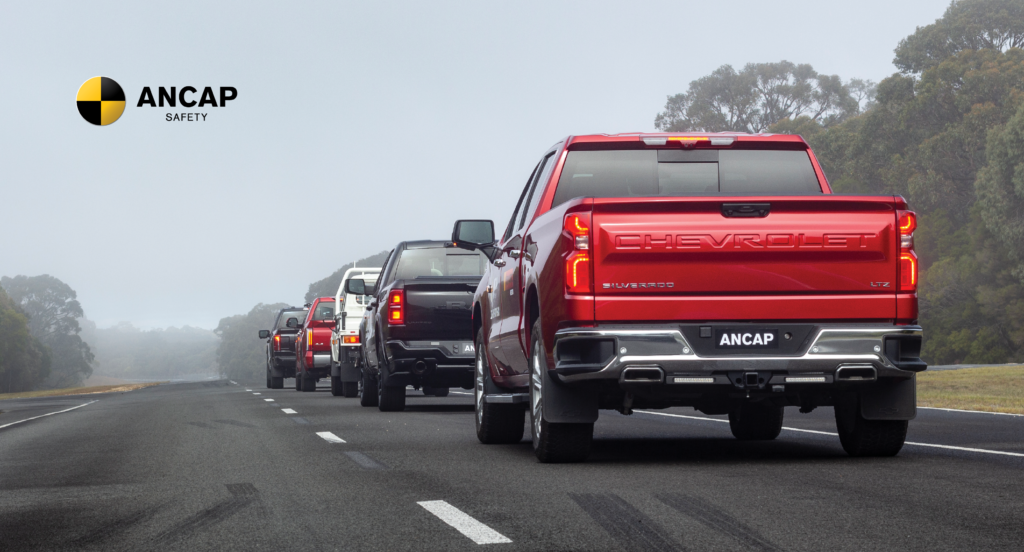
ANCAP SAFETY has examined how well large pickups protect road users by testing the crash avoidance technology fitted in these vehicles.
The inaugural Large Utilities ADAS Safety Comparison includes the current Chevrolet Silverado 1500, RAM 1500, Toyota LandCruiser 79 Series and Toyota Tundra – and an updated version of the Ford F-150.
“Larger vehicles pose a bigger threat to other road users than passenger cars. The best way to reduce the potential risk of fatalities and serious injuries from large vehicles is to make sure they do the best possible job at avoiding a crash,” ANCAP Chief Executive Officer, Carla Hoorweg said.
“This first-look comparison establishes a benchmark in safety for the large pickups cohort and provides a path forward for manufacturers of these vehicles in creating better outcomes for road users.
“There is community concern over the size of pickups when they are driving in suburban streets, around schools, and in built-up areas.
“We have applied international best practice in safety testing to this segment to make sure there is an incentive for manufacturers to improve crash avoidance technology.”
ANCAP has set a high standard for this program - well above regulation - and these vehicles have proven themselves with a high degree of advanced safety technology on board.
“Performance did vary but these results show there is a strong base to build from, and clear opportunity to achieve the performance levels seen in passenger vehicles.”
These initial comparisons will be used to inform the development of a framework and roadmap for future testing and assessment, and additional safety information is expected to be available for a broader range of large pickup models/variants from 2026.
Future phases could potentially extend into physical crash protection, ensuring the full picture of both crash avoidance and crash protection.
THE RESULTS
Fitted with one of the most comprehensive ranges of active safety features among the large utilities assessed, the updated Ford F-1501 achieved the highest score (81%) and a Platinum safety grading.
Next highest was the RAM 15002. Also fitted with a broad range of well-performing features, the RAM 1500 scored 70% and a Gold safety grading.
The two Toyota models, LandCruiser 79 Series3 and Tundra4, each provided a reasonable level of performance achieving Silver. Notably, Toyota’s enduring workhorse model – the LC79 – outshone its Tundra stablemate with scores of 55% and 50% respectively.
The Chevrolet Silverado5 offers a narrower range of crash avoidance performance, resulting in a safety grading of Bronze (27%).
NOTE: The Platinum grading applies to MY24 Ford F-150 vehicles available for customer deliveries from Q1 2026.
THE DATA
- Over 22,500 large utes were sold in Australia in 2024.6
- Sales of Chevrolet Silverado, Ford F-150, RAM Trucks, and Toyota Tundra have increased by 270% since 2019.7
- Increased popularity and manufacturer supply have seen market share rise from 5.9% to 9.4% since 2019.8
- Excluding the Toyota LandCruiser 79 Series which has been a market mainstay for decades, the market share of large utes has more than tripled since 2019 - rising from 1.4% to 4.4%.9
- In the United States:
- fatal pedestrian crashes involving pickups are four times more likely to occur during a turn than those involving cars10; and
- vehicles with bonnet heights above one metre are approximately 45% more likely to cause pedestrian fatalities.11
BACKGROUND
Dominating the Australian automotive landscape for decades, utes have been central to ANCAP’s independent safety regime since 1992. Over this time, the rigorous assessment of these workhorses has driven dramatic safety improvements across the traditional smaller ute segment.
The availability of objective safety information for these utes has not only encouraged manufacturers to elevate their product offerings, but has delivered direct safety benefits to Australian road users. Measurable gains in crash performance and crash avoidance technologies have reduced road trauma, ensuring that today’s mainstream ute models provide far greater levels of protection than ever before.
Stepping up in size, mass and towing capacity, larger ute models – some commonly referred to as pickup trucks – have become increasingly popular. A range of manufacturers are offering models to support growing consumer demand.
Traditionally designed for towing loads such as caravans, boats, or animal trailers, large utes are now frequently seen in general, everyday use. They’re driven by families and tradespeople in urban areas in addition to rural and regional roads.
The growing popularity of larger utes has been accompanied by increasing public interest. Anecdotal views suggest that due to their physical size and greater mass, these vehicles pose a higher risk and are less safe than those they share the road with.
ABOUT ANCAP
For more than three decades, ANCAP has tested and rated the safety performance of passenger cars and SUVs (MA and MC category vehicles), and light commercial vehicles (NA category) including vans and utes.
This traditional testing scope has seen single, dual-cab and cab-chassis utes with a Gross Vehicle Mass (GVM) of up to approximately 3.5 tonnes feature heavily among the star rating results published since its inception in 1992.
More recently, ANCAP’s testing regime has expanded into commercial vans and light trucks.
The new Large Utilities ADAS Safety Comparison – which examines NB and NA category utes with a Gross Combination Mass (GCM) of 7.0 tonnes or above – is a further step in ANCAP’s focussed expansion to provide fleet buyers and general consumers with independent safety information for vehicle types beyond the traditional passenger car.
MEDIA ASSETS
The Large Utilities ADAS Safety Comparison report is available at www.ancap.com.au/large-utes.
Media assets are available for download here.
1 Applies to Ford F-150 Platinum & Lariat (from MY24). Earlier generation models and other variants hold different safety specifications and have not been tested/assessed.
2 Applies to RAM 1500 Limited (from MY25). Earlier generation models and other variants hold different safety specifications and have not been tested/assessed.
3 Applies to Toyota LC79 single and double cab variants (from September 2022 build). Earlier generation models and other variants hold different safety specifications and have not been tested/assessed
4 Applies to Toyota Tundra Limited and Platinum variants (from October 2023 build).
5 Applies to Chevrolet Silverado 1500 LTZ and ZR2 variants (from February 2025 build). Earlier generation models and other variants hold different safety specifications and have not been tested/assessed.
6 VFACTS Australian New Vehicle Sales, 2024.
7 VFACTS Australian New Vehicle Sales, 2019-2024.
8 VFACTS Australian New Vehicle Sales (Pickup / Cab-Chassis segment), 2019-2024.
9 VFACTS Australian New Vehicle Sales, 2019-2024.
10 https://www.iihs.org/news/detail/suvs-other-large-vehicles-often-hit-pedestrians-while-turning
Contact details:
MEDIA CONTACT
Drew Creighton
Corporate Affairs Manager
0477 296 924
[email protected]