Global beef trade is poised for growth over the next five years, driven by increasing demand from Asia and export expansions by South American countries, according to a new report by agribusiness banking specialist Rabobank.
The report and accompanying world beef map highlight global beef trade has increased substantially over the past five years, with exports rising by 14 per cent from 2019 to nearly 13 million metric tons in 2024.
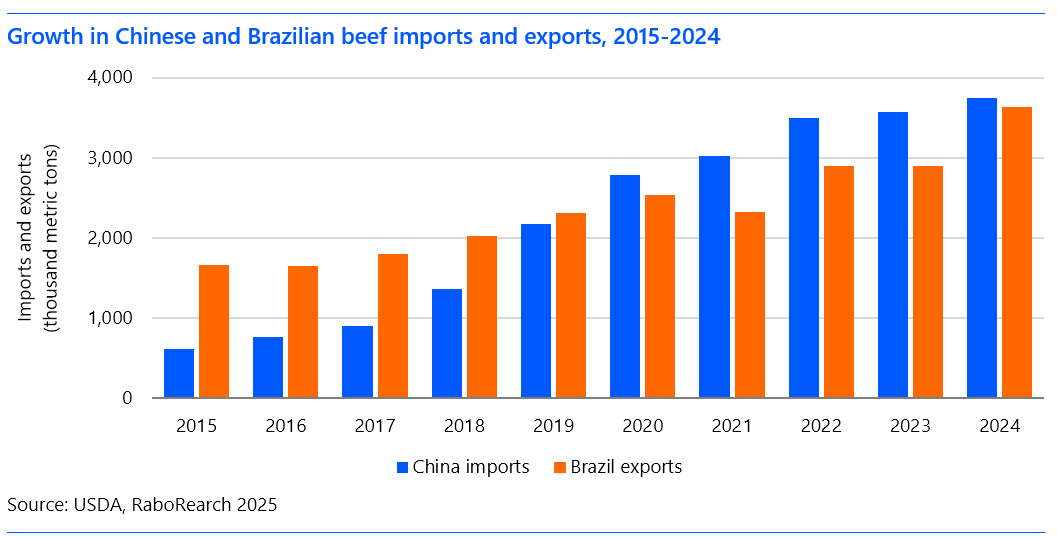
“Brazil and China have emerged as dominant forces, with Brazil leading exports and China becoming the top importer,” RaboResearch senior animal proteins analyst Angus Gidley-Baird said.
“Brazilian beef exports have surged from 2.3 million metric tons in 2019 to an estimated 3.6 million metric tons in 2024, largely fuelled by China's growing market demand.”
These volumes are double those of the second-largest exporter in 2024, Australia, the report said.
Mr Gidley-Baird said this growth underscores Brazil's pivotal role, accounting for approximately 50 per cent of China's beef imports.
Volatility and market dynamics
The report says the global beef market has experienced significant volatility in the last five years due to disease outbreaks, geopolitical tensions and shifting economic conditions.
According to Mr Gidley-Baird, this unpredictability is expected to persist, impacting traditional trade flows and creating uncertainty.
“As tariffs and market access restrictions continue, the geopolitical environment remains a key factor in ongoing market fluctuations. Companies that can navigate this volatility and capitalise on favourable conditions will be well-positioned for success,” he said.
Mr Gidley-Baird said in addition to seasonal variations that have driven some dramatic changes in production – both Australia and, more recently, the US have experienced historically-low beef cow inventories and record-high cattle prices. “The uncertainty and unpredictability have led to increasing volatility in global beef markets, with prices regularly reaching record highs and dropping to historic lows,” he said.
Asian demand fuels growth
The report says the second half of the decade is set to witness continued growth in global beef trade, driven by increasing consumption in Asia.
“Countries like Vietnam, China, Malaysia and the Philippines are experiencing strong per capita consumption growth, necessitating greater reliance on imported beef. South American countries, particularly Brazil, are expected to meet this demand through productivity improvements and enhanced management practices,” Mr Gidley-Baird said.
“Other established exporters – such as the US, Australia, and New Zealand – are expected to see more value-driven growth, leveraging quality attributes and established supply chains.”
Production shifts and consumer tensions
Global beef production has increased by 5.5 per cent over the last five years, but, the report says, a temporary decline is anticipated in the coming years, particularly in the US, Brazil and Europe.
“This reduction will support cattle and beef prices, shifting margins to producers,” Mr Gidley-Baird said.
“However, production levels are expected to recover, bolstered by improved genetics and increased carcass weights.”
“With lower global supplies of beef expected in the next couple of years, and our expectation that growth in beef consumption will be driven by net-importing countries, there is likely to be a growing tension between global and domestic customers.
“Australia, New Zealand and Brazil have experienced this recently, as very strong demand from US consumers has led to increased export volumes and prices, and this has supported beef and cattle prices in those countries.”
<ends>
RaboResearch Disclaimer: Please refer to Australian RaboResearch disclaimer here
Media contacts:
Denise Shaw Will Banks
Media Relations Media Relations
Rabobank Australia & New Zealand Rabobank Australia
Phone: 02 8115 2744 or 0439 603 525 Phone: 0418 216 103 103
Email: [email protected] Email: [email protected]
About us:
Rabobank Australia & New Zealand Group is a part of the international Rabobank Group, the world’s leading specialist in food and agribusiness banking. Rabobank has more than 125 years’ experience providing customised banking and finance solutions to businesses involved in all aspects of food and agribusiness. Rabobank is structured as a cooperative and operates in 38 countries, servicing the needs of more than nine million clients worldwide through a network of more than 1000 offices and branches. Rabobank Australia & New Zealand Group is one of Australasia’s leading agricultural lenders and a significant provider of business and corporate banking and financial services to the region’s food and agribusiness sector. The bank has 87 branches throughout Australia and New Zealand.