

● Record High: The Financy Women’s Index (FWX) rose 0.12 points
to a fresh high of 79.44 points out of 100 in the September quarter.
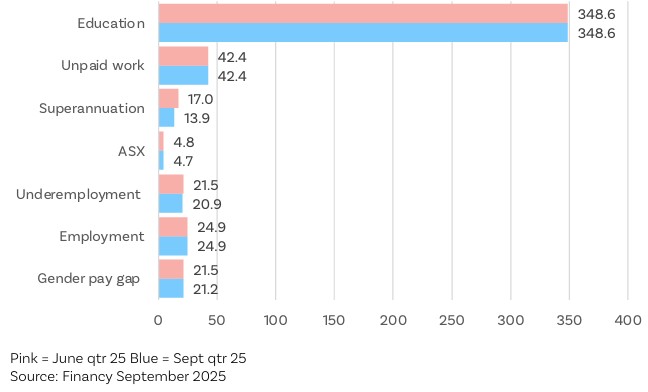
● Superannuation Gender Gap Narrows: The Superannuation sub-index was a standout performer, gaining 0.6 points. The estimated timeframe to achieve gender equality in superannuation has dropped significantly to 13.9 years (down from 17 years).
● Headwinds: Despite the record result, a crisis of confidence in
the childcare sector and stalling board diversity suggest that progress is "fragile," with early signs of women stepping back from full-time work.
● Boards Stalled: Progress on ASX 200 Boards has flatlined. The sub-index remained stalled at 38.1%, marking a second consecutive quarter of zero growth and signalling "gender diversity complacency" at the top.
● Call to Reform: The report calls for structural reforms to lock in
these gains, including urgent action on childcare quality and investor
pressure on stagnant boards.
Australia’s progress scorecard toward financial gender equality has reached a new high, with the latest Financy Women’s Index (FWX) hitting 79.44 points in the September quarter.
The result, up 0.12 points from 79.32 points in June, was primarily driven by a sharp improvement in female underemployment and a narrowing of the gender gap in lifetime superannuation savings.
The Underemployment sub-index delivered the quarter’s strongest performance, rising 0.8 points to 75.3 points. This shift suggests an easing of financial pressures on the home front and that more women are securing their desired working hours, with the female underemployment rate falling 1.5 percentage points.
Superannuation Gap Closing: The outlook for women’s long-term financial security also brightened. The Superannuation sub-index rose 0.6 points to 79.2 points, aided by a revised dataset from the Australian Tax Office and improved female wage growth.
Consequently, the estimated time frame to close the gender gap in superannuation savings has fallen to 13.9 years, down from 17 years previously. It is now the second-shortest time frame to equality of any index after ASX 200 Boards at 4.7 years. The median time frame to economic equality is 21.2 years.
Natalie Previtera, CEO of NGS Super, celebrated the momentum but emphasised that these gains must be structurally protected rather than relied upon by women acting as the economy's "shock absorbers."
“While our progress is real and the momentum is visible, the opportunity now is to design an economy where resilience is structural, not gendered. Equality should not be something women must absorb their way into, but something Australia builds into its foundations.”
“The lesson from this quarter’s FWX is not that women are faltering. It is that women have carried the burden of resilience long enough and that, with intentional investment, the burden itself can finally lessen.
While the FWX headline numbers are positive, the report warns of "fragile progress."
Beneath the record high, there are signs of a compositional shift in the workforce. Women’s full-time employment fell slightly (0.1%) in the quarter, as part-time employment rose, and participation rates retreated from recent highs, coinciding with a drop in childcare usage.
Rhiannon Yetsenga, Associate Director at Deloitte Access Economics and FWX Advisory Committee member, noted that trust in the childcare sector, which is grappling with abuse cases, is essential to maintaining workforce participation.
“When families can’t trust the childcare system, women step back from work and men stay out of the care workforce – reinforcing the idea that caregiving is ‘women’s work’,” said Yetsenga.
“Breaking that cycle starts with affordable, high-quality childcare, unlocking more equal participation and a more balanced gender workforce over time.”
Leonora Risse, Associate Professor in Economics at the University of Canberra, added that the decision to step back often carries an invisible cost.
“The current childcare crisis goes to the heart of women’s decisions to participate in the paid workforce in the sense that it’s most commonly women, not men, who get pulled out of the workforce when childcare is constrained or their family needs them,” said Dr Risse.
“Even if the numbers suggest that some women are pulling out of the workforce, what they don’t show is the extra emotional and mental strain, as well as the potential guilt, that many parents who are still in the workforce might be going through," said Dr Risse.
Board Diversity Stalls: In contrast to the gains in employment and superannuation, corporate leadership progress has flatlined. The ASX 200 Boards sub-index recorded zero growth for the second consecutive quarter, remaining at 38.1%.
With the time frame to board equality stagnating at 4.7 years, Financy is calling on institutional investors to vote against the re-election of directors at ASX 200 companies that have missed the 40:40:20 standard for three consecutive periods.
Bianca Hartge-Hazelman, Founder of Financy, stated: "This record high is reflective of fragile progress. While we celebrate the gains in superannuation and hours worked, the cracks appearing in childcare confidence and the stagnation in board diversity serve as a stark reminder that our progress is not yet cemented in strong foundations."
Key September Quarter Statistics:
- FWX Score: 79.44 points (Fresh High).
- Superannuation: +0.6 points (Gap closing).
- Underemployment: +0.8 points (Primary driver of growth).
- Employment: +0.1 points (Slight improvement).
- ASX 200 Boards: 38.1% (Stalled/Zero Growth).
- Gender Pay Gap: 11.5% (Record low national gap).
Timeframes to Equality:
- ASX 200 Boards: 4.7 years
- Superannuation: 13.9 years (Improved from 17)
- Underemployment: 20.9 years
- Gender Pay Gap: 21.2 years
- Employment: 24.9 years
- Unpaid Work: 42.4 years
- Education: 348.6 years
About us:
The Financy Women’s Index TM (FWX) is a quarterly measurement of the economic progress of women and timeframes to gender equality in Australia. The FWX is produced by Financy, which is a workplace equity advisory firm that provides leaders with insights and strategic creative communications. The Women’s Index is supported by an Advisory Committee which includes Dr Shane Oliver, Simone Cheung, Roger Wilkins, Leonora Risse, Bruce Hockman, Rhiannon Yetsenga and Nicki Hutley. The Index data analysis is also supported by Xin Deng of the University of South Australia’s Centre for Workplace Excellence (CWeX). The Index is proudly sponsored by NGS Super, Aspire Planning, HeirWealth and PritchittBland Communications.
Contact details:
Leeanne Bland
PritchittBland Communications
M: 0417 470 421
Bianca Hartge-Hazelman
Author Financy Women’s Index:
M: 0403 656 399