
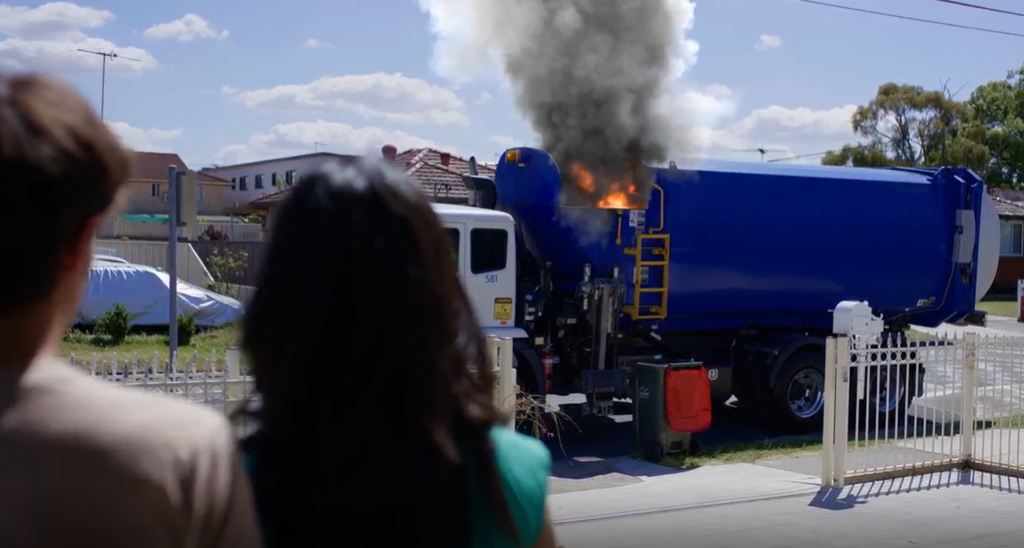
This week marks the launch of a major new phase of the successful ‘Never Bin A Battery’ campaign rolling out across New South Wales.
Designed to confront the escalating risks posed by batteries, the campaign will run until 30 June 2026 as a stark reminder for families and individuals to properly handle and dispose of household batteries and products with embedded batteries.
Fires caused by the incorrect disposal of batteries are a growing hazard. In NSW, Fire and Rescue have responded to more than 280 incidents caused by lithium-ion batteries this year alone.
Meanwhile, the waste industry reports an estimated 10,000 to 12,000 battery-related fires a year nationwide, posing a significant risk to human health, the environment and to critical infrastructure that we rely on to process waste.
NSW Environment Protection Authority (EPA) Executive Director of Programs and Innovation Alexandra Geddes said it was critical to get the message out that just one battery can spark a fire.
“Everyone has a role to play in the safe use and disposal of batteries, which should never be disposed of in kerbside bins,” Ms Geddes said.
“This new campaign builds on the success of our pilot awareness campaign from June this year, which reached nearly 5 million people in NSW with a simple message – Never Bin A Battery.”
The campaign reminds people to:
- Tape the ends of small loose batteries with clear, sticky tape
- Keep them safe in a ventilated, glass container
- Drop them off at nearby B-cycle collection points, like supermarkets and hardware stores
- Dispose of large batteries (5-20 kg) for free at Community Recycling Centres (CRCs)
- Drop off items with embedded batteries for free to one of 34 CRCs participating in the embedded batteries recycling trial
NSW EPA research revealed the pilot campaign in June was effective in influencing people’s behaviour and created a sense of urgency regarding battery disposal and safety.
9 in 10 people who saw the campaign took some form of action in response and 74% of people who saw the ads said they learned new information about battery disposal.
To inform the campaign, the EPA undertook behaviour change research to determine barriers to correct battery disposal.
This research identified that the most critical barriers to address were a lack of awareness around which devices contain batteries and that batteries can’t be disposed of in household waste bins.
The next phase of the campaign will build this awareness further – leveraging radio, video and social media ads as well as bus stops and billboards – to ensure the Never Bin A Battery message reaches as many people as possible.
Search 'Never Bin A Battery' or visit www.epa.nsw.gov.au/batteries for more information and to find your nearest battery drop-off location.
Contact details:
