
Skip to content
General News, Medical Health Aged Care

Step inside UNSW’s Health Translation Hub open day

UNSW Sydney < 1 min read
Key Facts:

Event details:

UNSW Health Translation Hub, 55 Botany Street, Randwick

Thursday 27 November from 11:30am to 3:30pm


Media invited to a first-of-its-kind facility aimed at fast-tracking health innovation

  • $600 million flagship Hub brings clinicians, researchers, educators and industry under one roof
  • Free open day: Thursday 27 November from 11:30am
  • Experience interactive exhibits including virtual reality simulations, robots & data visualisation

The UNSW Health Translation Hub is opening its doors to the public tomorrow, giving a behind-the-scenes look at a world-class facility designed to reshape how healthcare is taught, delivered and discovered.

The 35,600 square metre facility was developed in partnership by UNSW Sydney and leading infrastructure developer Plenary. The UNSW Health Translation Hub enables seamless integration between local hospitals and the University, ensuring the rapid translation of research directly into improved patient care.

Filming opportunities include:

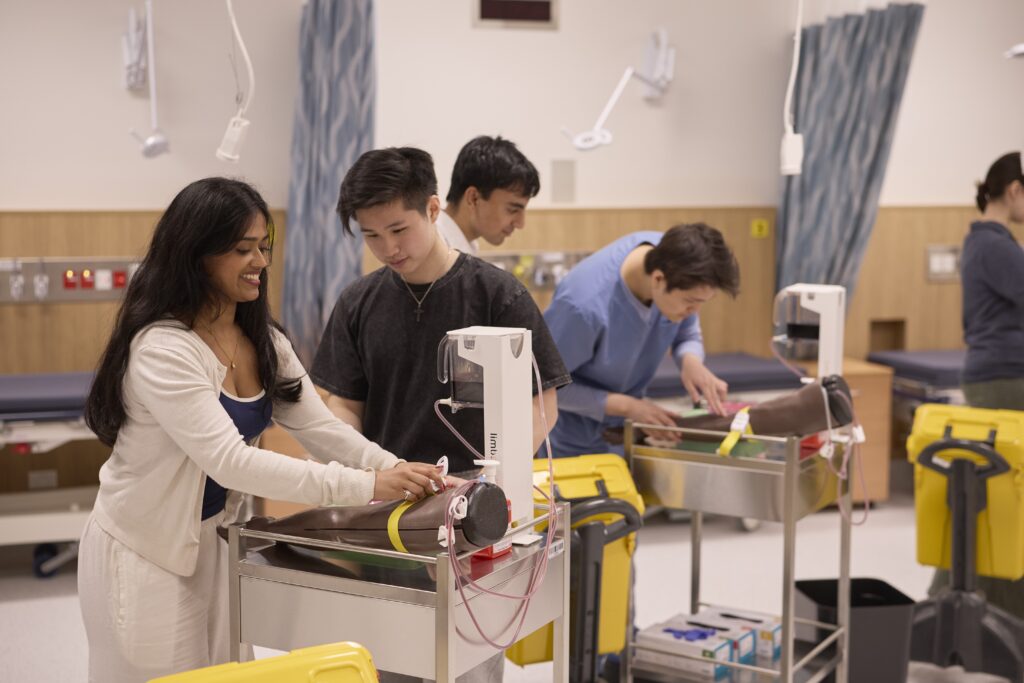
  • A prescription for the pharmacist crisis: Pharmacy students get hands-on experience in a full-sized simulated environment, learning the critical skills needed to tackle the nation’s pharmacist crisis.
  • A new pulse in teaching with high-tech mannequins: The simulation emergency room that’s revolutionising how future doctors learn to respond under pressure. With cutting-edge lifelike mannequins that bleed and breathe in real-world scenarios, the facility immerses students in realistic medical emergencies.
  • Breaking down silos: Students are learning side-by-side with clinicians from day one - breaking down silos between medicine, pharmacy and allied health.
  • Generations in motion: At the new state-of-the-art Lifestyle Clinic, students are helping seniors stay fit for the long haul, lifting dumbbells and spirits.

Additional video: https://we.tl/t-iCUtXwncd6

Stills: UNSWHTH-Media-Images


Contact details:

For media passes and to arrange interviews contact:

Ashleigh Steele, 0421 308 805, [email protected]

Media

More from this category

  • Medical Health Aged Care
  • 23/03/2026
  • 00:01
McKell Institute & Menzies Research Centre

REGIONAL AUSTRALIANS BEARING THE BRUNT OF THE OBESITY CRISIS

A new national report has found Australians living in regional communities are disproportionately affected by the country’s obesity epidemic, highlighting a growing health and economic gap between the city and country. The report, A Preventable Crisis, released by the McKell Institute and the Menzies Research Centre, shows two in three Australian adults are now overweight or obese, while one in four children aged 5 to 17 falls into the same category. Regional communities are particularly exposed to the impacts of rising obesity rates due to differences in healthcare access, food availability and socioeconomic conditions. “Obesity disproportionately affects socioeconomically disadvantaged groups…

  • Contains:
  • Medical Health Aged Care
  • 23/03/2026
  • 00:01
The McKell Institute & Menzies Research Centre

AUSTRALIA’S $90 BILLION OBESITY TIME BOMB

Australia’s obesity epidemic will cost the national economy nearly $90 billion a year within a decade without coordinated policy intervention to address the crisis, according to a bipartisan report released today. The report titled A Preventable Crisis by The McKell Institute and Menzies Research Centre warns that the economic cost of obesity will hit $87.7 billion a year by 2032 and $228 billion annually by 2060, with two-thirds of the costs linked to lost productivity, including absenteeism, reduced workplace performance and premature death. Obesity already costs the economy $39 billion annually and $320 million per year in unnecessary hospitalisations. Its…

  • Contains:
  • Medical Health Aged Care
  • 23/03/2026
  • 00:01
The McKell Institute & Menzies Research Centre

AUSTRALIA’S $90 BILLION OBESITY TIME BOMB

Australia’s obesity epidemic will cost the national economy nearly $90 billion a year within a decade without coordinated policy intervention to address the crisis, according to a bipartisan report released today. The report titled A Preventable Crisis by The McKell Institute and Menzies Research Centre warns that the economic cost of obesity will hit $87.7 billion a year by 2032 and $228 billion annually by 2060, with two-thirds of the costs linked to lost productivity, including absenteeism, reduced workplace performance and premature death. Obesity already costs the economy $39 billion annually and $320 million per year in unnecessary hospitalisations. Its…

  • Contains:

Media Outreach made fast, easy, simple.

Feature your press release on Medianet's News Hub every time you distribute with Medianet. Pay per release or save with a subscription.