By 2100 Australian and global coral reef communities will be slow to recover, less complex, and dominated by fleshy algae, as high carbon dioxide changes ocean chemistry.
An international study published today in Communications Biology has used unique coral reefs in Papua New Guinea to determine the likely impact of ocean acidification on coral reefs in the face of climate change.
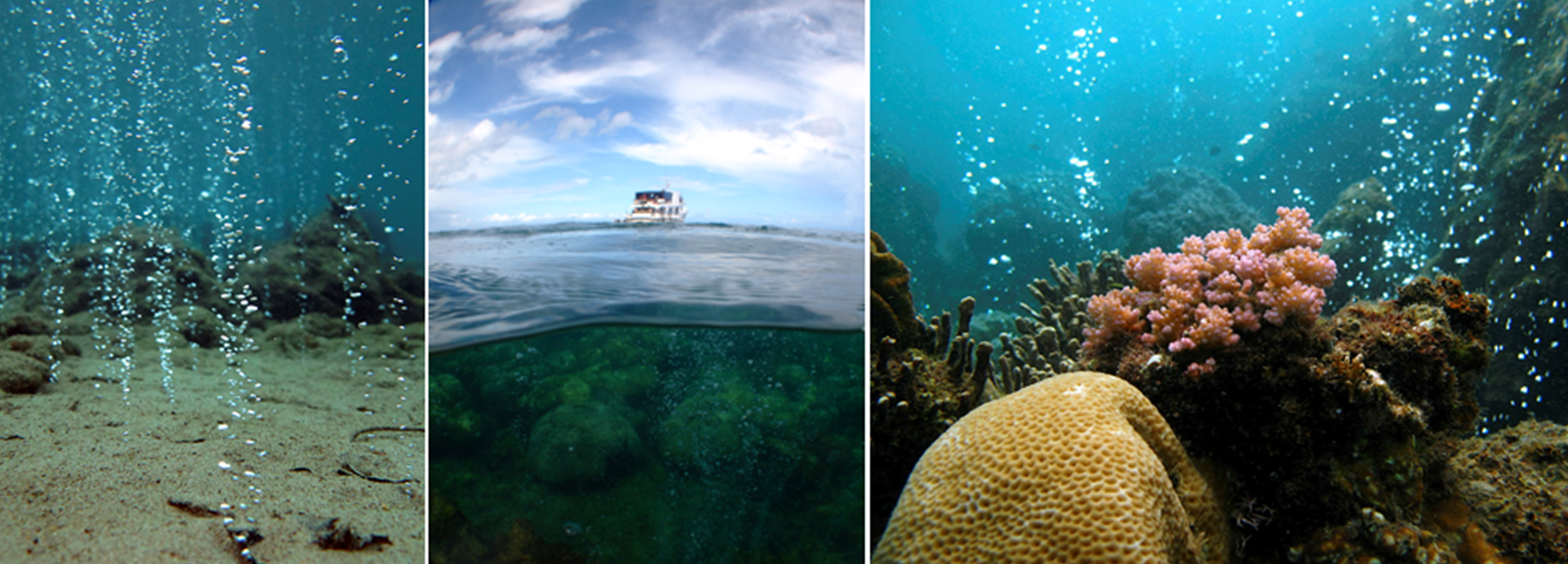
The research team, led by the Australian Institute of Marine Science (AIMS), studied entire coral reefs, locally enriched with CO2that is seeping from the sea floor, near some of Papua New Guinea’s remote shallow submarine volcanoes.
Dr. Katharina Fabricius, a coral researcher at AIMS in Townsville and senior author on the paper, says the research has revealed which species can thrive under lifelong exposure to elevated CO2.
“These unique natural laboratories are like a time machine,” said Dr Fabricius.
“The CO2 seeps have allowed us to study the reefs’ tolerance limits and make predictions. How will coral reefs cope if emissions are in line with the Paris Agreement level emissions? How will they respond to higher CO2 emissions scenarios?”
In 2000 Dr Fabricius came across bubbles of gas emerging through coral reefs while surveying species in Milne Bay, about 500 km east of Port Moresby. In 2009, as ocean acidification emerged as an issue, she thought back to that experience, had samples of the gas analysed and discovered it was nearly pure CO2.
The scene was set for the creation of a unique living laboratory and a decade-long research program to study how tropical marine ecosystems may adapt and how organisms acclimatise after generations of exposure to high CO2.
Dr Sam Noonan, also from AIMS and first author on the paper, said: “These Papua New Guinea reefs are telling us that with every bit of increase in CO2, we will see fewer corals and more fleshy algae. Importantly, we also found far fewer baby corals, which means reefs won’t be able to grow and recover quickly. That has implications for all the species that depend on them, including humans. Many coastal communities depend on fish that start their lives using coral reefs for shelter and food.”
Oceans are slightly alkaline with a pH of 8.0, but their acidity has already increased by 30%. As CO2 emissions rise, the ocean pH is predicted to decline further down to a pH of 7.8 by the year 2100.
“By studying organisms at 37 sites along a 500-metre gradient of CO2 exposure, we were able to see what happens as CO2 increases. There was no sudden collapse or tipping point, instead, as the CO2 increased, we saw fleshy algae became dominant, replacing and smothering coral and calciferous algae,” Dr Fabricius said.
The reefs are hard to reach, requiring a flight into Papua New Guinea, a second to Milne Bay Province, then six hours in a boat.
“The coral reefs in Milne Bay are amazing, and the local people so welcoming. It was a real privilege to work at their reefs with these volcanic CO2 seeps, which are globally unique,” Dr Fabricius continued.
“Ocean acidification is a massive global problem, which has been understudied and underreported to date. This research is a first of its kind, presenting unique field data and allowing us to assess how whole communities change in the real world.
“We have observed coral reefs starting to change in response to CO2 gradients in the Great Barrier Reef. The Papua New Guinea reefs tell us what will happen next.
“The more CO2 we emit into the atmosphere, the greater the changes will be to coral reefs and the coastal communities which depend on them. This is on top of the impact of global warming and sea level rise.”
The research was conducted with colleagues from The University of Western Australia and Saudi Arabia.
Abstract: progressive changes in coral reef communities with increasing ocean acidification
Communications Biology, 24 November 2025, https://doi.org/10.1038/s42003-025-08889-w
Sam H. C. Noonan, Australian Institute of Marine Science, Townsville, Australia.
Chico Birrell, General Organization for Conservation of Coral Reefs and Turtles in the Red Sea, Jeddah, Kingdom of Saudi Arabia.
Rebecca Fisher, AIMS/Oceans Institute, University of Western Australia, Perth, Australia.
Katharina E. Fabricius, Australian Institute of Marine Science, Townsville, Australia.
Ocean acidification from increasing atmospheric CO2 is progressively affecting seawater chemistry, but predicting ongoing and near-future consequences for marine ecosystems is challenging without empirical field data.
Here we quantify tropical coral reef benthic communities at 37 stations with varying exposure to submarine volcanic CO2seeping, and determine the aragonite saturation state (ΩAr) where significant changes occur in situ.
With declining ΩAr, reef communities displayed progressive retractions of most reef-building taxa and a proliferation in the biomass and cover of non-calcareous brown and red algae, without clear tipping points.
The percent cover of all complex habitat-forming corals, crustose coralline algae (CCA) and articulate coralline Rhodophyta declined by over 50% as QAr levels declined from present-day to 2, and importantly, the cover of some of these groups was already significantly altered at an ΩAr of 3.2. The diversity of adult and juvenile coral also rapidly declined.
We further quantitatively predict coral reef community metrics for the year 2100 for a range of emissions scenarios, especially shared socio-economic pathways SSP2-4.5 and SSP3-7.0.
The response curves show that due to ocean acidification alone, reef states will directly depend on CO2 emissions, with higher emissions causing larger deviations from the reefs of today.
About us:
More about the Australian Institute of Marine Science:
The Australian Institute of Marine Science (AIMS) is Australia’s tropical marine research agency. In existence for half a century, it plays a pivotal role in providing large-scale, long-term and world-class research that helps governments, industry and the wider community to make informed decisions about the management of Australia’s marine estate. AIMS science leads to healthier marine ecosystems; economic, social and environmental benefits for all Australians; and protection of coral reefs from climate change. More here: https://www.aims.gov.au/
Contact details:
Danielle Koopman, Media Officer, [email protected]; 0407 102 684
Niall Byrne, Science in Public, [email protected], 0417 131 977
Download images and vision: https://aimsimages.fotoware.com.au/fotoweb/albums/aR-qXlc8yXYbl-NW/
Website: https://www.aims.gov.au/information-centre/news-and-stories