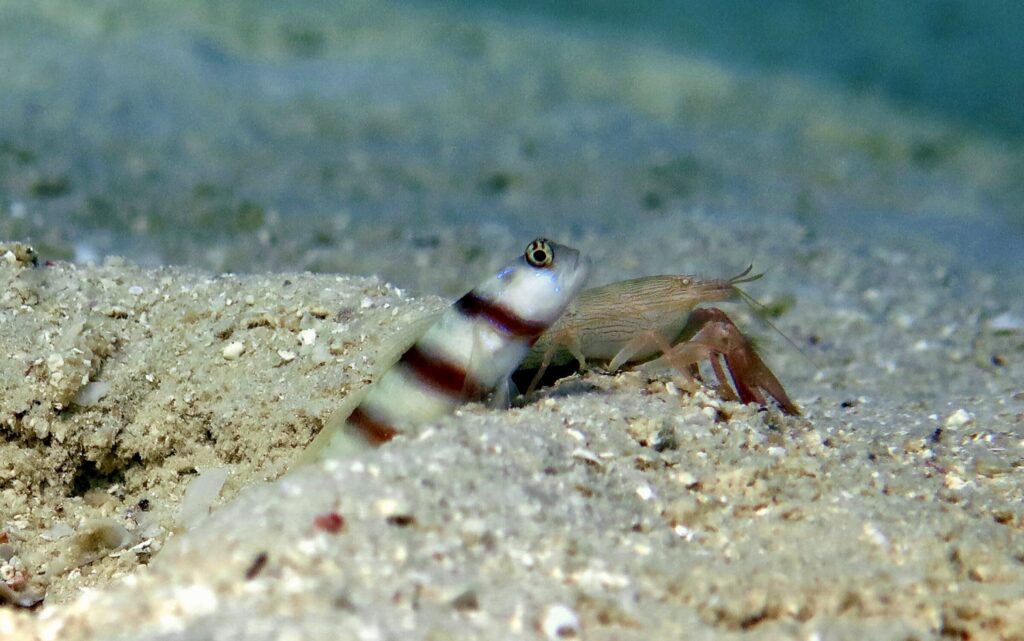

It’s a tale of underwater odd couples, one digs, the other keeps watch, and together they’ve thrived on the Great Barrier Reef for millennia.
New research led by an international team of biologists from Monash, Deakin, RMIT, University of Waikato, and the Swedish University of Agricultural Sciences, has found that the growing hum of boats above is changing how these tiny reef partners behave.
Published in Behavioral Ecology, the study is the first to reveal how boat engine noise alters individual behaviour without breaking communication between the burrow-digging snapping shrimp (Alpheus spp.) and its vigilant housemate, Steinitz’s goby (Amblyeleotris steinitzi).
Using high-definition underwater video at Lizard Island on the Great Barrier Reef, researchers compared how four-stroke and two-stroke boat engines affected the famous shrimp-goby duo.
The goby, acting as lookout, ducked for cover more often when four-stroke boats passed overhead. The shrimp, meanwhile, reacted more strongly to two-stroke motors, proof that not all engine noise sounds the same underwater.
“Both engines make a lot of noise, but their sound profiles are very different – and so are the animals’ responses,” said lead author Jack Manera, who was then an Honours student at the School of Biological Sciences, supervised by Professor Bob Wong.
“We found gobies and shrimp each have their own sensitivities, yet despite the stress, their relationship holds strong.”
Despite the individual jitters, the animals continued to communicate through touch, the goby’s gentle fin flicks still signalled “all clear” to the shrimp below.
“That’s the heart-warming twist,” said Dr Maria Palacios, co-author and field operations lead.
“Even when the neighbourhood gets loud, their cooperation doesn’t crumble. It’s a reminder that some partnerships in nature are surprisingly resilient, but it doesn’t mean the noise isn’t taking a toll.”
The findings highlight that different engines have different ecological fingerprints, reinforcing the need to consider noise type, not just noise level, when regulating marine traffic.
“Understanding how our technology shapes life beneath the surface is key to protecting reefs already under pressure,” Jack said.
“Sometimes, the most important voices in conservation are the ones we can’t hear.”
Read the research paper: https://doi.org/10.1093/beheco/araf110
ASSETS AVAILABLE
Vision and images available here.
MEDIA ENQUIRIES
Hande Cater
Media and Communications Manager
P: +61 456 428 906
E: [email protected]
Silvia Dropulich
Marketing, Media & Communications Manager, Monash Science
T: +61 3 9902 4513 M: +61 435 138 743
Email: [email protected]
GENERAL MEDIA ENQUIRIES
Monash Media
P: +61 3 9903 4840
E: [email protected]
For more experts, news, opinion and analysis, visit Monash News.