

Skip to content
Political

With Adelaide rents now as bad as Sydney — immigration must be cut and supply increased

Family First Party 2 mins read

Family First’s Upper House candidate for the up-coming South Australian election, Deepa Mathew, says the housing crisis will only be solved if governments take bold action to cut immigration, release more land and increase housing supply so families can get relief from rents now as high as Sydney’s.


“The best way to take pressure off families struggling to pay rent is to increase housing supply. That means cutting immigration to manageable levels, freeing up land, slashing red and green tape, and fast-tracking modular and affordable homes,” Ms Mathew said.


Family First says state and federal politicians have ignored the core drivers of the crisis for too long, allowing construction bottlenecks and population pressures to overwhelm the market.


“Our plan tackles the real causes,” Ms Mathew said.


“Release more land. Remove excessive compliance costs. Support modular housing. Extend the first home buyers grant to existing homes. Allow pensioners to downsize without penalty. And above all — reduce immigration until supply catches up. These are the practical and urgent steps needed to put downward pressure on rents.”


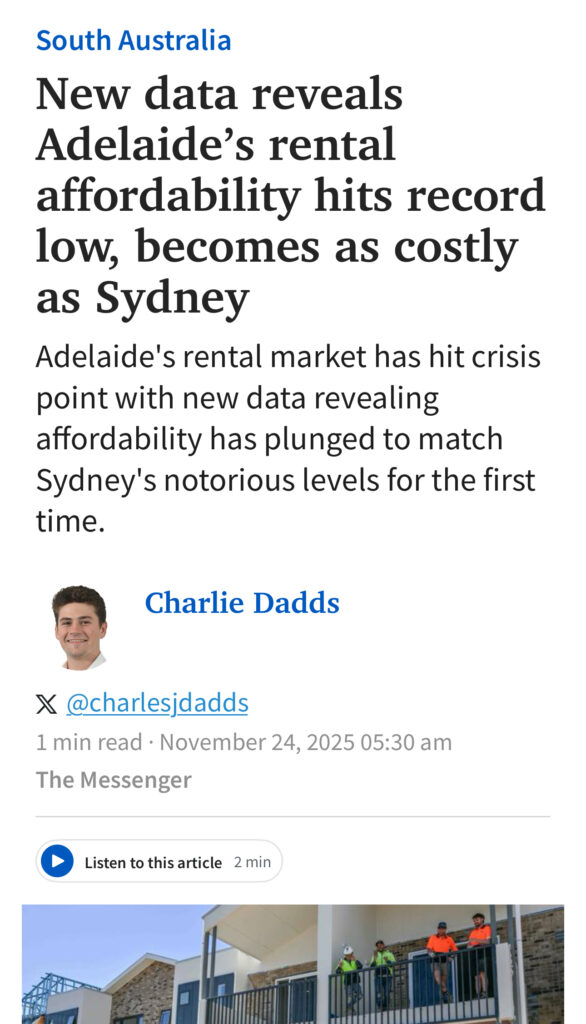
The warning comes as new data from the National Shelter–SGS Economics and Planning Rental Affordability Index reveals that Adelaide is now just as unaffordable as Sydney — the worst result on record.


“Families in Adelaide are being pushed to the brink,” Ms Mathew said.

“When median rents swallow 30 per cent of household income, something is seriously wrong. We are no longer talking about isolated pockets — from Gawler to Aldinga, affordable rentals have simply vanished.”


Ms Mathew said the crisis is harming families and crippling local businesses that cannot attract workers because people can’t afford to live nearby.


“This is destroying opportunities for young families and leaving employers desperate. South Australia cannot prosper without homes that ordinary people can actually afford.”


Contact details:

[email protected]

Media

More from this category

  • Political, Transport Automotive
  • 01/04/2026
  • 22:34
Sustainable Cities - Better Buses Campaign

Albo says ‘Catch the bus,’ but fuel crisis exposes broken bus network in Melbourne’s west

PM urges Australians to use public transport in the current fuel crisis, but in Melbourne’s West, the broken bus network leaves families with no choice. This evening, Prime Minister Anthony Albanese addressed the nation, interrupting television and radio broadcasts to announce measures to tackle the worsening fuel crisis as a result of the war in the Middle East. In his speech, he urged Australians to reduce fuel use, stating “if you can switch to catching the train or bus or tram to work, do so.” While inner-city communities have access to frequent trains, trams and buses, in the outer suburbs…

  • Political, Transport Automotive
  • 01/04/2026
  • 22:25
Sustainable Cities - Better Buses Campaign

Fuel crisis exposes broken bus network in Melbourne’s west

PM urges Australians to use public transport in the current fuel crisis, but in Melbourne’s West, the broken bus network leaves families with no choice. This evening, Prime Minister Anthony Albanese addressed the nation, interrupting television and radio broadcasts to announce measures to tackle the worsening fuel crisis as a result of the war in the Middle East. In his speech, he urged Australians to reduce fuel use, stating “if you can switch to catching the train or bus or tram to work, do so.” While inner-city communities have access to frequent trains, trams and buses, in the outer suburbs…

  • Community, Political
  • 01/04/2026
  • 09:00
ACOSS

ACOSS calls for measures to help people most at risk, and to support critical community services

Australia’s community services sector is experiencing direct impacts from fuel supply disruption and price increases combined with extreme weather incidents, prompting ACOSS to urge the government to work collaboratively towards cohesive, targeted action. An emergency consultation undertaken by ACOSS with national members has found a significant increase in calls for help from people most at risk, and pressure on frontline services particularly in regional and remote areas. Amidst fuel shortages and grocery prices rising, frontline services are hearing increasing reports of people on lower incomes having to make impossible choices and going without necessities like food and medicine to get…

Media Outreach made fast, easy, simple.

Feature your press release on Medianet's News Hub every time you distribute with Medianet. Pay per release or save with a subscription.