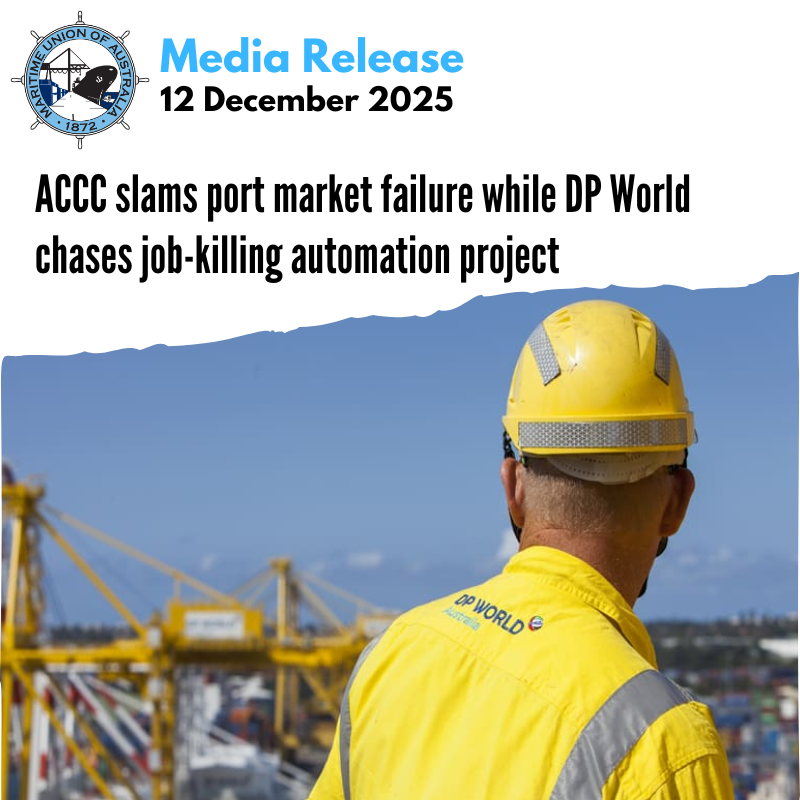

The Maritime Union of Australia demands urgent government intervention to stop DP World’s AI automation experiment after the ACCC’s latest Container Stevedoring Monitoring Report painted a picture of systemic market failure in Australia’s container port sector, with record price gouging by multinational port operators underpinned by skyrocketing landside charges that rob Australian consumers and businesses before 99% of Australia’s imports arrive.
DP World’s automation: no benefit to the supply chain
DP World, one of the big three oligopoly controllers of Australia’s container ports, is pushing a large‑scale AI automation program across its four container terminals that is designed to cut labour and bust unionised workers rather than fix the landside dysfunction identified by the ACCC or increase port productivity.
While well-known bottlenecks exist at the point where containers are transferred to road and rail transport, the company’s plans focus on eliminating wage-earning and taxpaying humans at the ship‑side of their terminals, with no intention of improving the interface with road and rail interface, meaning higher charges and higher profits are not matched by better service for Australian businesses or consumers.
Union demands AI automation test
The MUA is demanding that any AI automation proposals at Australian container terminals reopen bargaining rights for workers under the Fair Work Act and workforce agreement. AI automation must be subject to a public interest test that requires demonstrable benefits to the wider freight supply chain, enforceable job and safety protections, and full transparency around how the resulting profits and tax obligations are shared.
ACCC identifies record profits
The ACCC reports that stevedoring prices and profits have climbed to historic highs for the fifth year in a row, even though terminal capacity is under‑used, volumes for most operators have been flat for years, and productivity has flatlined. The regulator concludes that elevated profits are unlikely to be temporary and that stevedores face little effective constraint when increasing fixed landside charges.
Landside charges weaponised against Australian business
According to the ACCC, stevedores now collect almost half their total revenue from landside and other charges, with terminal access fees alone bringing in hundreds of millions each year from trucking operators and cargo owners who have no real ability to avoid or negotiate them. This is a deliberate manipulation and abuse of stevedores unique place in the supply chain and undermines Australian consumers and businesses ready access to vital imports at a fair price.
Since 2017–18, these charges have raised billions of dollars – more than double industry‑wide investment over the same period. DP World’s only proposed investments are to automate and further reduce productivity of their ports.
Communities, safety and budgets on the line
DP World’s approach would remove large numbers of skilled waterfront jobs, reduce the labour share of income and erode the tax contributions that flow from those jobs into federal and state budgets, while creating additional safety and reliability risks through increased interaction between workers and autonomous equipment. At the same time, DP World admits that their automation proposal is purely about cutting jobs and increasing profit - which goes to the Dubai royal family - while not increasing port productivity.
DP World is a skilled and renowned tax avoider. Eliminating Australian workers, who most years would collectively pay more tax in this country than DP World itself does, would remove the only social or economic benefit the country provides to this country – the payroll and income taxes generated by its employees.
The capital spending behind the automation push also opens the door to long‑term tax write‑offs and financial structuring that further shift the gains offshore, compounding the concerns already raised by regulators about the way stevedores are monetising market power on the landside.
ENDS
Contact details:
Tom Harris-Brassil: 0401 834 924