UNSW researchers are turning what was once waste into a protective film that could help extend the expiry date of some of Australia’s favourite summer fruits.
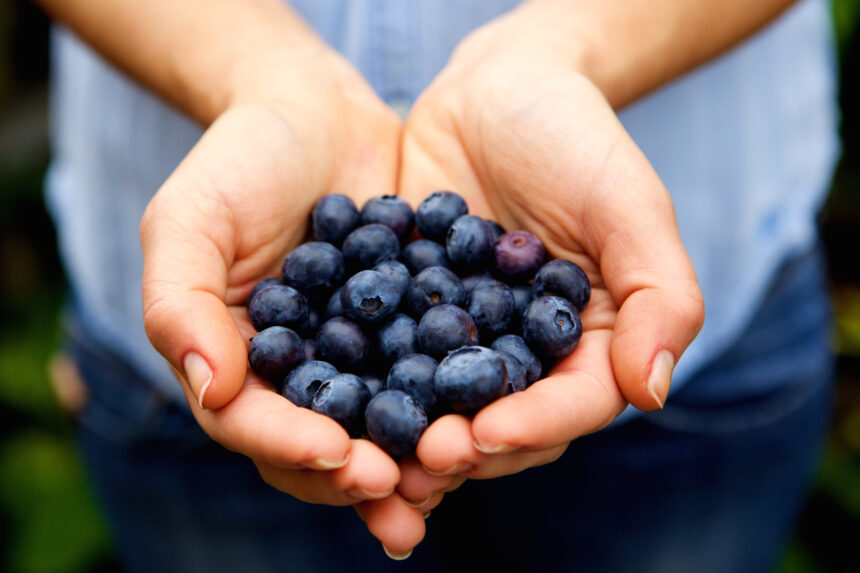
Ever splurged on a punnet (or few) of blueberries only to find them a wrinkled, grey-flecked disappointment in your fridge a few days later? You’re not alone. This little blue superfood is known for perishing quickly.
But now, a team of chemical engineers from UNSW Sydney are working on slowing down that decline. They’ve developed an edible film made from coffee waste that could help preserve the freshness of delicate fruits like blueberries by reducing how much water seeps in or out.
The new formulation was created and tested in their lab, making sure it could be applied directly to food. The next step is to test this as a coating in real-life environments, before scaling it up to commercial production.
“We’ve created a polysaccharide-based coating to improve the fruit’s water-vapour barrier,” says UNSW lead author and PhD candidate Lilah Saidi.
“The coating contains cellulose nanofibres (CNFs) – derived from used coffee grounds – and grapeseed oil.”
Current polysaccharide films made from other plant cellulose fibres or starches are already widely studied for use as edible coatings because they are biocompatible, biodegradable and food safe. But they are not effective at protecting fresh produce from moisture.
“Polysaccharides are excellent biopolymers for films, but their major disadvantage is their high-water affinity,” Saidi says.
“Our innovation lies in repurposing spent coffee grounds. These are an abundant waste product from cafés that can serve as both nano-fillers and stabilisers in the coating.”
Saidi says nanofibres from the coffee grounds help create a tighter, more interconnected network, making it harder for water molecules to migrate through. The grapeseed oil, being water-repellent, further reduces the film’s affinity for moisture.
“This leads to a food film that is still clear and see-through while also having an improved mechanical strength. The nanofibres from coffee grounds make it tougher and more flexible – and are also safe to eat.”
A sustainable twist
By upcycling spent coffee grounds from UNSW’s Maze Café, the research offers a two-for-one environmental win: reducing food-industry waste while creating a biodegradable product.
Preliminary tests also suggest the oil-containing films could help inhibit bacterial growth on the film’s surface. This opens the door to a further antimicrobial function.
Soft fruits such as blueberries are more easily damaged during storage and transport because of moisture loss, microbial spoilage and mechanical damage. These all lead to food waste.
Saidi says the new formulation provides a gentle, edible ‘skin’ in the form of a spray coating or a packaging film that preserves freshness, reducing the reliance on synthetic plastics.
“These properties are especially well-suited to barrier coatings, potentially slowing dehydration, or moisture absorption, in those more highly perishable fruits like blueberries.”
Challenges ahead
Professor Cordelia Selomulya, Saidi’s PhD supervisor, says while the research is helping improve polysaccharide-based films, turning this innovation into a solution for large-scale commercial fruit production remained a challenge.
“Translating laboratory films into a commercially viable fruit coating is no easy process,” Prof. Selomulya says.
The edible coating team at UNSW includes Dr Yong Wang and Associate Professor Peter Wich. Together with Saidi and Prof. Selomulya, they still need to prove the coating can be applied consistently across large volumes of fruit – ensuring it stays safe, tasteless and affordable for commercial use.
This means testing the coating on fruit beyond the lab under real-world storage and transport conditions, while exploring application methods and regulatory approvals.
“When testing this edible coating on blueberries in the lab, we also compared how they performed against uncoated blueberries when stored,” Prof. Selomulya says.
“To test this in real-life environments, we first need to run a pilot trial that mimics commercial fruit processing,” she says.
“We’ve seen how this is currently done and can identify the potential steps where the coating can be applied.”
She says before the product can run at full scale, the team need to demonstrate it works at a small scale, to reduce risks and attract industry investment.
“Extracting nanofibres from coffee grounds is currently labour- and energy-intensive,” Saidi says.
“But we’ve shown that non-oxidised CNFs from spent coffee grounds can stabilise lipophilic droplets and reinforce the film very efficiently.”
The team’s next study will investigate a new source of cellulose nanofibres that can be produced differently and offers further unique properties – paving the way for even more advanced and versatile coatings.
For now, they’ve filed a provisional patent for this discovery and are open to collaborations with commercial fruit producers.
Saidi is optimistic that the new technology can not only help reduce postharvest loss but give coffee waste a second life.
“We’re offering a cleaner, greener way to keep fruit fresh from farm to fridge.”
Contact details:
Melissa Lyne, UNSW news & content