
- Australians risk significant post-Christmas debt with household spending up 5% year-on-year and savings ratios down to 4-5%
- Household costs have increased across multiple categories: travel/accommodation (1.1%), dining (3.3%), groceries (3%), and alcohol/tobacco (6%)
- 78% of Australians plan to adjust Christmas spending habits, with most preferring debit over credit cards and implementing stricter budgets
- Business-related personal insolvencies are rising, with 29.4% of personal insolvencies now linked to business issues
- Key recommendations include making detailed spending lists, avoiding buy-now-pay-later schemes, maintaining essential bill payments, and seeking early financial advice if needed
Media release
10 December 2025
Festive spending warning: Aussies urged to act now
Australians face a significant risk of ‘Debtmas’ this year, with national insolvency solutions firm Jirsch Sutherland urgently advising households to review their finances before rising holiday costs and tax debts exacerbate financial distress in the new year.
With cost-of-living pressures still high and debt levels stubbornly elevated, many Australians are entering the festive season already financially strained. ABS data indicates household spending rose 5 per cent in August year-on-year, driven by essentials such as housing, groceries and transport. Over the year to August 2025, holiday travel and accommodation costs increased by 1.1 per cent, dining by 3.3 per cent, and groceries by 3.0 per cent (with alcohol and tobacco up 6 per cent), highlighting how festive expenses can extend well beyond gifts. Meanwhile, the household savings ratio has decreased to just 4-5 per cent – well below pre-pandemic levels – signalling that fewer people have a buffer for unexpected costs.
“Many Australians are feeling the strain this year, with rising mortgage repayments, rent and everyday costs,” says Malcolm Howell, Partner, Jirsch Sutherland. “According to Pureprofile’s latest research*, 78 per cent plan to adjust their Christmas spending, with more than half using debit over credit and most setting tighter festive budgets. But while gifts tend to grab the spotlight, it’s the hidden costs of the holidays – from travel and entertainment to dining, groceries and surcharges – that can quietly derail even the best intentions.
“People relax over the holidays and spend more freely; by late January, optimism can turn to anxiety as bills, buy-now-pay-later repayments and credit card statements roll in. Taking stock now – setting limits, trimming non-essentials and tackling high-interest debt early – can relieve enormous pressure down the track.”
Businesses feeling the pinch
Howell says both households and small business owners are feeling the financial pressure. “We’re seeing a rise in business-related personal insolvencies – directors and sole traders whose personal finances have been dragged down by struggling businesses,” he adds. “This year has also been marked by a sharp lift in ATO enforcement through Director Penalty Notices, which is bringing business tax debts into the personal arena. AFSA’s September quarter statistics show that almost one-in-three personal insolvencies (29.4%) are now business-related. When cash flow tightens and debts build up, both the business and the individual are at risk. Acting early – whether by seeking advice, restructuring debt, or reviewing expenses – can make a real difference.”
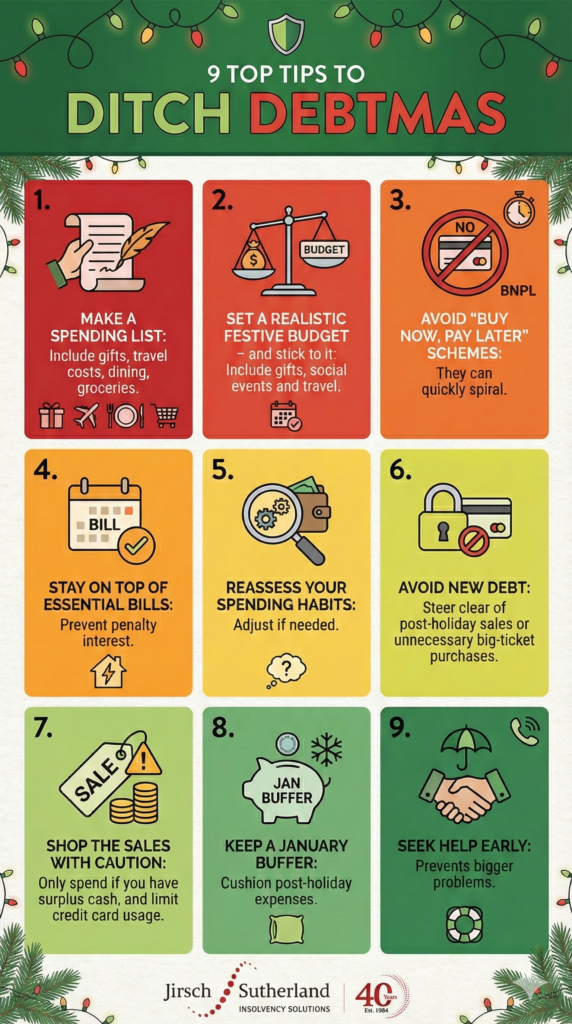
Jirsch Sutherland’s 9 top tips to ditch Debtmas:
- Make a spending list – and check it twice. Include gifts, travel, dining, groceries and factor in those hidden extras like booking fees and surcharges
- Set a realistic festive budget that includes gifts, social events and travel – and stick to it.
- Avoid “buy now, pay later” traps. They can feel manageable in December but quickly spiral when January bills arrive.
- Stay on top of essential bills. Paying utilities and credit cards early helps prevent penalty interest or late fees.
- Reassess your spending habits. If overspending is a pattern, create a budget that keeps you accountable and redirects funds to existing debts. Even small tweaks – like skipping luxury spending – to get ahead.
- Avoid taking on new debt. Steer clear of post-holiday sales or unnecessary big-ticket purchases. Focus on paying down what you already owe before adding more to the pile.
- Shop the sales with caution: avoid New Year sales unless you have surplus cash and limit what you put on credit cards.
- Keep a January buffer. Even a small reserve can cushion post-holiday expenses.
- Seek help before it’s a crisis. A conversation with a financial counsellor, your accountant or insolvency professional can prevent far bigger problems.
*Christmas 2025 unwrapped: Global insights to spending, shopping & holiday celebrations
About us:
About Jirsch Sutherland – jirschsutherland.com.au
Established in 1984, Jirsch Sutherland is one of Australia’s leading national independent insolvency specialists, and is the country’s leading voluntary insolvency firm. The Jirsch Sutherland team works closely with small and mid-size accounting, finance and legal firms – and their clients – to provide a wide range of expert corporate and personal insolvency services including liquidations, voluntary administrations, receiverships and bankruptcy.
With head offices in Sydney, Melbourne, Brisbane, Newcastle and Perth, supported by a network of regional offices, Jirsch Sutherland’s national reach combined with a local presence underpins the company’s ongoing success. For over three decades, Jirsch Sutherland has earned a well-deserved reputation for protecting and guiding clients through the insolvency process in a fair and ethical way.
In Western Australia, Jirsch Sutherland trades as WA Insolvency Solutions (WAIS).
Contact details:
For further information:
Lisa Llewellyn
Llewellyn Communications
0419 401 362