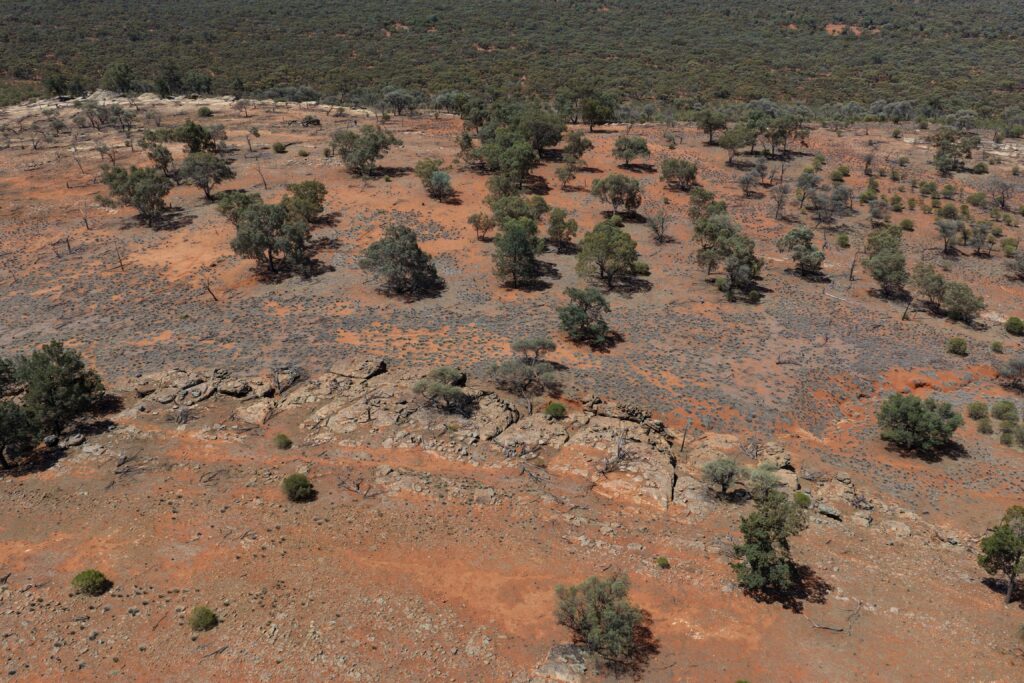
The Nature Conservancy Australia welcomes the NSW Government’s landmark purchase of Corinya and Tasman stations — collectively known as the Tasman Corinya property — spanning 71,866 hectares of ecologically rich and culturally significant land in central west New South Wales.
This major conservation milestone was made possible through collaboration and a generous contribution of approximately $AU4.3 million from the Wyss Foundation through their longstanding partnership with The Nature Conservancy (TNC) Australia.
The protected area — about a third of the size of the Australian Capital Territory — will build connectivity with nearby National Parks, creating a vital wildlife corridor for threatened species including the south-eastern hooded robin and the pink cockatoo.
It also takes vital steps toward advancing Australia’s commitment to protect 30% of its lands and waters by 2030 (the 30x30 target) while safeguarding vital ecosystems. Areas in the property, such as the Sand Hill Pine woodland, are recognised as threatened ecological communities that are at risk from damage and regeneration from livestock grazing.
Dr Thalie Partridge, Acting Protected Landscapes Director at TNC Australia, said: “Tasman Corinya has really significant biodiversity and cultural values. Its protection is a powerful example of what can be achieved when governments, philanthropy and conservation organisations work together.
“This acquisition is a significant contribution to NSW environmental conservation and Australia’s goal to protect 30% of its lands and waters by 2030. It fills a critical gap in the NSW landscape, connecting parks and safeguarding diverse ecosystems, from sand dunes and woodlands to wetlands and riverine areas that were previously unprotected and can now be enjoyed by future generations.”
With the help of TNC Australia, over 140,000 hectares have been added to the NSW protected area estate in the past three years. These include Brindingabba National Park, which has opened its campground and camper trailer access, and Cuttaburra National Park which is likely to be open next year.
Molly McUsic, President of the Wyss Foundation, said: “We are proud to support the permanent protection of this extraordinary landscape, home to numerous threatened bird and bat species.”
“Philanthropy plays a critical role in accelerating the pace of conservation, and this partnership demonstrates the importance of strategic funding in meeting national and global biodiversity goals.”
Lara Gallagher, TNC’s Australia Country Director, said she was proud of TNC’s ability to bring together philanthropy and government to protect and restore ecosystems at scale.
“For more than two decades, TNC has been bringing people together to acquire and protect large-scale, high conservation value properties across Australia,” Ms Gallagher said.
“Expanding Australia’s protected areas and safeguarding our unique plants and wildlife has never been more important.”
In November 2023, The Nature Conservancy and other conservation organisations published the Pathways to 30x30 report, which provided recommendations to the Australian Government on how to reach 30x30. A key recommendation of the report is the creation of a $5 billion dedicated land acquisition fund to bring high-value conservation land into the protected area estate.
Facts about the Tasman Corinya property:
- The NSW Government has acquired 71,866 hectares of land – about a third of the size of the ACT – to be added to national park estate.
- Located 110 km southeast of Wilcannia and 140 km southwest of Cobar, the property spans two IBRA bioregions and nine NSW landscapes: These range from the high country of Corinya Hills and Neckarbo Ranges, through sand dunes and woodlands, to the wetland and riverine areas associated with Corinya Lake, Corinya Swamp and Sandy Creek.
- The property is home to at least 13 threatened species including:
- South-eastern hooded robin (Endangered)
- Pink cockatoo (Endangered)
- Southern Whiteface (Vulnerable)
- White Fronted Chat (Vulnerable)
- Three threatened bat species
- Future biodiversity surveys may confirm the presence of a number of other threatened species.
- The acquisition was supported by The Nature Conservancy Australia, with funding from the Wyss Foundation.
Images can be downloaded here, footage available on request. Credit photos to NPWS.
About us:
About The Nature Conservancy Australia
The Nature Conservancy Australia helps people and nature thrive by protecting and restoring ecosystems at scale. Our work contributes to reduced greenhouse gas emissions and protects plant and animal species for generations to come. We do this by developing tools, amplifying local knowledge, influencing decision-making and unlocking sustainable finance to scale evidence-based solutions. To find out more visit www.natureaustralia.org.au
About the Wyss Foundation
The Wyss Foundation is a private, charitable foundation focused on conserving land, ocean, and wildlife. The Foundation’s philanthropic efforts also include support for economic opportunity, medical advancements, education, and the arts. Since its establishment in 1998, the Wyss Foundation and its partners have helped local and indigenous communities, national governments, land trusts, and nonprofit partners permanently protect more than 120 million acres of land and more than 3.2 million km2 of ocean. For more information about the Wyss Foundation, visit www.wyssfoundation.org.
Contact details:
For media enquiries, contact Laura Jade, [email protected] and 0400 170 663