Key points
- Modern Slavery Statements are compulsory for organisations operating in Australia with $100 million or more in annual consolidated revenue
- Since they became mandatory in 2020, more companies are complying well
- However, some continue to lag in their reporting
Australia’s first Anti-Slavery Commissioner Chris Evans has welcomed Monash University’s fifth report on ASX100 companies’ Modern Slavery Statements and committed to engage with those that need to improve their reporting.
The annual assessment by Monash Centre for Financial Studies in the Monash Business School has found most big Australian companies produced high-quality Modern Slavery Statements, five years after they became compulsory for Australia’s biggest companies.
Mr Evans said the report provided key insights into modern slavery reporting in Australia, supported his work to raise awareness, and demonstrated the value of independent research in driving progress.
“This report confirms what we are seeing across reporting entities,” Mr Evans said. “Some companies are showing leadership, while others are falling behind.
“While progress among the ASX100 is welcome, it raises questions about the broader group of companies required to report under the Modern Slavery Act. The non-reporting, non-compliant, and those providing only superficial statements show the urgent need to strengthen legislation, ensure robust risk-based due diligence, and lift standards across all entities.”
The Modern Slavery Disclosure Quality Ratings ASX100 Companies Update 2025 is an independent review of ASX100 companies’ Modern Slavery Statement reporting quality for the 2024-2025 financial year.
Companies involved in utilities (AGL Energy Ltd, APA Group and Origin Energy Ltd), consumer staples, such as Woolworths and Coles, and real estate continued to be the strongest performers, with health care and information technology the weakest.
Health care companies ranked lowest overall, due to poor supply chain descriptions and modern slavery risks identification, inadequate due diligence and remediation processes and effectiveness assessment.
Modern slavery, which is a growing global problem, encompasses situations where workers are subjected to coercion, threats or deception to exploit them and undermine their freedom.
Australian companies can be exposed to these risks through suppliers, particularly those with complex international supply chains, posing significant legal and reputational risks.
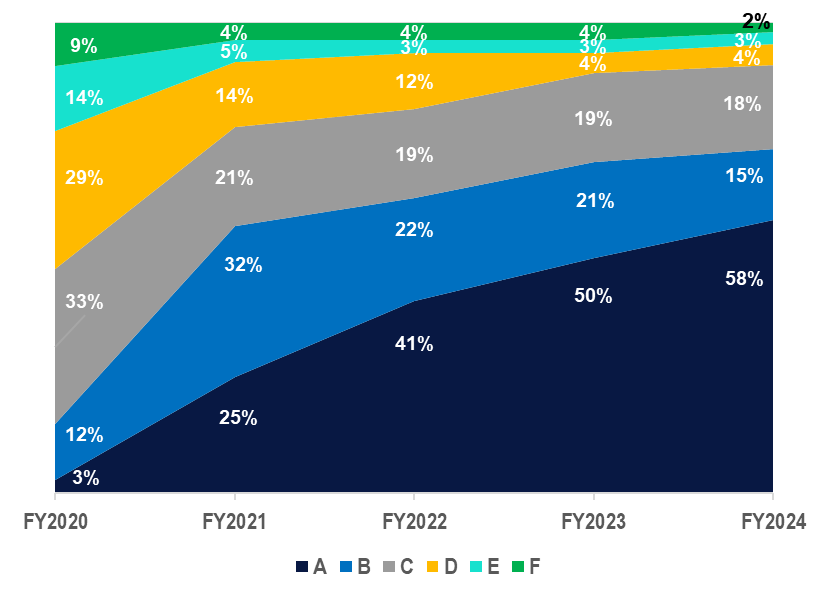
Modern Slavery Statements achieve an A if a company addresses 80+ per cent of reporting requirements, a B for 70-80, C for 60-70, D for 50-60, E for 40-50 and F for less than 40.
The percentage of ‘As’ rose from just three per cent in 2020-2021 to 58 per cent in 2024-2025, while the percentage with an E or F fell from 23 per cent to five per cent.
Of 112 statements ranked in 2024-2025, 58 per cent received an A, 15 per cent a B, 18 per cent a C, 4 per cent a D, 3 per cent an E and 2 per cent an F. Thirteen were upgraded, and six downgraded. In 2020-21, of 109 statements, three per cent received an A, 12 per cent a B, 33 per cent a C, 29 per cent a D, 14 per cent an E and 9 per cent an F.
Report co-author at the Monash Centre for Financial Studies, Associate Professor Nga Pham, said it was pleasing to see so many companies take meaningful steps to address modern slavery risks and improve the reporting transparency.
Associate Professor Pham, who produced the report with colleagues Dr Bei Cui and Associate Professor Ummul Ruthbah, said this year saw a notable uplift in the scope and sophistication of disclosures by many ASX100 companies in supply chain mapping, risk identification and due diligence.
“What we’ve seen over the years has been very encouraging,” Dr Pham said. “Some ASX100 companies are proud leaders on best practices, strengthening their own reporting while also sharing insights and collaborating through industry initiatives to lift standards across the economy.
“We are now working to support reforms that will strengthen the Modern Slavery Act to make reporting clearer and more consistent. Hopefully, this will provide the clarity needed to help the remaining companies lift their disclosure practices and meet the standards expected.”
Mr Evans said high-quality reporting was a vital first step and had to be coupled with action. “I will be engaging directly with companies whose reporting falls behind best practice to offer guidance and support, with the aim of lifting standards across all reporting entities,” he said.
“This type of reporting helps us benchmark progress across the ASX100 and beyond. By assessing the quality of statements, we can see where companies are improving and where persistent failures remain, and where further support is needed.
“Reporting is a vital first step, but it must be coupled with action. Australia must introduce mandatory due diligence reforms and penalties for non-compliant businesses to improve not just the quality of reporting, but real-world action to address modern slavery.”
Modern Slavery Statements have been mandatory for large businesses and other entities in the Australian market with annual consolidated revenue of at least $100 million since 2020. Under the Commonwealth Modern Slavery Act 2018, they must report on the risks of modern slavery in organisational supply chains.
The Report also shared the key recommendations put forward by the researchers in their response to the Government’s Consultation on Strengthening the Act that reporting could improve further if:
- Reporting criteria were clarified and simplified
- The criteria were more logically sequenced
- Companies had to immediately report actions taken in the event of modern slavery incidents
- Guidance on due diligence was strengthened.
- The reporting requirement for grievance mechanisms and remediation was enhanced.
- The Act allowed effective enforcement with penalties for non-compliance
Note: The ratings published in this report are an assessment of the quality of a company’s modern slavery disclosure statement and do not represent an assessment of the company’s actual risk or exposure to modern slavery practices in its operations and supply chains.
The percentage of ASX100 companies in each ranking category. Source: Modern Slavery Disclosure Quality Ratings ASX100 Companies
Read the full report here
MEDIA ENQUIRIES
Cheryl Critchley – Media and Communications Manager (medical)
E: [email protected]
P: +61 (0) 477 571 442
GENERAL MEDIA ENQUIRIES
Monash Media
P: +61 3 9903 4840
For more experts, news, opinion and analysis, visit Monash News.