The 2025 UNSW aerial waterbird survey shows waterbird numbers, breeding activity and wetland habitat areas remain in significant long-term decline.
New data released today from one of the world’s longest-running wildlife surveys show Australia’s waterbird population made a partial return after last year’s steep drop, but numbers remain well below historic levels.
Researchers conducting the annual waterbird survey – led by UNSW’s Centre for Ecosystem Science with the NSW Department of Climate Change, Energy, the Environment and Water (DCCEEW) and other state agencies – counted 375,419 birds across a third of the continent this year.
The number is an improvement on 2024’s 287,231 birds, but still far short of the 579,641 birds recorded in 2023. The survey recorded no mass mortality events, which usually signal outbreaks of avian influenza.
This year ranks as the 12th highest for total bird numbers since the survey began in 1983 – and the data show the broader picture remains troubling.
“The total abundance of waterbirds, the number of species breeding and wetland habitat areas continue to show significant long-term decline,” says Scientia Professor Richard Kingsford, Director of the Centre for Ecosystem Science, who leads the survey program.
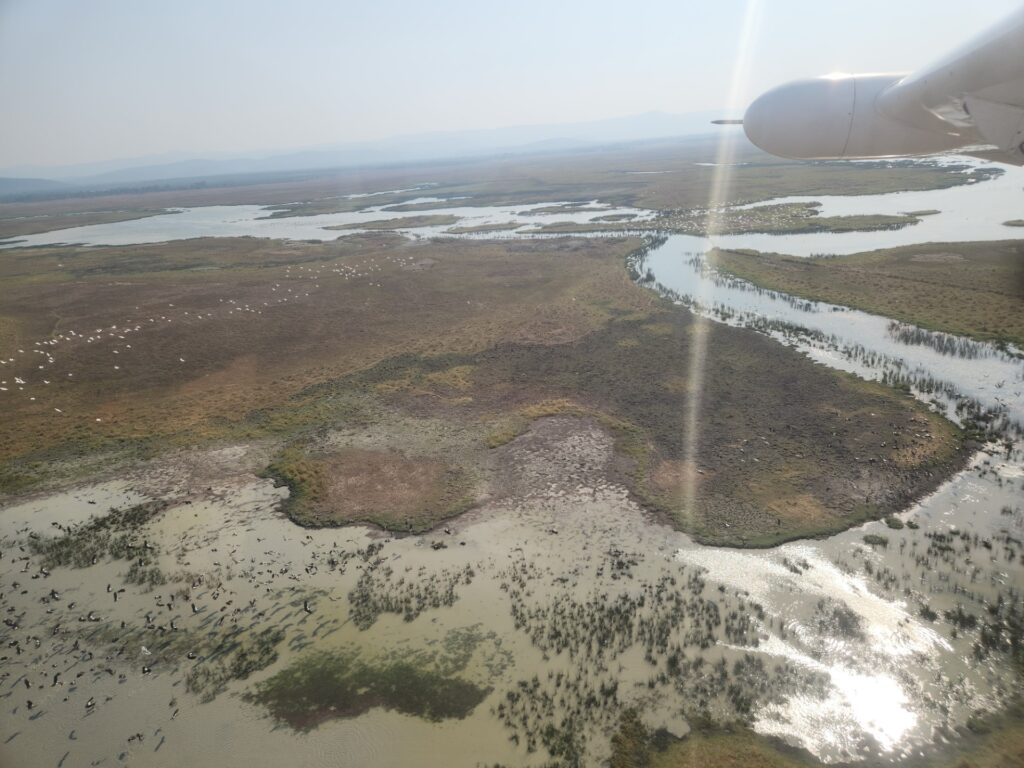
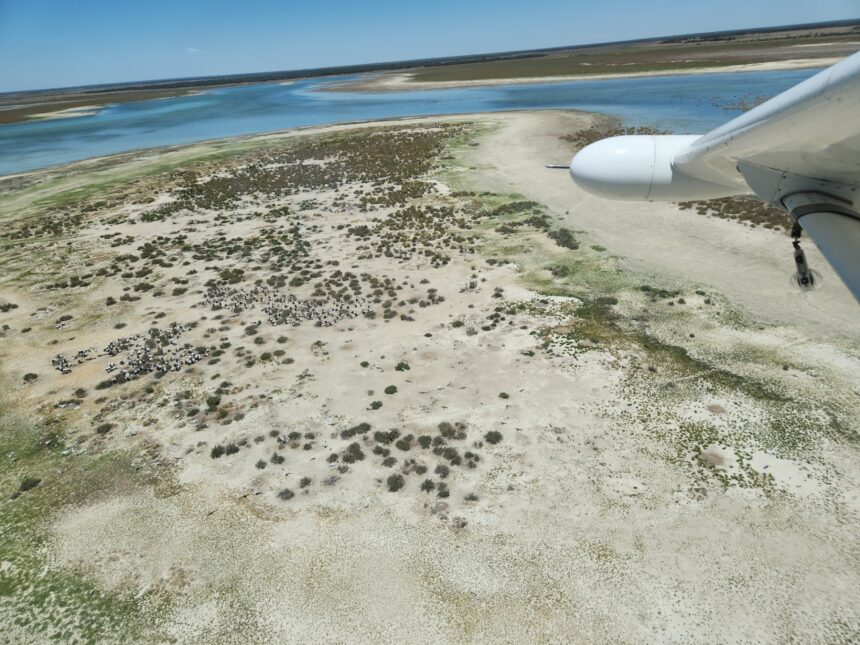
The survey took place from October to the first week of November this year, with observations taken from a light plane around 50 metres above water, across the area from Northern Queensland down to the south of Melbourne.
“There were up to 2000 wetlands surveyed,” Prof. Kingsford says. “We had two observers on either side of the plane each day. Their counts are brought together for each wetland.
“We count and identify more than 70 different species of waterbirds.”
Both ends of extreme weather
Wetland habitat area is a major driver of waterbird abundance, breeding and diversity. Climate change, river regulation and water extraction have resulted in ongoing long-term habitat declines – particularly in the Murray-Darling Basin.
The survey results capture a country experiencing more volatile and unpredictable weather as global temperatures climb.
“We had some significant river flow and flooding events this year, with extreme rainfall in southwestern and western Queensland,” Prof. Kingsford says.
“This caused major floods that reached Lake Eyre and became a one-in-500-year severe flooding event on the mid north coast of New South Wales,” he says.
“A lot of the waterbirds have gone up in that part of the world, right out in the desert. They're some of the most stunning parts of Australia and long may they continue to experience the natural booms and busts.
“But, at the same time, we also saw drier conditions persist across parts of southeastern Australia.”
The mixed picture aligns with broader climate records. The world is on track for one of its hottest years on record, amid 15 consecutive months of record global surface temperatures from mid–2023 to mid–2024. And the Bureau of Meteorology recorded a continued shift towards drier conditions across southern Australia, especially from April to October.
This variability carried through to rivers and wetlands: the intense flooding in parts of Queensland and north-eastern NSW contrasted with reduced river flows in western Victoria and South Australia. Murray–Darling Basin dams, or storages, also dropped to 66% full, down from 77% in 2024 and 92% in 2023.
Birds drawn to refreshed waters
While wetland habitat areas are in long-term decline, the wetland area index rose this year to 334,324 hectares, up from 122,283 hectares in 2024.
Much of this habitat came from major inland systems. Kati Thanda–Lake Eyre, Cooper Creek, Lake Yamma Yamma and the Diamantina floodplain together accounted for 51% of all wetland areas surveyed.
But these expansive wetlands only supported about 4% of the total waterbirds counted.
The most bird numbers were instead recorded at temporary saline desert wetlands – Lakes Mumbleberry and Torquinie in South Australia and Lake Galilee in Queensland. Together, these held more than 99,000 birds – nearly a quarter of this year’s total.
Breeding remains low
Despite the overall increase in abundance, the survey showed a continued long-term decline of breeding levels.
“We had a bounce in numbers after solid breeding in the flood years of 2021 and 2022,” Prof. Kingsford says. “But now numbers are below the long-term average, with little breeding happening in 2023, 2024 and now, 2025.”
The breeding index of nests plus broods rose to 1270 – a ten-fold increase on last year – with 16 species recorded breeding. But breeding activity was still well below the long-term average and heavily concentrated at just a few sites in Queensland’s Channel Country.
Magpie geese, little black cormorants and pelicans accounted for most of the recorded breeding.
The researchers found waterbirds were strongly clustered: just 10 wetlands supported 59% of all birds counted. And about 44% of surveyed wetlands – including many that were dry – supported no birds at all.
Declines across most species
Most functional feeding groups of waterbirds showed significant long-term declines. Several duck species commonly hunted in Victoria and South Australia – including Australasian shovelers, chestnut teal, mountain ducks, pink-eared ducks and wood ducks – were well below their long-term averages. Five of the eight game species showed significant declines over the four-decade record.
Some species also appear to be contracting in range. Black ducks, mountain ducks and Australasian shovelers showed decreases in the number of wetlands they occupied.
A crucial long-term record
The aerial survey program, covering roughly 38,000km each year, has become a central tool for tracking environmental change across Australia’s inland rivers and wetlands.
“It has underpinned major management decisions,” says Dr John Porter, who is an Adjunct Research Fellow at the Centre for Ecosystem Science and Senior Scientist at DCCEEW.
“The surveys have led to the identification of new protected areas and changed water policy in the Murray-Darling Basin,” Dr Porter says.
He says purchased and targeted releases of environmental water continue to offset some of the impacts of climate change, water extraction and river regulation – though the long-term trends remain downward.
As climate volatility increases, the researchers warn it’s these long-term trends – rather than year-to-year variability – that offer the clearest picture of waterbird health.
“And those trends continue to point to decline,” says Prof. Kingsford. “Even in a year of partial recovery.”
The annual survey is run by UNSW’s Centre for Ecosystem Science, supported by resourcing and funding from DCCEEW, with additional funding provided by the South Australian Department for Environment and Water, the Queensland Government, the Victorian Department of Energy, Environment and Climate Action, and the Victorian Game Management Authority.
Contact details:
Melissa Lyne, UNSW news & content